News · 5 min read
Rain and hail over Delhi NCR: will the storm clean the air, and for how long?
Rain and hail on 14 and 15 October 2026 should briefly reduce Delhi pollution, but IMD expects dry weather from 16 October, and the smog usually returns.
 By the Good Air team
In this article · 6 sections
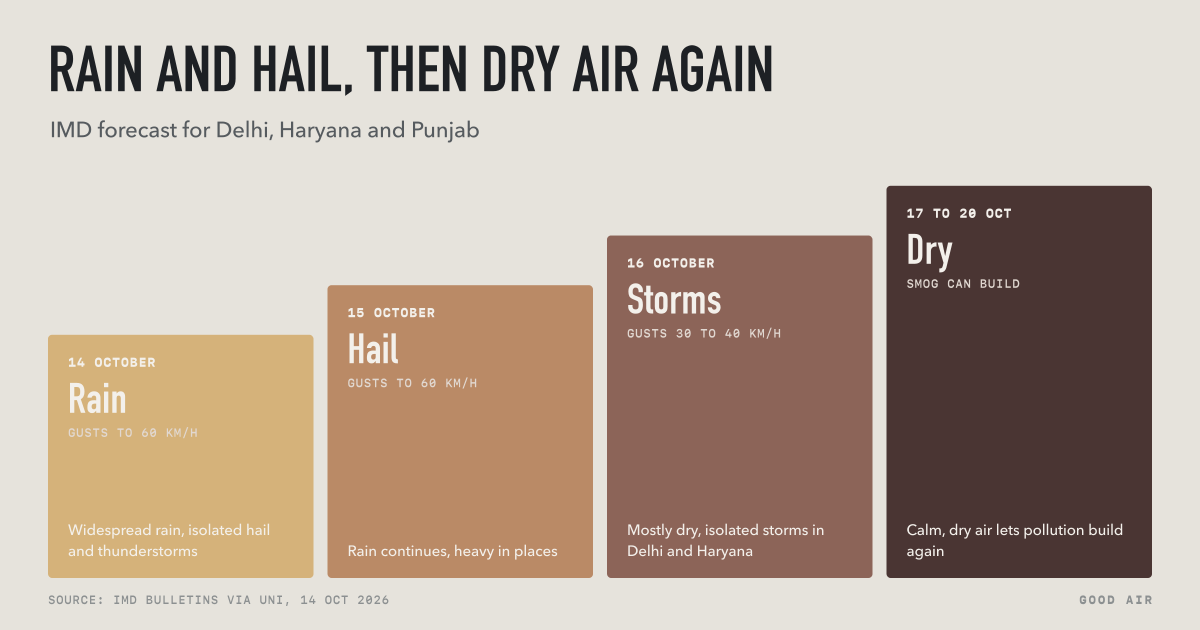
Yes, the rain should reduce Delhi's pollution, but only for a few days. The India Meteorological Department (IMD) forecast rain, isolated hailstorms and gusts of up to 60 km/h over Delhi, Haryana, Punjab and Chandigarh on 14 and 15 October 2026, followed by dry weather from 16 to 20 October (UNI, 14 October). Rain washes particles out of the air and strong wind spreads them out, so Delhi's AQI usually drops during a spell like this and climbs again once the air turns calm and dry.
Before the storm, Delhi NCR's air was already slipping. CPCB's daily bulletin for 14 October put Delhi's 24-hour AQI at 181 (Moderate), with Greater Noida at 224, Ghaziabad at 208 and Noida at 201, all in the Poor band (CPCB, 14 October, 4 pm).
What is the IMD forecasting for Delhi NCR?
A western disturbance is behind the storm. A western disturbance is a low-pressure system that travels east from the Mediterranean region and brings rain and snow to north India, mostly in winter. IMD's bulletins on 14 October described this one as a cyclonic circulation over northern Pakistan and Jammu, with more circulations over north-west Uttar Pradesh and central Rajasthan (UNI, 14 October).
The forecast for Haryana, Punjab, Chandigarh and Delhi, day by day:
| Date | IMD forecast |
|---|---|
| 14 October 2026 | Fairly widespread rain, isolated hail and thunderstorms, winds of 40 to 50 km/h gusting to 60 km/h |
| 15 October 2026 | Rain continues, isolated hail and thunderstorms, the same wind speeds |
| 16 October 2026 | Mostly dry; isolated thunderstorms with gusts of 30 to 40 km/h in Haryana, Chandigarh and Delhi |
| 17 to 20 October 2026 | Dry weather |
Source: IMD bulletins reported by UNI on 14 October. IMD's evening bulletin on 14 October added heavy to very heavy rain at isolated places across the four areas over the two days (UNI, 14 October, 7:10 pm).
Good Air's feed of IMD district warnings on the morning of 15 October showed orange warnings for thunderstorms with hail and strong winds in Rohtak, Panipat, Karnal and Ambala in Haryana, Ludhiana, Patiala, Mohali and Pathankot in Punjab, and Chandigarh. Ghaziabad, Gurugram, Faridabad, Meerut and Agra had yellow warnings. Orange means "be prepared"; yellow means "be aware".
How much does rain clean Delhi's air?
Rain helps in two ways. Raindrops collect particles as they fall, which scientists call wet deposition. Storm winds also mix polluted air near the ground with cleaner air higher up and carry it away. The Centre for Science and Environment (CSE) credits heavy rain for the cleaner air Delhi gets from May to September (CSE, 31 December 2025).
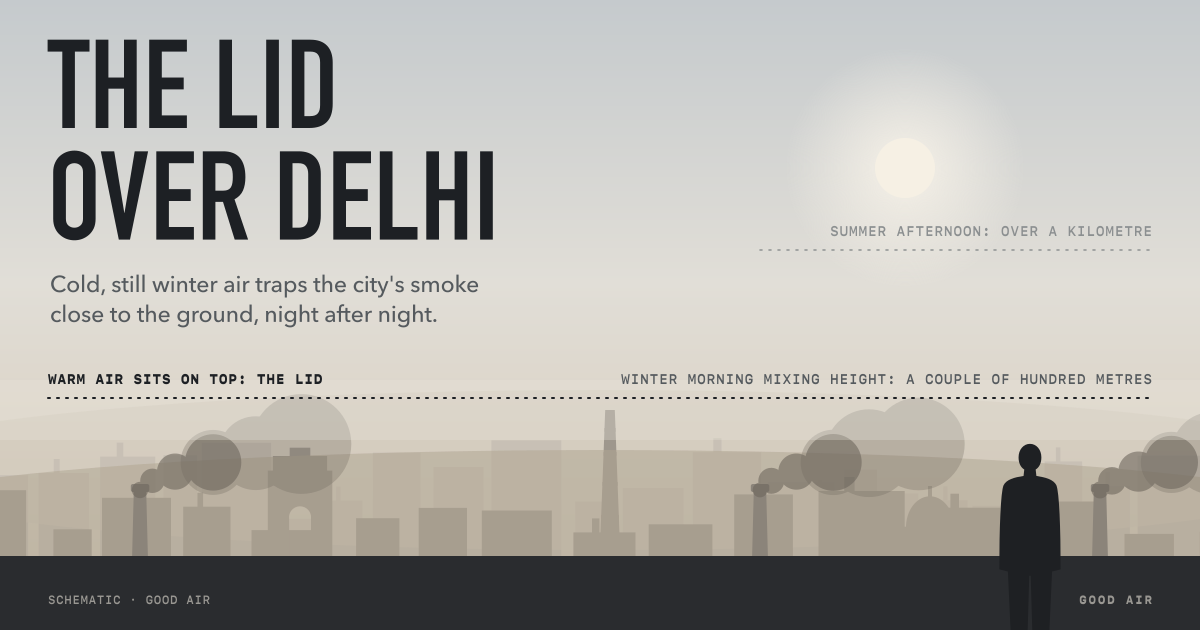
A short October storm is different from the monsoon. It removes what is in the air now, but it does not stop what is being emitted. Traffic, construction dust, industry and waste burning carry on. Once the wind drops, pollution starts to build again, and October nights are getting colder, which traps it near the ground.
Readings in Delhi were uneven before the rain arrived. IANS reported station readings on 14 October ranging from 113 at Tikri Kalan to 220 at Alipur, with Sirifort at 217 and Dwarka Sector 8 at 205 (IANS via SocialNews, 14 October). Readings over 200 are in the Poor band on India's National Air Quality Index (NAQI), even when the city average is Moderate.
Which NCR cities had the worst air before the storm?
CPCB's bulletin gives a 24-hour average for each city, published at 4 pm. On 14 October 2026, the eastern side of NCR was worst:
| City | NAQI, 14 October 2026 | Band | Main pollutant |
|---|---|---|---|
| Greater Noida | 224 | Poor | PM2.5, PM10 |
| Ghaziabad | 208 | Poor | PM2.5 |
| Noida | 201 | Poor | PM2.5 |
| Delhi | 181 | Moderate | PM2.5 |
| Panipat | 177 | Moderate | PM2.5 |
| Meerut | 172 | Moderate | PM2.5, PM10 |
| Bahadurgarh | 163 | Moderate | PM10 |
| Gurugram | 145 | Moderate | PM2.5, PM10 |
Source: CPCB daily AQI bulletin, 14 October 2026, 4 pm.

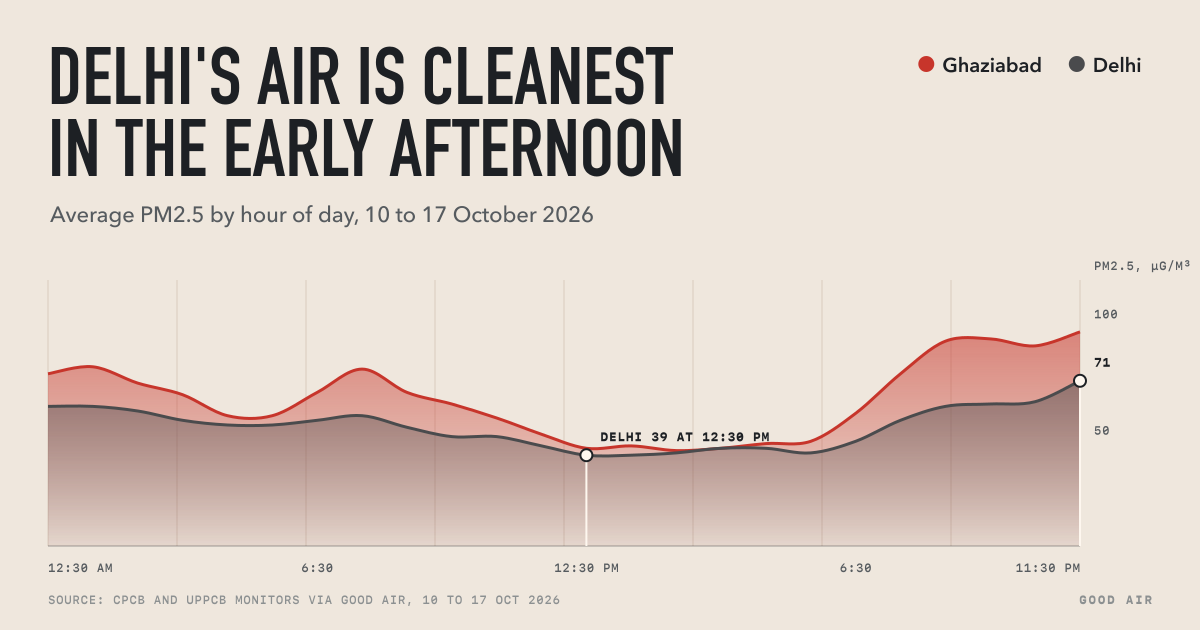
The hourly picture on the morning of 15 October was worse. At about 9:15 am IST, Good Air's live feed from NCR monitors showed Ghaziabad at 304 (Very Poor), Greater Noida at 288, Meerut at 267, Noida at 228, Delhi at 203 and Gurugram at 201. Morning hours are usually the worst of the day, before the sun warms the ground and the air starts to mix. The Delhi air quality page and the Ghaziabad page update through the day.
Does this change GRAP?
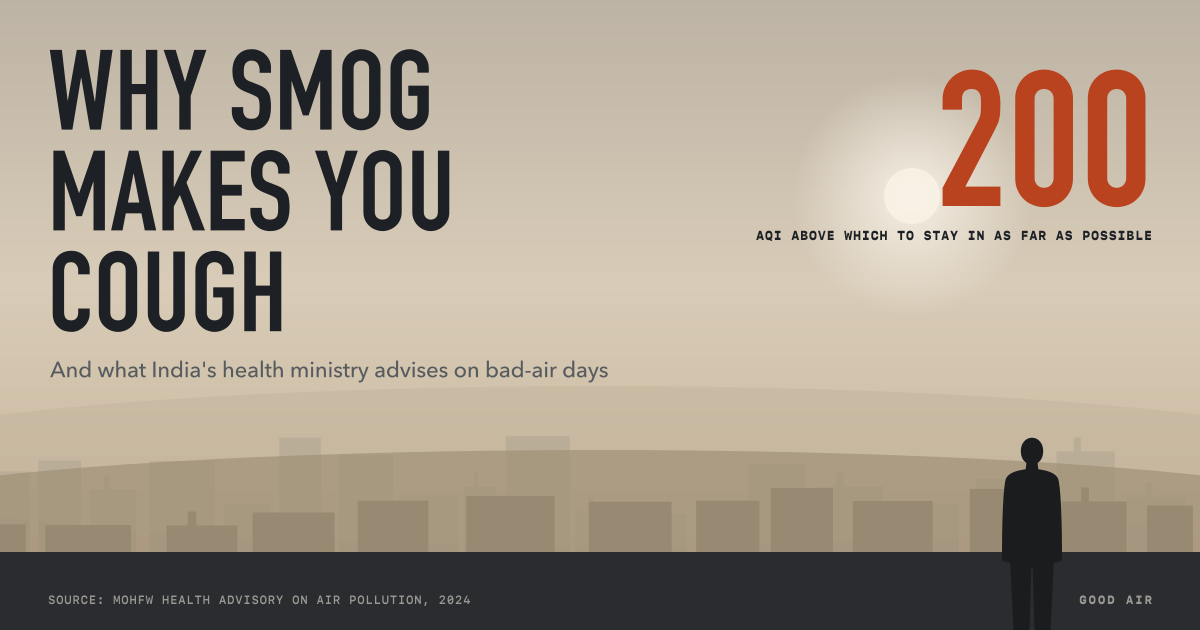
GRAP, the Graded Response Action Plan, is Delhi NCR's emergency plan: a set of curbs that the Commission for Air Quality Management (CAQM) switches on in stages as the daily AQI rises. Stage I starts when Delhi's 24-hour AQI passes 200.
Delhi's daily average of 181 on 14 October was below that line. As of the morning of 15 October 2026, we had not found any CAQM order invoking Stage I this winter. If the rain brings a few cleaner days, Stage I is likely to wait until the air turns calm again. Our live Delhi tracker records each GRAP decision, and GRAP explained lists what each stage bans.
October is already off to a poor start. Delhi's AQI of 166 on 1 October was the highest for that date in four years, according to Centre for Research on Energy and Clean Air (CREA) data reported by India.com (India.com, 2 October).
What the storm means for stubble burning
Farm fires in Punjab and Haryana add smoke to Delhi's air from October to November. CSE estimated that farm fires made up about 4.2% of Delhi's PM2.5 on average between 1 October and 30 November 2025, peaking at over 22% in mid-November (CSE, 31 December 2025). Our explainer on stubble burning covers why farmers burn and how the smoke travels.
Rain wets the paddy fields and the straw, so few fires are likely on rainy days. IMD warned that hail could damage standing crops (UNI, 14 October, 7:10 pm). What is not yet known is whether the wet spell will delay the rice harvest in Punjab and Haryana, and so push more burning into late October and November, when calm weather already traps smoke over Delhi. As of 15 October no agency had published an estimate.
How to use the clean days, and prepare for the next smog
- Air out your home when the AQI drops. Open windows when the reading is Satisfactory or Moderate, and close them again when it climbs.
- Plan exercise around the reading. After rain, mornings can be clean. Our guide on when it is safe to exercise outside gives thresholds.
- Stay indoors during the storm. IMD warned that gusts and hail can bring down trees and power lines, and that people in the open can be injured.
- Get ready for November. Check your mask and air purifier before the worst weeks. Diwali is on 8 November.
- Read the live number, not yesterday's. Delhi's readings can change by more than 100 points in a day after a storm.
Frequently asked questions
Will rain reduce Delhi pollution?
Yes, for a short time. Rain washes particles out of the air and storm winds disperse pollution, so Delhi's AQI usually falls during and just after rain. The effect lasts only until the air turns calm and dry again. In October 2026, IMD forecast rain on 14 and 15 October and dry weather from 16 to 20 October.
What was Delhi's AQI on 14 October 2026?
CPCB's daily bulletin put Delhi's 24-hour average AQI at 181 on 14 October 2026, in the Moderate band, with PM2.5 as the main pollutant. Greater Noida (224), Ghaziabad (208) and Noida (201) were in the Poor band. Readings at individual stations ranged from about 113 to 220.
Is GRAP in force in Delhi today?
As of 15 October 2026, we had not found a CAQM order invoking GRAP Stage I for winter 2026. Stage I applies when Delhi's 24-hour AQI rises above 200 (Poor). Delhi's average was 181 on 14 October. Good Air's Delhi live tracker records each change the day CAQM announces it.
When will it rain in Delhi this week?
IMD's bulletins on 14 October 2026 forecast rain, isolated hail and thunderstorms over Delhi, Haryana, Punjab and Chandigarh on 14 and 15 October. Isolated thunderstorms were possible on 16 October in Delhi, Haryana and Chandigarh. Dry weather was forecast from 17 to 20 October.
Does rain stop stubble burning?
Rain makes paddy straw too wet to burn, so few farm fires are likely on rainy days. It does not end the burning season. Whether the October 2026 wet spell delays the rice harvest and pushes more burning into November was not known as of 15 October.