Guides · 5 min read
N95 vs KN95 vs FFP2: which mask actually protects you from smog and haze?
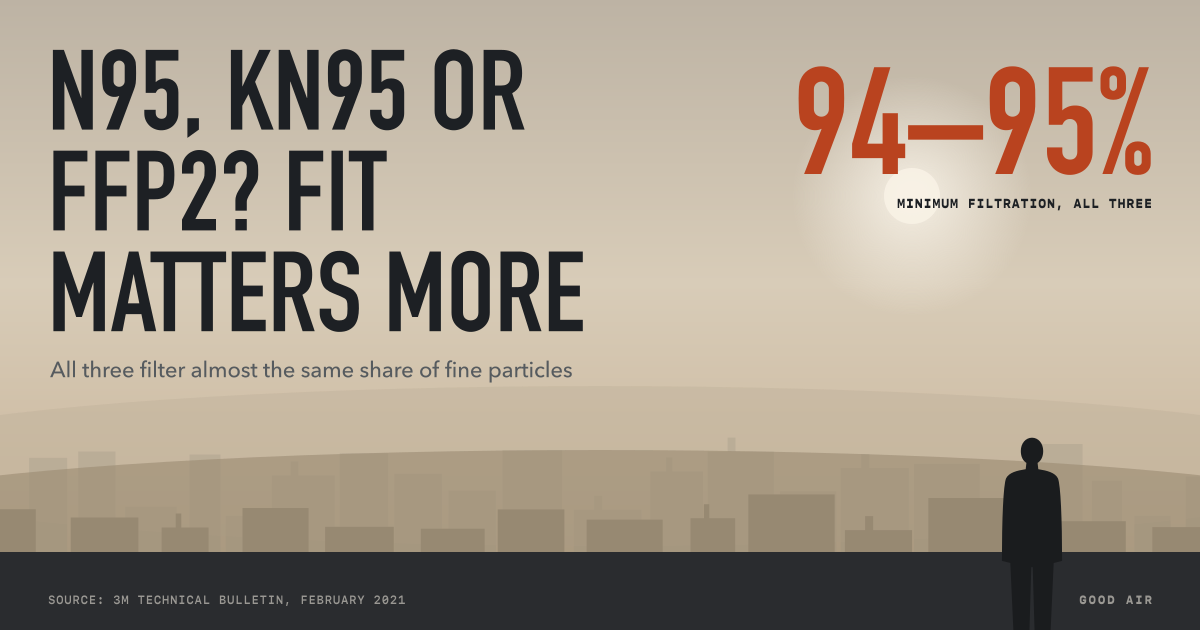
N95, KN95 and FFP2 masks all filter at least 94 to 95% of fine particles. For pollution, fit and a genuine label matter far more than which one you buy.
 By the Good Air team
In this article · 7 sections
For pollution, N95, KN95 and FFP2 masks do the same job. All three are tested to filter at least 94 to 95% of fine particles, so for smog, haze and smoke the difference between them is about one percentage point (3M technical bulletin, February 2021). What matters far more is whether the mask is genuine and whether it seals around your face.
This matters right now. On the morning of 14 October 2026, Good Air's readings from CPCB monitors put Delhi in the Poor band on India's National AQI at 224, and Ghaziabad in Very Poor at 331. In Malaysia, schools in three states were closed by haze from Indonesia's fires.
The short answer
- Any of the three is fine for PM2.5 pollution, as long as it is a real, certified product and fits you well.
- Surgical and cloth masks are not a substitute. They let most fine particles through the gaps and the fabric.
- Fit beats label. A loose N95 protects you less than a well-sealed FFP2.
- Buy the one you can verify. An N95 can be checked against a public US government list. KN95 quality varies much more.
What the letters and numbers mean
Each name comes from a different country's standard. The number is the minimum share of test particles the filter must stop.
| Mask | Standard | Minimum filtration |
|---|---|---|
| N95 | United States (NIOSH, 42 CFR 84) | 95% |
| KN95 | China (GB2626) | 95% |
| FFP2 | Europe (EN 149) | 94% |
| KF94 | South Korea (first class) | 94% |

The tests differ in detail. The European and Korean tests use oil mist as well as salt particles, and run at a slightly higher airflow. Europe, China and Korea also test how much air leaks in around the edges on real people, which the US standard does not. 3M, which makes masks to all of these standards, concludes that KN95 and the Korean and Australian equivalents can reasonably be treated as similar to N95 and FFP2 for non-oily particles, including wildfire smoke and PM2.5 pollution. The same bulletin warns that masks are often shaped for faces common in the region they are made for, so a mask designed for one market may not seal well on everyone.
The "N" in N95 means "not oil resistant". That doesn't matter for city smog, haze or smoke. It matters in some workplaces with oil mists.
Why fit matters more than the label
A mask filters only the air that goes through it. Air takes the easiest path, so any gap at the nose, cheeks or chin lets unfiltered air straight in. That is why the US Environmental Protection Agency tells people to look for a mask that fits over the nose and under the chin, and that collapses slightly as you breathe in without letting air in from the sides (EPA and AirNow, The right respirator and proper fit).
How to put one on:
- Use both straps, not ear loops if you have a choice. One strap above the ears and one below. Don't cross them.
- Pinch the metal nose bar to the shape of your nose with both hands, not one.
- Check the seal. Breathe out hard. If you feel air escaping around the edges, or your glasses fog, adjust it.
- Shave if you can. Facial hair stops a proper seal and cuts the mask's effectiveness.
- Replace it when it is dirty, damp, misshapen or hard to breathe through.

How to spot a fake
Fakes are common, especially when demand spikes during a smog or haze episode. The US National Institute for Occupational Safety and Health (NIOSH) keeps a public list of every approved N95, the Certified Equipment List. A genuine N95's model name and NIOSH approval number should match an entry on that list (NIOSH, updated February 2025).
Warning signs for any mask:
- Seller websites with only a free email address as contact, poor grammar or misspelt domain names.
- Listings on marketplaces that insist the product is "genuine" or "legitimate".
- Prices that swing wildly, or "unlimited stock" during a shortage.
- Sellers with no history, no reviews and no proper contact details.
There is no equivalent public list for KN95 masks, so quality depends on the maker. If you buy KN95, choose an established brand from a pharmacy or a known shop.
When should you wear one?
Health agencies treat masks as a last line of defence. The first steps are cutting time outdoors, avoiding hard exercise in bad air, and keeping the air clean indoors.
Singapore's official health portal, HealthHub, advises for haze that healthy people wear an N95 when the 24-hour PSI is above 300, and people with chronic lung or heart disease when it is above 200. It says a mask isn't needed for short trips, such as walking from a bus stop into a mall, or indoors (HealthHub, reviewed 11 October 2026).
In Delhi's winter smog, many people choose to wear one whenever they are outside for long on Poor days or worse. Our guide to AQI 151 to 200 explains what each level means, and what AQI is safe for exercise covers running and cycling, when a mask is hard to breathe through.
Who should be careful
- People with heart or lung disease. A tight mask makes breathing harder. The EPA advises asking your doctor before using one.
- Pregnant women. Ask your doctor or midwife about how long to wear one.
- Children. The EPA notes that respirators are not designed to fit children. Keeping children indoors in clean air is the main protection.
- Anyone who feels dizzy or short of breath should take the mask off, move somewhere with cleaner air and get medical help if it doesn't pass.
Where to look next
- Live readings: Delhi air quality now and the Delhi NCR live tracker.
- Haze in Southeast Asia: Malaysia's haze school closures and the haze live tracker.
- Smoke: our wildfire smoke safety guide.
Frequently asked questions
Is KN95 as good as N95 for pollution?
On paper, yes. Both must filter at least 95% of test particles. The difference is that N95 approvals can be checked on NIOSH's public list, while KN95 quality varies more between makers. A genuine, well-fitting KN95 works as well as an N95 for smog and haze.
Is FFP2 better than N95?
Neither is clearly better. FFP2 has a 94% minimum against N95's 95%, but its test uses oil mist as well as salt and checks leakage on real wearers. For city pollution, pick whichever fits your face best.
Do surgical masks protect against pollution?
Not much. They are designed to stop droplets, not fine particles, and they leave gaps at the sides. Singapore's health authorities say they don't effectively filter PM2.5.
Can I reuse an N95 mask for pollution?
For pollution, you can wear the same mask more than once if it stays clean, dry and in shape. Replace it when it is dirty, damp, distorted or harder to breathe through. Don't share masks.
Which mask is best for children in smog?
Respirators are not designed to fit children, according to the EPA. Some brands sell small KN95 or KF94 masks, but a good seal on a child's face is hard to achieve. Keeping children indoors with clean air on bad days is the main protection; ask your doctor if your child has asthma.