Seasonal · 4 min read
Why Delhi's air turns toxic every winter, and what is being done in 2026
Cold, still air traps vehicle exhaust, dust and smoke over North India every winter. The causes, 2026 farm fire data and Delhi's action plan.
 By the Good Air team
In this article · 5 sections
Every year from late October, Delhi and much of the Indo-Gangetic plain disappear under smog. Delhi's emissions don't jump in winter; most of them are there all year. What changes is the weather, which stops the pollution from escaping, while a few seasonal sources such as crop fires and festival fireworks add to it.
As of mid-October 2026 the season has barely started. Delhi's daily AQI was 138, Moderate, on 13 October (The Patriot, 13 October). That can change within days.
The weather traps the pollution
Three things happen to North India's air as the monsoon withdraws and winter sets in:
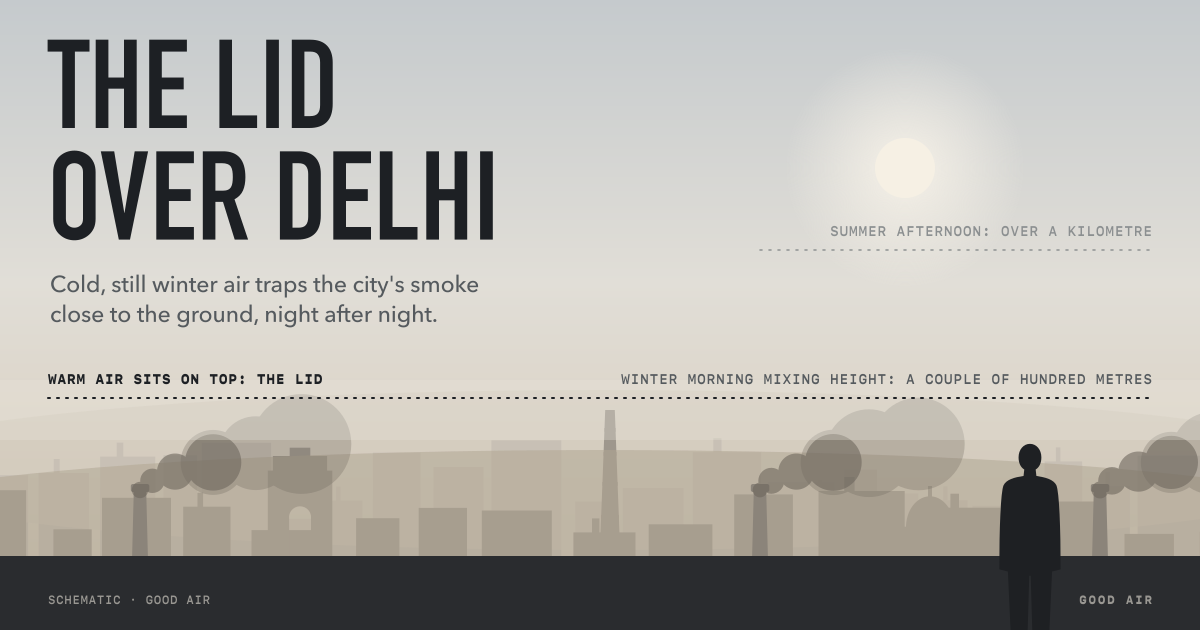
- Temperature inversions. On cold, clear nights the ground loses heat quickly, and a layer of warmer air settles above a layer of cold air near the surface. This lid stops pollution from rising and mixing. The mixing height, the depth of air pollution can spread into, can fall from over a kilometre on a summer afternoon to a couple of hundred metres on a winter morning.
- Calm winds. Light winds don't carry pollution away. Delhi sits in a basin, with the Himalayas to the north acting as a wall.
- Fog and humidity. Moisture helps fine particles grow and helps form secondary pollutants, turning haze into smog.

That is why the worst hours are usually late night and early morning, and why a windy day or a western disturbance bringing rain can clean the air within hours.
Where the pollution comes from
Studies attribute Delhi's PM2.5 to a mix of local and regional sources, and the shares change by season and by day. The main contributors are:
- Vehicles. Exhaust and road dust from millions of cars, two-wheelers, trucks and buses. Older diesel vehicles are the heaviest emitters per kilometre.
- Dust. From construction and demolition, unpaved roads and open land. It drives PM10 in particular.
- Industry and power plants in and around the National Capital Region, including those burning coal.
- Biomass and waste burning. Garbage fires, and wood and dung burned for cooking and heating, especially in winter.
- Crop residue burning in Punjab, Haryana and beyond. Farmers clear paddy stubble to sow wheat, mostly from mid-October to mid-November. On days when north-westerly winds carry the smoke to Delhi, its share of the city's PM2.5 can rise sharply. More on stubble burning.
- Firecrackers around Diwali, which falls on 8 November this year. They add a sharp, short spike on the night itself. Our Diwali guide.
Farm fires in 2026: the lowest in years, so far
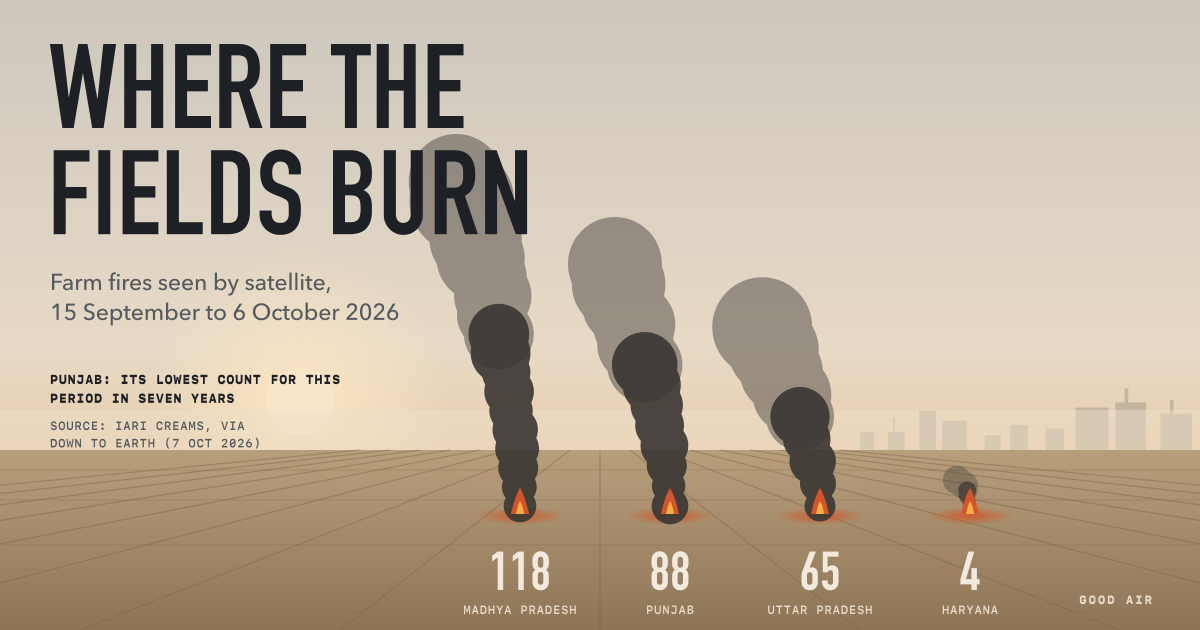
Early numbers are encouraging. Between 15 September and 6 October 2026, satellites tracked by the Indian Agricultural Research Institute's CREAMS lab recorded 88 farm fires in Punjab and 4 in Haryana. Uttar Pradesh recorded 65 and Madhya Pradesh 118, the most of any state. Punjab's count was its lowest for that period in seven years (Down To Earth, 7 October). For comparison, the whole 2025 season, from 15 September to 30 November, recorded 5,114 fires in Punjab and 662 in Haryana.
The peak of harvesting is still ahead, so these numbers will rise. In Haryana, five farm fire cases had been reported by 8 October, against seven at the same point in 2025 (The Tribune, 12 October).
What the government is doing this winter
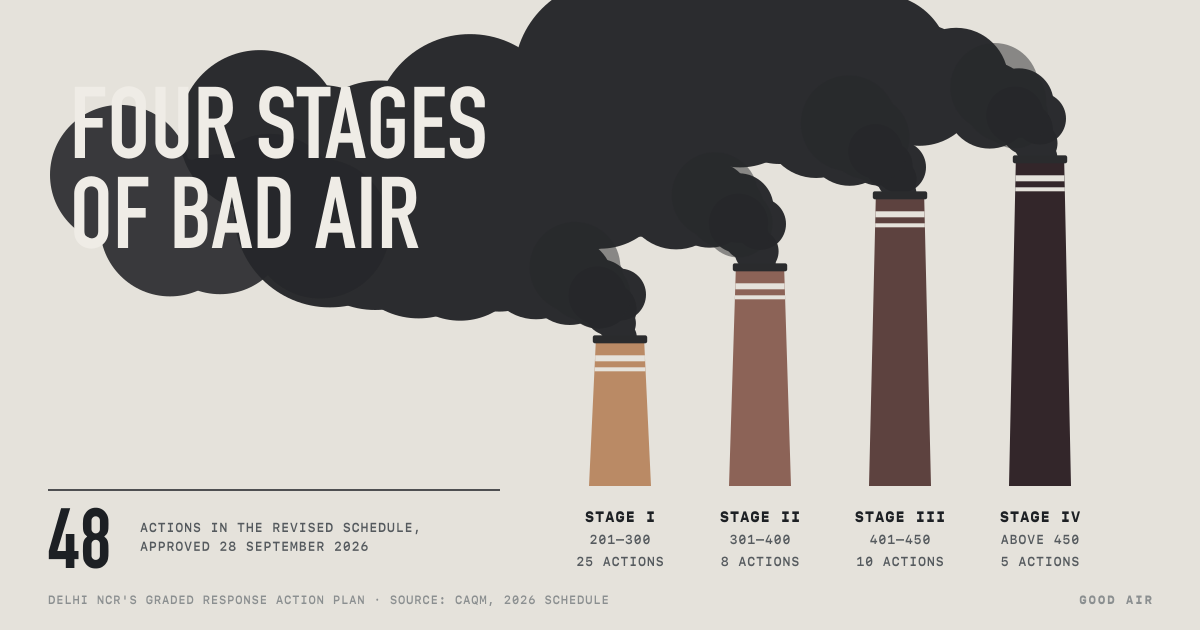
A tighter GRAP. On 28 September, the Commission for Air Quality Management revised the Graded Response Action Plan, the stage-by-stage emergency curbs for Delhi NCR. It brought diesel generator curbs and a ban on older buses forward to Stage I, extended restrictions on older cars to Sonipat, and removed exemptions for older goods vehicles at the higher stages. Read our full GRAP explainer.
Delhi's Winter Action Plan 2026-27, announced on 29 September by Environment Minister Manjinder Singh Sirsa (Asianet Newsable, 29 September), includes:
- A "No PUCC, No Fuel" drive at 500 fuel stations, refusing fuel to vehicles without a valid pollution certificate.
- 50 percent work from home and staggered office hours during the pollution period.
- A ban on dust-generating demolition and outdoor construction from 1 November to 31 January, and on all construction and demolition from 10 December to 20 January.
- More monitoring stations, from 47 to 60, and 334 enforcement teams.
Firecrackers. On 30 September the Supreme Court said it would not impose a total ban on firecrackers. The rules for Delhi NCR are being decided separately by the bench hearing the long-running M.C. Mehta case (Organiser, 3 October).
What you can do
- Check the hourly AQI where you live, not just the city average. Readings across Delhi's 40-plus stations can differ by more than 100 points at the same moment. See Delhi by area.
- Time your outdoors. Walk or exercise in the afternoon, when the air is usually most mixed, rather than at dawn.
- Use a well-fitted N95 or FFP2 mask outdoors on Poor days and worse.
- Run a HEPA air purifier in the bedroom with the door and windows closed.
- Don't add to it. Avoid burning anything, keep your vehicle's PUC certificate valid, and report open burning.
Frequently asked questions
Why is Delhi's air worse in winter than in summer?
Because cold, calm weather traps pollution close to the ground. Temperature inversions and light winds stop pollutants from dispersing, while crop fires and festival fireworks add to year-round emissions from vehicles, dust, industry and waste burning.
When is Delhi's air pollution at its worst?
Usually from late October to early January, with the sharpest peaks in early to mid November when crop burning, Diwali and calm, cold weather often coincide.
How much of Delhi's pollution comes from stubble burning?
It varies from day to day with the wind. On most days local sources such as vehicles, dust and industry dominate. On days when north-westerly winds carry smoke from Punjab and Haryana, farm fires can become one of the largest single contributors.
What time of day is Delhi's air quality worst?
Typically late night and early morning, when the air is coldest and stillest. It often improves in the afternoon as the ground warms and the air mixes.