Guides · 3 min read
What AQI is safe for running, cycling and outdoor exercise?
Exercise makes you breathe in far more air, and more pollution with it. When to train outdoors, when to move inside, and how to time your run on smoggy days.
 By the Good Air team
In this article · 5 sections
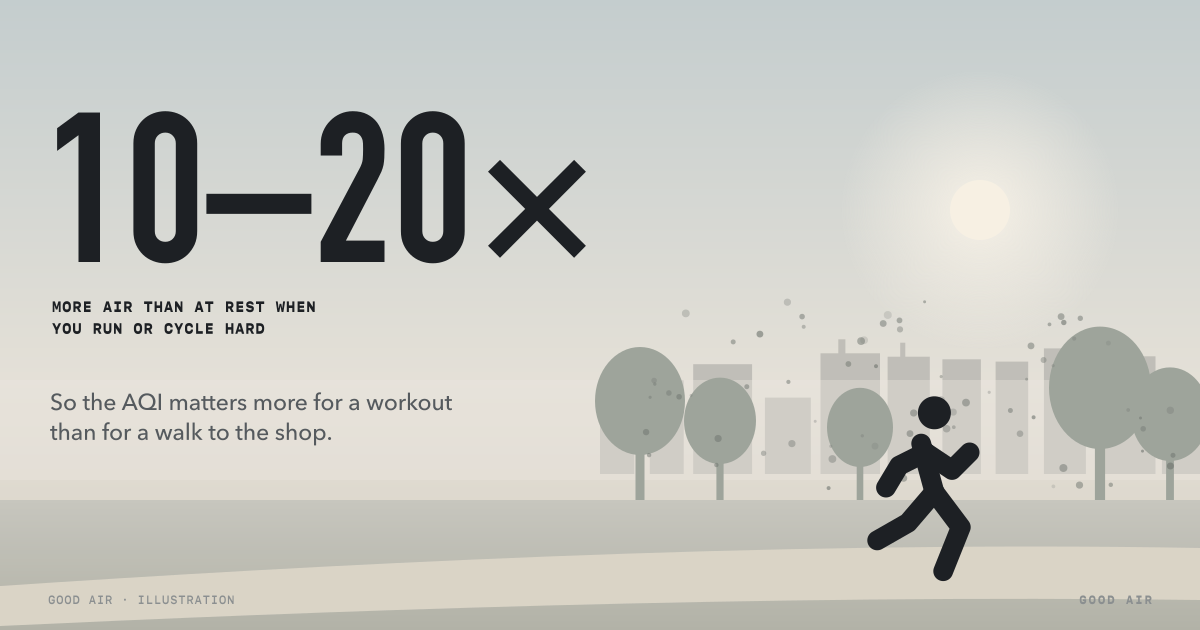
Exercise is good for your heart and lungs even in moderately polluted air. But when you run or cycle hard you breathe 10 to 20 times more air than at rest, often through your mouth, which bypasses the nose's filtering. So the AQI matters more for a workout than for a walk to the shop.
Here is how to decide, using the US AQI. If your country reports a different index, the AQI guide explains how the scales compare.
The quick answer
| US AQI | Running and hard exercise outdoors |
|---|---|
| 0 to 50, Good | Go ahead. |
| 51 to 100, Moderate | Fine for almost everyone. If you are unusually sensitive, ease the pace. |
| 101 to 150, Unhealthy for Sensitive Groups | If you have asthma, heart or lung disease, are pregnant, a child or over 65: move indoors or go shorter and easier. Others: take more breaks. |
| 151 to 200, Unhealthy | Move hard exercise indoors, or reschedule for a cleaner hour. |
| 201 to 300, Very Unhealthy | Exercise indoors only, with windows closed. |
| 301+, Hazardous | Skip strenuous exercise, even indoors unless the air is filtered. |
Each range has its own page with advice for walking, cycling, children's play and more: 0 to 50, 51 to 100, 101 to 150, 151 to 200, 201 to 300, 301 to 500.
Pick the right hour
Pollution changes a lot through the day, so timing can matter as much as the day you choose.

- Winter smog (North India, Hanoi, Beijing, Kathmandu): the air is usually worst late at night and early in the morning, when cold air is trapped near the ground. Early afternoon is often cleanest. The pre-dawn run that works in summer can be the worst choice in November.
- Summer ozone (US cities, Mexico City, the Gulf): ozone builds up in afternoon sunshine. Run in the early morning or evening.
- Smoke and haze move with the wind and can change in an hour. Check the live reading right before you head out.
Look at the hourly reading from the monitor closest to you, not just a city-wide average. Find your city.
Choose the route
- Stay away from traffic. Pollution from exhaust drops sharply within 100 to 200 metres of a busy road. Parks, riverside paths and back streets are better than main roads.
- Avoid rush hour on roads.
- Indoor tracks and gyms are not automatically clean. If the gym's windows are open on a smoggy day, the air inside is close to the air outside.
Do masks help when you exercise?
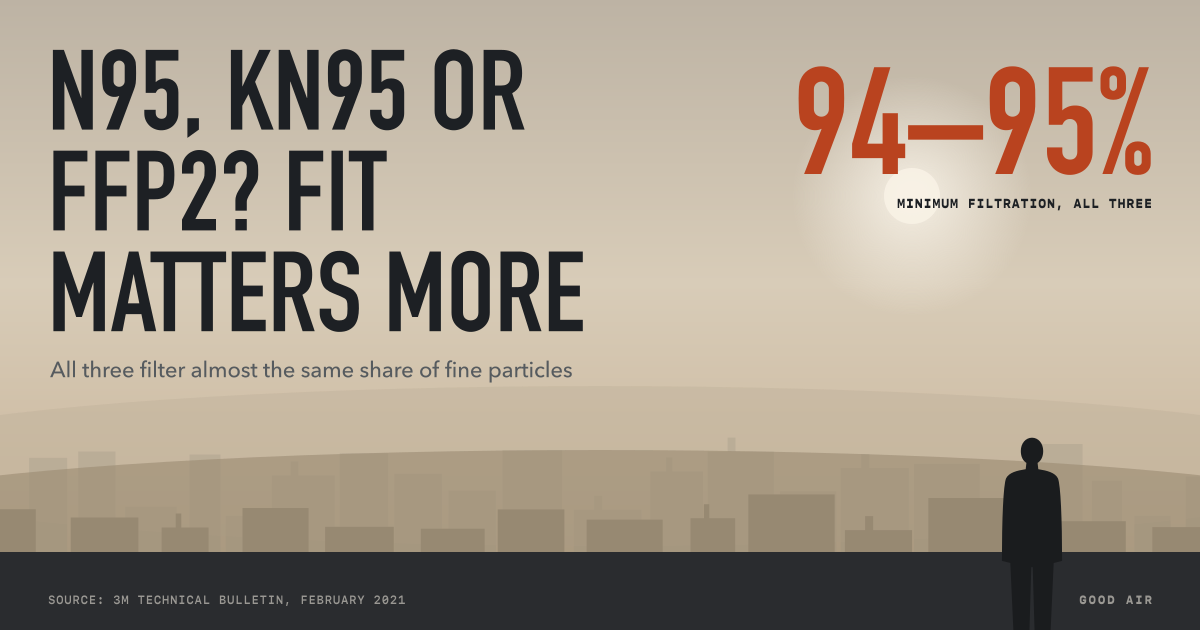
A well-fitted N95 or FFP2 mask filters most fine particles, but it is hard to breathe through during hard exercise and loses its seal as you sweat. On days bad enough to need a mask, the better choice is to move the workout indoors, to a space with filtered air.
Who should be more careful
- People with asthma: carry your reliever inhaler, warm up gradually and stop if you get symptoms. Pollution and cold air together are a common trigger.
- People with heart disease: fine-particle spikes are linked to heart attacks and arrhythmias in the hours after exposure. Follow your doctor's advice on exercise during pollution episodes.
- Children: they breathe faster than adults and play harder. Move sports and PE indoors when the AQI is above 150, or above 100 for children with asthma.
- Pregnant people and adults over 65.
Frequently asked questions
Is it safe to run when the AQI is 150?
AQI 101 to 150 is unhealthy for sensitive groups. Healthy adults can usually run, but should go shorter or easier and take breaks. If you have asthma, heart or lung disease, are pregnant or over 65, move the run indoors.
Is it better to skip exercise on polluted days?
On most days with Moderate air, the benefits of exercise outweigh the risk from pollution. On Unhealthy days, keep exercising but move indoors to filtered air, or swap a hard session for an easy one.
What time of day is air pollution lowest?
It depends on the pollutant. In winter smog, early afternoon is usually cleanest. In summer, ozone peaks in the afternoon, so mornings are better. Check the hourly reading where you are.
Can I exercise indoors when outdoor air is bad?
Yes, ideally in a room with windows closed and an air purifier or a building ventilation system with good filters.