Explainers · 4 min read
Stubble burning explained: why farmers burn paddy straw and how it reaches Delhi
Why farmers in Punjab and Haryana burn paddy straw each autumn, how much it adds to Delhi's smog, the alternatives, and 2026 farm fire data.
 By the Good Air team
In this article · 4 sections
Every October and November, satellites pick up thousands of small fires across the farmland of North India. Farmers are burning the stubble left after the rice harvest so they can sow wheat in time. The smoke adds to the smog over Punjab, Haryana and, when the wind blows from the north-west, Delhi.
Why farmers burn stubble
The rice-wheat rotation in Punjab and Haryana leaves a very short gap between crops. Paddy is harvested from late September to early November. Wheat yields fall if it is sown much after mid-November.
Combine harvesters cut the grain high and leave tall, tough straw standing in the field. Clearing it by hand or machine costs time and money. A match costs nothing and clears a field in hours, so many farmers burn it.
The window has also narrowed over the years. To save groundwater, Punjab and Haryana passed laws that delay paddy transplanting until the monsoon arrives. That pushes the rice harvest later and squeezes the time left before wheat sowing.
How much does it add to Delhi's pollution?
It depends on the day. Stubble smoke is one source among many: vehicles, road and construction dust, industry, power plants and waste burning pollute Delhi all year. Crop fires matter most when three things coincide:
- many fires on the same days, usually from late October to mid-November;
- north-westerly winds that carry the smoke toward Delhi;
- calm, cold weather that traps it near the ground.
On such days, farm fire smoke can be one of the largest single contributors to Delhi's PM2.5. On days with other wind directions it contributes little. Across Punjab and Haryana themselves, rural communities living next to the fields breathe the smoke most directly.
The 2026 season so far
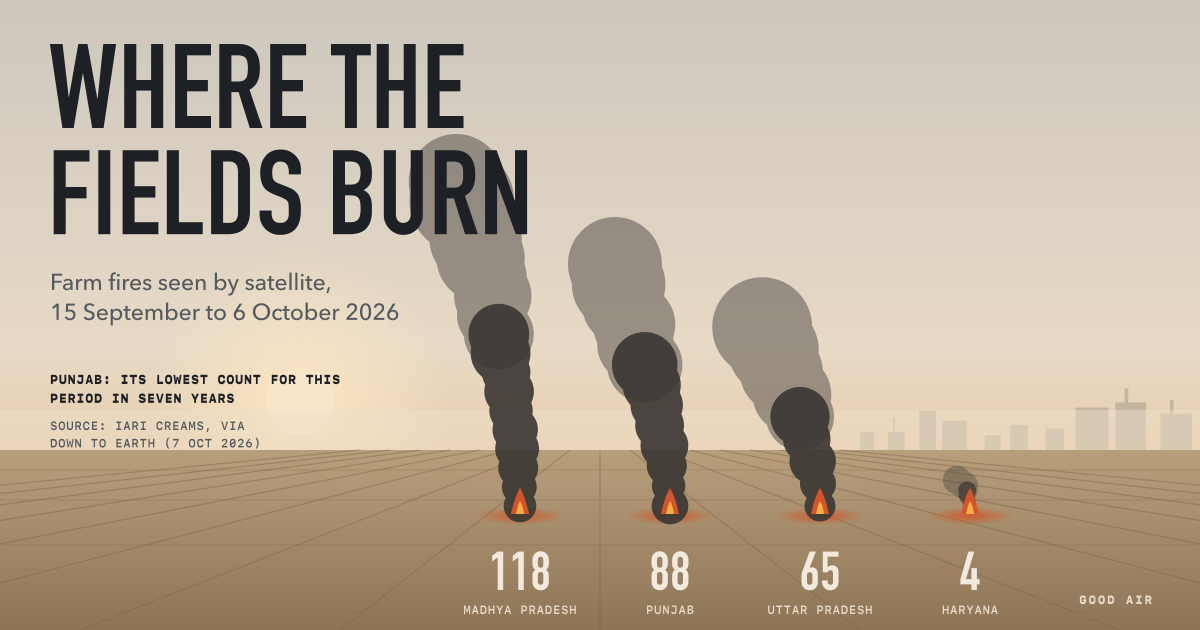
Satellite counts tracked by the CREAMS laboratory at the Indian Agricultural Research Institute show a quiet start. Between 15 September and 6 October 2026, they recorded (Down To Earth, 7 October):
| State | Farm fires, 15 Sep to 6 Oct 2026 |
|---|---|
| Madhya Pradesh | 118 |
| Punjab | 88 |
| Uttar Pradesh | 65 |
| Haryana | 4 |
Punjab's count was its lowest for that period in seven years. For scale, the full 2025 season, from 15 September to 30 November, recorded 5,114 fires in Punjab and 662 in Haryana. In Punjab, 52 fires had been detected by 29 September, of which 16 were confirmed on inspection; one police case had been registered and Rs 55,000 in fines imposed (Bilkul Online, 30 September).
Update, 13 October 2026: the Centre asks five states for "mission mode"
On 13 October 2026, Agriculture Minister Shivraj Singh Chouhan and Environment Minister Bhupender Yadav held a review meeting with state agriculture ministers. They asked Madhya Pradesh, Rajasthan, Punjab, Haryana and Delhi NCR to work in "mission mode" against stubble burning and to hold immediate meetings with district magistrates (India TV with PTI, 13 October).
The ministry's figures for 15 September to 12 October, compared with the same period of 2025:
| State | 2025 | 2026 | Change |
|---|---|---|---|
| Madhya Pradesh | 55 | 277 | up 452% |
| Rajasthan | 20 | 60 | up 200% |
| Haryana | not given | not given | down 53.3% |
| Uttar Pradesh | not given | not given | down about 32% |
| Punjab | not given | not given | down (no figure given) |
Chouhan called the rise in Madhya Pradesh and Rajasthan "extremely concerning" and told both states to draw up action plans for the worst-hit districts and villages. He warned the states with fewer fires not to become complacent, since much of the harvest is still to come. The ministry's count and the CREAMS bulletin above use different cut-off dates and are not directly comparable. Down To Earth links Madhya Pradesh's rise to farmers switching from soybean and other kharif crops to paddy.
The real test comes in the last week of October and the first half of November, when most of the paddy is cut.
The alternatives to burning

- In-situ management: machines such as the Happy Seeder and Super Seeder sow wheat directly through the stubble, and mulchers chop it into the soil. Government schemes subsidise these machines, but they are expensive and needed by everyone at the same moment.
- Ex-situ use: straw is baled and sold to biomass power plants, compressed biogas plants, brick kilns, and paper and packaging mills. Collection and transport costs are the main hurdle.
- Bio-decomposers: a microbial spray developed by IARI that breaks down stubble in the field over a few weeks, if the weather and timing allow.
- Shorter-duration rice varieties, which are harvested earlier and leave a longer window before wheat.
Penalties exist, including fines and red entries in land records, but enforcement is politically difficult. Most experts agree that making the alternatives cheaper and more convenient than a match matters more.
Frequently asked questions
When does stubble burning happen?
Mainly from late September to the end of November, peaking in the last week of October and the first two weeks of November, after the paddy harvest and before wheat sowing.
Is stubble burning the main cause of Delhi's pollution?
No, not on most days. Delhi's year-round sources, such as vehicles, dust, industry and waste burning, make up most of its pollution. Farm fire smoke becomes a major contributor on days with many fires, north-westerly winds and calm weather, usually in early November.
Is stubble burning illegal?
Yes. Burning crop residue is banned in Punjab, Haryana and the National Capital Region, and offenders can be fined. Enforcement varies widely.
How are farm fires counted?
By satellites. Instruments on NASA's and NOAA's polar-orbiting satellites detect active fires, and IARI's CREAMS lab compiles daily state-wise counts during the season.