Guides · 5 min read
What size air purifier do you need? CADR and room size, explained for smog season
Match an air purifier's CADR to your room: at least two-thirds of the floor area in sq ft, or equal to it for heavy smoke. Worked examples for Indian homes.
 By the Good Air team
In this article · 7 sections
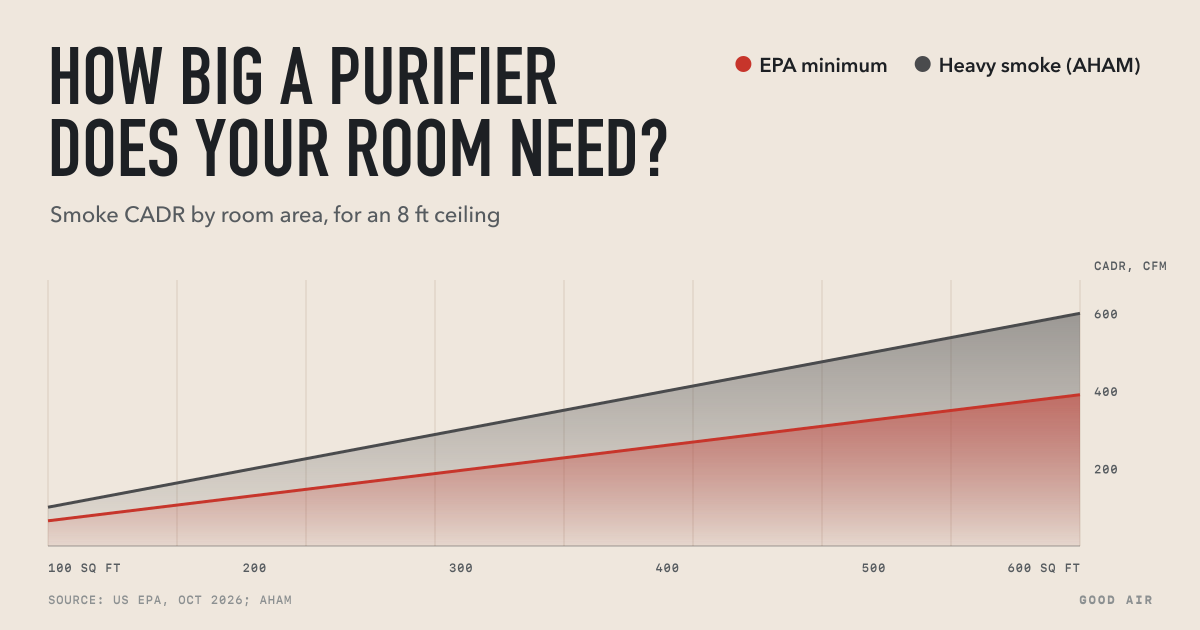
An air purifier's CADR (clean air delivery rate) should be at least two-thirds of the room's floor area in square feet. A 10 by 12 ft bedroom (120 sq ft) needs a smoke CADR of at least 80 cfm, according to the Association of Home Appliance Manufacturers, which runs the CADR test (AHAM Verifide). For heavy smoke, AHAM recommends a smoke CADR equal to the room's area, so 120 cfm for the same bedroom.
That matters now in North India. On the evening of 14 October 2026, Good Air's live reading for Delhi was 212 on India's National AQI (Poor), with Ghaziabad at 284 and Meerut at 314, and the smog season has barely begun.
What is CADR?
CADR is the volume of filtered air a purifier delivers, measured at its highest fan speed. AHAM tests three separate scores: tobacco smoke, dust and pollen. The smoke CADR is the one to look at for city smog and crop-fire smoke, because smoke particles are the smallest and the hardest to catch, much like the PM2.5 that drives North India's winter AQI.
In the US, CADR is given in cubic feet per minute (cfm). Many purifiers sold in India and the rest of Asia list it in cubic metres per hour (m³/h) instead. To convert, multiply cfm by 1.7, or divide m³/h by 1.7. A smoke CADR of 80 cfm is about 136 m³/h.
A higher CADR cleans the same room faster, or a bigger room in the same time. CADR covers particles only. It says nothing about gases such as nitrogen dioxide or ozone (US EPA, updated 1 October 2026).
How big an air purifier do I need for my room?
Measure the room's length and width in feet and multiply them. That gives the floor area. Then use this table. The two left columns are the US Environmental Protection Agency's own sizing chart, for a room with an 8 ft (2.4 m) ceiling.
| Room area | Minimum CADR (EPA) | In m³/h | For heavy smoke (AHAM, CADR = area) |
|---|---|---|---|
| 100 sq ft (9 m²) | 65 cfm | about 110 | 100 cfm |
| 200 sq ft (19 m²) | 130 cfm | about 220 | 200 cfm |
| 300 sq ft (28 m²) | 195 cfm | about 330 | 300 cfm |
| 400 sq ft (37 m²) | 260 cfm | about 440 | 400 cfm |
| 500 sq ft (46 m²) | 325 cfm | about 550 | 500 cfm |
| 600 sq ft (56 m²) | 390 cfm | about 660 | 600 cfm |
The m³/h and m² figures are our conversions, rounded.
Three adjustments:
- High ceilings. Both sizing rules assume an 8 ft ceiling. For anything higher, AHAM and the EPA say to choose a purifier rated for a bigger room.
- Open-plan spaces. Count the whole connected area, not just the corner where the purifier sits.
- One unit not enough? The EPA suggests using more than one. Two mid-sized units in two rooms are usually better than one big unit in the hall.
Worked examples for Indian homes
- A 10 by 12 ft bedroom (120 sq ft). AHAM's minimum is a smoke CADR of 80 cfm, about 136 m³/h. On heavy smog days, aim for 120 cfm, about 204 m³/h.
- A 12 by 14 ft master bedroom (168 sq ft). Minimum 112 cfm (about 190 m³/h); for heavy smoke, 168 cfm (about 286 m³/h).
- A 15 by 20 ft living room (300 sq ft). Minimum 195 cfm on the EPA chart (about 330 m³/h); for heavy smoke, 300 cfm (about 510 m³/h).
Which target should you use? AHAM's higher figure was written for wildfire smoke. North India's winter smog is also dense fine-particle pollution, much of it from burning, and it lasts for weeks. Our suggestion: if you live in Delhi NCR or elsewhere on the Indo-Gangetic plain and can afford it, size for heavy smoke. The two-thirds rule is the minimum, not the goal.
Ignore the "room size" on the box
Manufacturers print a recommended room size, but it rests on assumptions they do not always state, such as how many times an hour the room's air should be cleaned and which test standard was used. Two machines with the same CADR can claim very different room sizes. Work it out yourself from the smoke CADR and your floor area. If the box lists only a CADR in m³/h with no pollutant named, ask which test standard it used.
Does an air purifier actually work against smog?
Yes, in a closed room. A 2022 study of homes in Kaohsiung, Taiwan, found that HEPA air cleaners cut average indoor PM2.5 from 33.5 to 17.2 µg/m³. The share of outdoor pollution getting indoors fell from 76.3% to 38.6%. Homes that ran more units, at a sensible fan speed, with windows kept shut, did best (Chen and others, International Journal of Environmental Research and Public Health, September 2022).
The EPA notes that several studies of portable HEPA units found small improvements in heart and lung health and in some allergy and asthma symptoms. A purifier is not a medical treatment. It lowers what you breathe at home; it does nothing for the air outside or on the way to work.
How to get the most from an air purifier

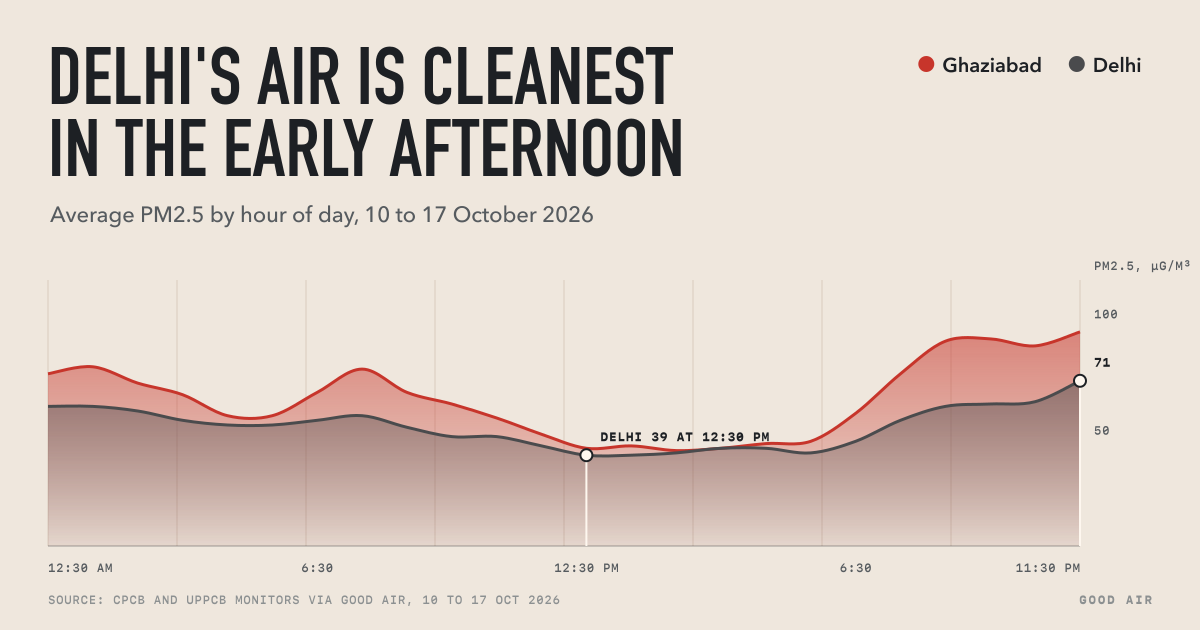
- Close the windows and doors. A purifier cannot keep up with a room open to smoggy air. Ventilate briefly when the outdoor AQI is lowest, often in the early afternoon.
- Put it where you sleep. You spend a third of the day in the bedroom. The EPA advises placing a purifier in the room where you spend the most time.
- Give it space. Keep it clear of curtains, furniture and walls so air can flow in and out.
- Run it on high when the AQI is Poor or worse. CADR is measured at the highest speed. On low, it cleans far less air. Our guide to NAQI 201 to 300 explains what Poor means for your health.
- Change the filter on time. Follow the manufacturer's schedule and replace it sooner if it looks heavily soiled. A clogged filter does not work well, the EPA says. In Delhi's winter, filters fill up faster than the box suggests.
What to avoid
- Ozone generators and "ionisers" that make ozone. The EPA advises against air cleaners that intentionally produce ozone, a lung irritant. Some ionisers, electrostatic precipitators and plasma devices also give off ozone as a by-product. A true HEPA filter does not.
- Undersized units. A small desk purifier in a big living room is the most common mistake. Check the smoke CADR against the table above.
Running costs are mostly the filter and electricity. Check the wattage at the speed you will use. A purifier drawing 50 W for 10 hours a day uses 0.5 kWh a day, so multiply by your electricity tariff.
For the rest of your smog-day kit, read our guides to N95, KN95 and FFP2 masks and why Delhi's air turns toxic every winter, and follow the Delhi air pollution tracker for GRAP updates.
Frequently asked questions
What CADR do I need for a 10 by 12 room?
A 10 by 12 ft room is 120 sq ft. AHAM's rule of thumb gives a minimum smoke CADR of 80 cfm, about 136 m³/h. For heavy smoke, such as North Indian smog or wildfire smoke, AHAM recommends a smoke CADR equal to the floor area, so 120 cfm, about 204 m³/h.
How do I convert CADR from m³/h to cfm?
Divide m³/h by 1.7 to get cubic feet per minute (cfm), or multiply cfm by 1.7 to get m³/h. A purifier with a CADR of 340 m³/h delivers about 200 cfm, enough for a 300 sq ft room on the two-thirds rule.
Is a bigger air purifier better?
For the same room, yes. A higher CADR cleans the air faster and copes better on bad days, and a bigger unit can run on a quieter, lower speed. Size it to your room's floor area and ceiling height, and use more than one unit for open-plan spaces or several rooms.
Should I run an air purifier all day?
Run it whenever you are in the room and the outdoor AQI is Moderate or worse, with windows closed. Higher fan speeds and longer running times filter more air, the US EPA notes. During Delhi's smog season, many families run purifiers in bedrooms through the night.
Do air purifiers remove PM2.5?
Yes. Portable purifiers usually reach a high CADR by using a HEPA filter, which traps fine particles, the US EPA says. In a 2022 study of homes in Taiwan, HEPA cleaners cut average indoor PM2.5 from 33.5 to 17.2 µg/m³. They work only in a closed room and do not remove gases.