Data stories · 5 min read
What time of day is Delhi's air cleanest? Our hourly data says early afternoon
Delhi NCR's air was cleanest from noon to 5 pm and dirtiest late at night in our hourly data for 10 to 17 October 2026. When to walk, run and open windows.
 By the Good Air team
In this article · 4 sections
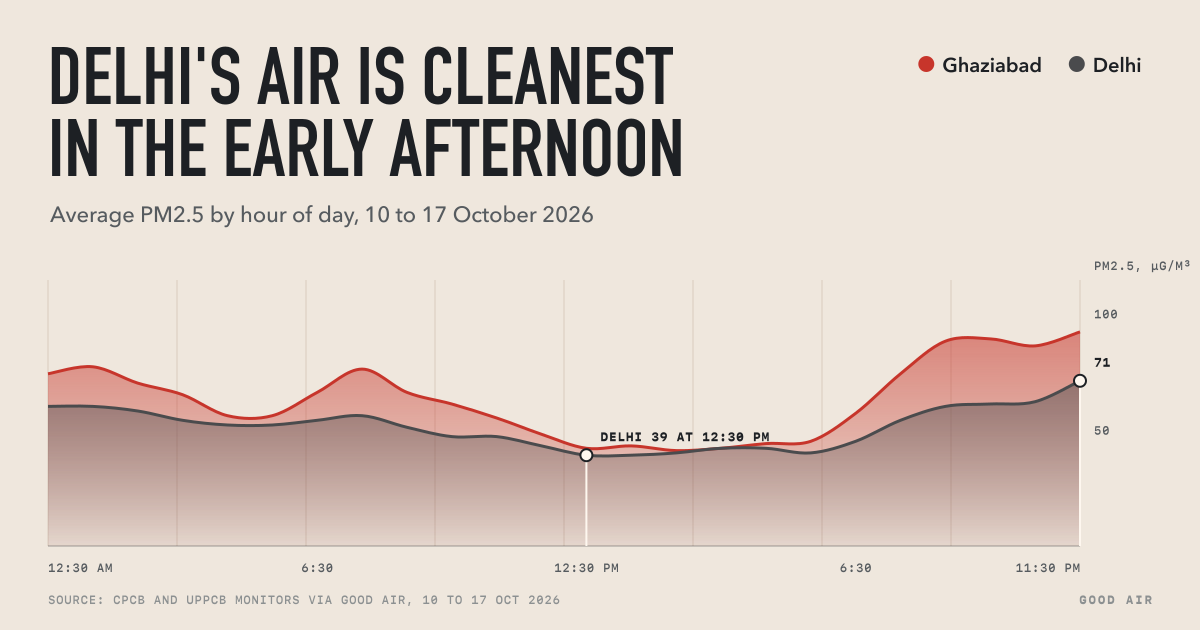
Delhi NCR's air is cleanest in the early afternoon and dirtiest late at night. In Good Air's hourly readings from official monitors between 10 and 17 October 2026, Delhi's average PM2.5 fell to 39 micrograms per cubic metre (µg/m³) at 12:30 pm and 1:30 pm and rose to 71 µg/m³ at 11:30 pm, almost twice as high. Ghaziabad and Noida showed the same pattern even more sharply, from about 41 in the afternoon to 92 and 94 late at night.
So the best time to go out in Delhi when pollution is high, whether to walk, run or open the windows, is roughly noon to 5 pm; avoid late evenings and early mornings. India's health ministry gives the same advice for days when the AQI is above 200.
When is pollution lowest in Delhi?

We averaged every hourly PM2.5 reading for Delhi, Ghaziabad and Noida over the week to 17 October 2026 by time of day. Each city's figure is the average of its reporting monitoring stations; Delhi has dozens. PM2.5 is the fine dust and soot that does the most harm to health (our explainer).
| Time (IST) | Delhi | Ghaziabad | Noida |
|---|---|---|---|
| 2:30 am | 58 | 70 | 56 |
| 5:30 am | 52 | 56 | 51 |
| 7:30 am | 56 | 76 | 64 |
| 10:30 am | 47 | 55 | 46 |
| 12:30 pm | 39 | 42 | 40 |
| 2:30 pm | 40 | 41 | 42 |
| 5:30 pm | 40 | 45 | 50 |
| 8:30 pm | 60 | 88 | 72 |
| 11:30 pm | 71 | 92 | 94 |
Average PM2.5 in µg/m³. Readings from 10 October, 10:30 am, to 17 October 2026, 7:30 am. India's 24-hour standard for PM2.5 is 60 µg/m³.
Three things stand out:
- The cleanest window was about 12:30 pm to 4:30 pm in all three cities, with averages between 39 and 44 µg/m³.
- Air got worse fast after sunset. In Ghaziabad, PM2.5 doubled from 45 at 5:30 pm to 88 by 8:30 pm.
- Early morning was not clean. The 5:30 am readings, when many people walk, were still a third higher than the early afternoon in Delhi, and Ghaziabad and Noida had a second bump around 7:30 am, when the morning traffic starts.
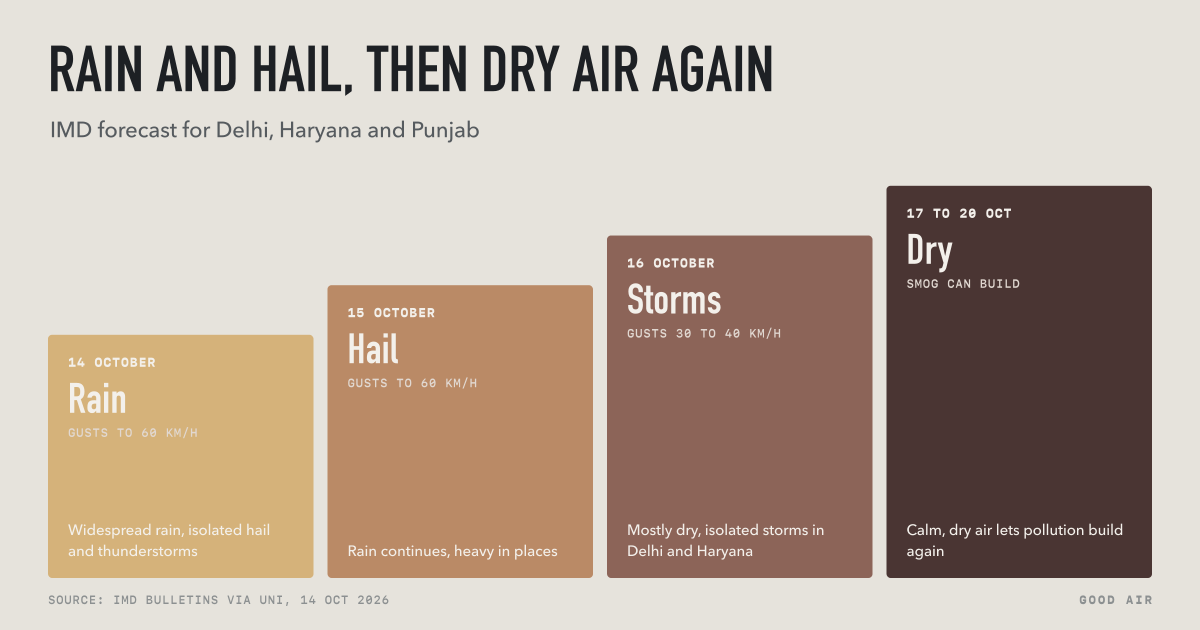
This was a fairly mild week, helped by heavy rain on 11 and 12 October. On CPCB's official 24-hour bulletins, Delhi's AQI ranged from 83 on 12 October (Asianet Newsable, 13 October) to 158 on 13 October (ThePrint with PTI, 13 October), and was 90 on 16 October (CPCB, 16 October). IITM's Early Warning System expects Poor air from 19 October. The gap between day and night tends to grow as winter deepens, so the pattern matters more from November.
Why is Delhi's air worse at night?
The amount of pollution released in Delhi changes less across the day than the volume of air it mixes into. That volume depends on the mixing height: how far up from the ground the air is stirred by the sun's heat.
On a winter day, sunshine warms the ground, the warm air rises and the pollution spreads through a thick layer. After sunset the ground cools, the air near it turns cold and still, and a lid forms. The same smoke and exhaust is squeezed into a much thinner layer, so concentrations climb. Meteorologists call this a temperature inversion.
An analysis by UrbanEmissions.info, a Delhi research group, put the modelled mixing height in Delhi at about 500 metres on an average winter day and 100 metres on a winter night, against 2,000 metres on a summer day. Halving the mixing height doubles the concentration if emissions stay the same (UrbanEmissions.info, updated 14 December 2015). Evenings also add emissions: rush-hour traffic, cooking and, as nights get colder, fires lit for warmth.
What time should you walk or run in Delhi?
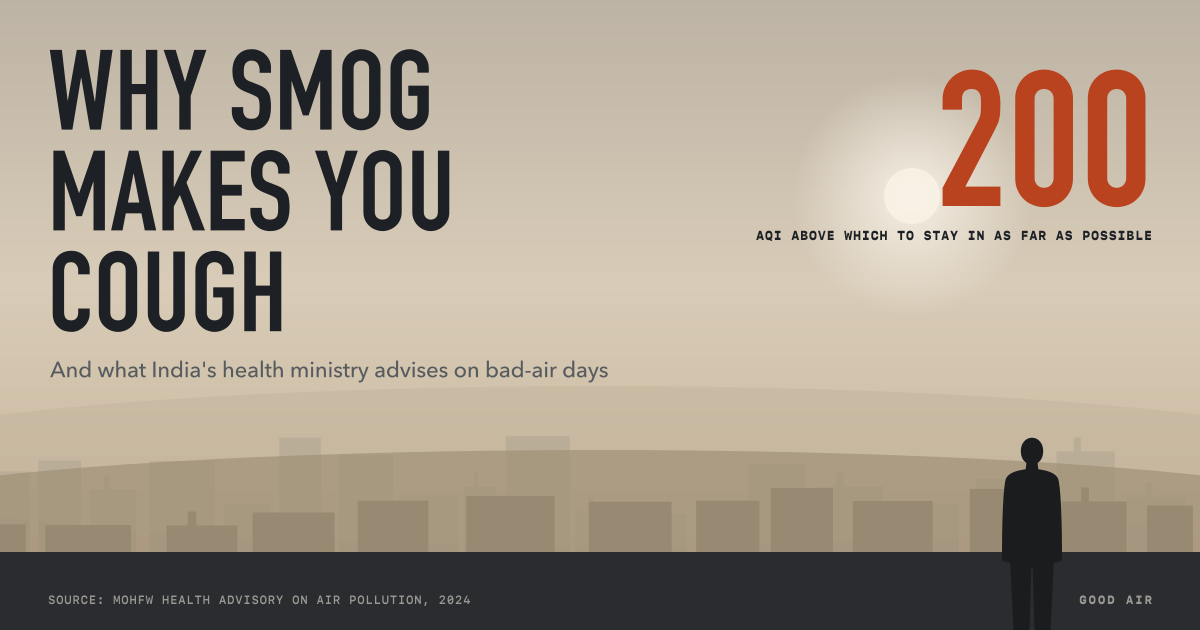
India's Ministry of Health and Family Welfare advises that on days when the AQI is Poor to Severe (above 200), people should avoid outdoor walks, runs and exercise in the early morning and late evening, keep outside doors and windows shut at those hours, and air rooms if needed between 12 pm and 4 pm (MoHFW health advisory on air pollution, 2024). Our data shows why that window works.
In practice:
- Check the live reading first. Day-to-day changes are bigger than the daily rhythm; a windy morning can beat a still afternoon. Our Delhi live page shows every station.
- Move exercise to midday or early afternoon on Poor or worse days, and keep it light. Our guide to what AQI is safe for running and cycling gives the levels.
- Keep windows shut from evening to mid-morning. If you air the house, do it in the early afternoon.
- Avoid busy roads at rush hour. The US Environmental Protection Agency's guidance for schools says particle pollution "can be high any time of day", and advises staying away from idling cars, buses and busy roads, especially during rush hours (US EPA, Air Quality and Outdoor Activity Guidance for Schools).
- Plan the school run and evening walks around the night peak. Children and older people are most at risk; our parent's guide has more.
Is the afternoon always cleaner?
For smog from particles in a North Indian winter, usually yes, but not always. Rain, a western disturbance or a strong breeze can clean the air at any hour, and fog can keep pollution trapped well into the morning. Smoke from Diwali fireworks or farm fires can arrive late at night and linger.
Ozone, a different pollutant, behaves the other way. The US EPA says ozone is often worse on hot, sunny afternoons and early evenings, and advises planning outdoor activities in the morning on high-ozone days. That matters more in Indian summers and in cities like Los Angeles. In Delhi's winter, PM2.5 is the main pollutant on most days, which is why the early afternoon wins.
Our data covers one week of mid-October. We will repeat the analysis as the season deepens and update this article. For the bigger picture, see why Delhi's air turns toxic every winter and the Delhi air pollution tracker.
Frequently asked questions
What is the best time to go outside in Delhi pollution?
In Good Air's hourly data for 10 to 17 October 2026, Delhi's PM2.5 was lowest between about 12:30 pm and 5:30 pm, averaging 39 to 42 µg/m³, and highest at 11:30 pm at 71 µg/m³. India's health ministry also advises avoiding early mornings and late evenings outdoors on days when the AQI is above 200.
Is morning air cleaner in Delhi?
Not in winter. Early morning air in Delhi NCR is often worse than the afternoon, because cold, still air overnight traps pollution near the ground. At 5:30 am, Delhi's average PM2.5 was 52 µg/m³ in the week to 17 October 2026, against 39 at 12:30 pm. Ghaziabad and Noida also had a rush-hour rise around 7:30 am.
Why is AQI higher at night?
At night the ground cools and the air above it becomes cold and still, so pollution is trapped in a thin layer near the surface. UrbanEmissions.info estimated Delhi's mixing height at about 100 metres on a winter night, against 500 metres on a winter day. Evening traffic, cooking and fires for warmth add more pollution as the layer shrinks.
When should I open windows in Delhi during smog?
India's health ministry advises keeping outside doors and windows shut in the early morning and late evening on days when the AQI is Poor or worse, and airing rooms if needed between 12 pm and 4 pm. Good Air's hourly data for October 2026 showed Delhi NCR's PM2.5 lowest in that window.
Is it safe to go for a morning walk in Delhi in winter?
On days when the AQI is Poor or worse, India's health ministry advises against outdoor morning and late-evening walks, runs and exercise. Check the live AQI first; on cleaner days a morning walk is fine. On smoggy days, an early afternoon walk away from busy roads exposes you to less pollution.