Explainers · 5 min read
PM2.5 vs PM10: what's the difference, and which one should you worry about?
PM10 is coarse dust up to 10 micrometres; PM2.5 is fine smoke and soot up to 2.5. PM2.5 vs PM10 explained, with safe levels and today's examples.
 By the Good Air team
In this article · 6 sections
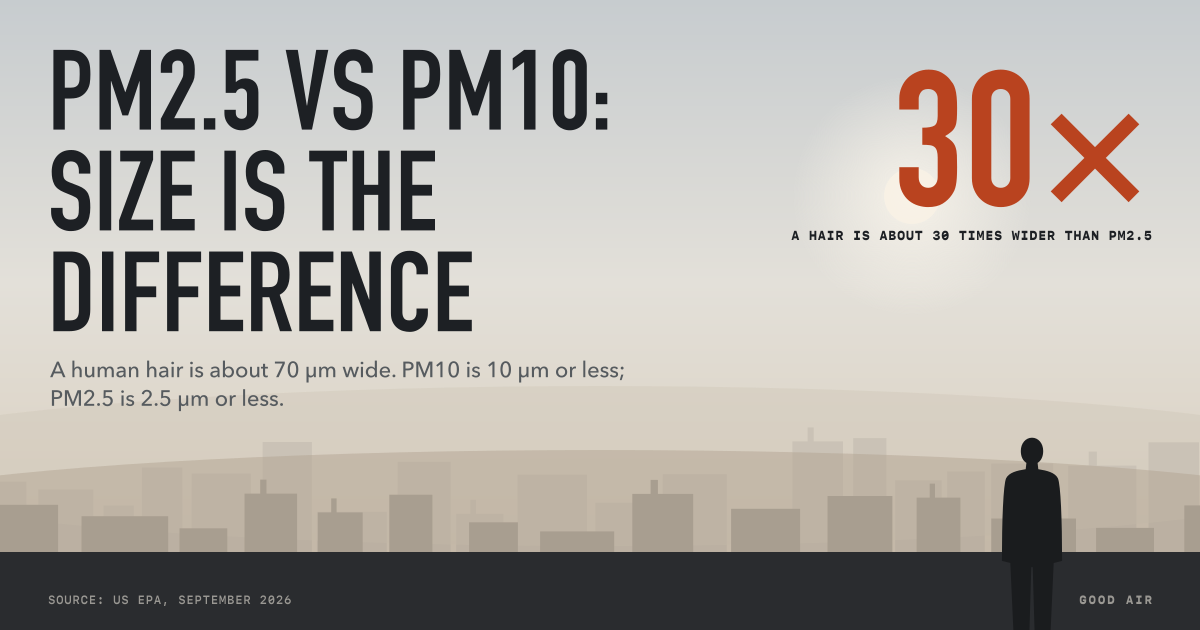
The difference between PM2.5 and PM10 is size. PM10 means inhalable particles 10 micrometres across or smaller, and PM2.5 means fine particles 2.5 micrometres or smaller; an average human hair is about 70 micrometres wide, roughly 30 times the largest fine particle, according to the US Environmental Protection Agency (US EPA, updated 18 September 2026). PM2.5 is the bigger health risk, because it travels deeper into the lungs.
You can see both at work in India this week. On 14 October 2026, CPCB's daily bulletin named PM10, coarse dust, as the main pollutant in Bikaner (AQI 204, Poor), and PM2.5, fine smoke and exhaust, in Ghaziabad (AQI 208, Poor) and Delhi (181, Moderate) (CPCB, 14 October, 4 pm).
What is the difference between PM2.5 and PM10?
PM stands for particulate matter: tiny solid or liquid particles floating in the air. The number is the largest particle size counted, in micrometres (µm). A micrometre is a thousandth of a millimetre.
- PM10 is every particle 10 µm or smaller. That includes the fine ones.
- PM2.5 is the subset that is 2.5 µm or smaller.
- Coarse particles are the part of PM10 between 2.5 and 10 µm.
So PM2.5 is not separate from PM10; it is part of it. When a monitor reports PM10 of 200 µg/m³ and PM2.5 of 90 µg/m³, about 90 of the 200 are fine particles and the other 110 are coarse. Both are measured in micrograms per cubic metre of air (µg/m³).
| PM10 | PM2.5 | |
|---|---|---|
| Size | 10 µm or smaller | 2.5 µm or smaller |
| Compared with a hair (about 70 µm) | About 7 times smaller | About 30 times smaller |
| Typical sources | Road and construction dust, dust storms, pollen | Vehicle exhaust, burning (crops, wood, waste), industry, power plants |
| How far into the body | Nose, throat and lungs | Deep into the lungs; some enters the blood |
| Main health concern | Coughing, irritation, asthma attacks | Heart disease, stroke, lung disease |
Sources: US EPA, September 2026; WHO, 2021 and 2024.
Where do PM2.5 and PM10 come from?
The US EPA lists two routes. Some particles are emitted directly, from construction sites, unpaved roads, fields, smokestacks and fires. Others form in the air from gases, mainly sulphur dioxide and nitrogen oxides from power plants, industry and cars (US EPA, September 2026).
Coarse PM10 is mostly made by grinding and blowing: dust lifted by wind and traffic, building work, stone crushing and pollen. Fine PM2.5 mostly comes from burning, and from those gases turning into particles. That is why desert towns in western Rajasthan, such as Bikaner and Sri Ganganagar, often record PM10 as their main pollutant, and cities in Delhi NCR in October and November record PM2.5 from traffic, industry and crop and waste fires.
At about 9:15 am IST on 15 October 2026, Good Air's live feed showed Bikaner at an NAQI of 438, Severe, driven by PM10 from a single monitor, while Ghaziabad's 304 (Very Poor) was driven by PM2.5. What lifted the dust in Bikaner that morning was not known. You can follow both on the Bikaner and Ghaziabad pages.
Which is more harmful, PM2.5 or PM10?
PM2.5. The US EPA says fine particles pose the greatest health risk. Particles under 10 µm can get deep into the lungs, and some may enter the bloodstream (US EPA, September 2026). The World Health Organization (WHO) says both reach deep into the lungs, but PM2.5 can also enter the blood (WHO, 22 September 2021).
WHO estimates that outdoor air pollution caused 4.2 million early deaths worldwide in 2019, and links them to fine particulate matter. About 68% of those deaths were from heart disease and stroke, 14% from chronic obstructive pulmonary disease (COPD), 14% from lower respiratory infections and 4% from lung cancer (WHO fact sheet, 24 October 2024-air-quality-and-health)).
That does not make PM10 harmless. Coarse dust irritates the eyes, nose and throat and can set off asthma attacks. On a dusty day, people with asthma still need to take care.
What are safe levels of PM2.5 and PM10?
WHO's 2021 guidelines set much lower levels than most national standards. They were tightened from the 2005 guidelines as evidence of harm at low levels grew (IQAir summary, 31 December 2021):
| WHO guideline | PM2.5 | PM10 |
|---|---|---|
| 24-hour average | 15 µg/m³ | 45 µg/m³ |
| Annual average | 5 µg/m³ | 15 µg/m³ |
| 24-hour, old 2005 guideline | 25 µg/m³ | 50 µg/m³ |
India's National Air Quality Index (NAQI) turns 24-hour averages into bands. At every level it allows more PM10 than PM2.5 (Arthapedia, Indian Economic Service):
| NAQI band | PM2.5 (µg/m³, 24 hours) | PM10 (µg/m³, 24 hours) |
|---|---|---|
| Good (0 to 50) | 0 to 30 | 0 to 50 |
| Satisfactory (51 to 100) | 31 to 60 | 51 to 100 |
| Moderate (101 to 200) | 61 to 90 | 101 to 250 |
| Poor (201 to 300) | 91 to 120 | 251 to 350 |
| Very Poor (301 to 400) | 121 to 250 | 351 to 430 |
| Severe (401 to 500) | Above 250 | Above 430 |

India's Satisfactory band for PM2.5 ends at 60 µg/m³, four times WHO's 24-hour guideline of 15. For PM10 it ends at 100, a little over twice WHO's 45. A day that India calls Satisfactory can still be above WHO's advice.
How do you know which one is driving your AQI?
An AQI is built from sub-indices, one for each pollutant, and the highest one becomes the overall number. India's NAQI looks at up to eight pollutants: PM10, PM2.5, nitrogen dioxide, ozone, carbon monoxide, sulphur dioxide, ammonia and lead. It is only calculated when at least three are measured and one of them is PM2.5 or PM10 (Arthapedia).
So the "main pollutant" or "prominent pollutant" on an AQI report tells you what kind of day it is:
- PM10 on top: a dust day. Wind, dry roads or building work. Common in Rajasthan, Punjab and Haryana in dry spells.
- PM2.5 on top: a smoke and exhaust day. Burning, traffic and industry, trapped by calm, cold air. This is Delhi NCR's usual winter pattern.
- Both listed: a mix, which CPCB showed for Greater Noida, Gurugram and Meerut on 14 October 2026.
The US AQI, which many apps use, handles the same pollutants on different breakpoints, so the numbers differ. Our explainer on US AQI vs India's NAQI shows the gap side by side, and the AQI guide explains each band.
Do masks and air purifiers stop PM2.5 and PM10?
Yes, if you choose the right ones. Anything that stops fine PM2.5 also stops the bigger PM10 particles. The reverse is not true: cloth masks and simple dust filters catch some coarse dust but let most fine particles through.
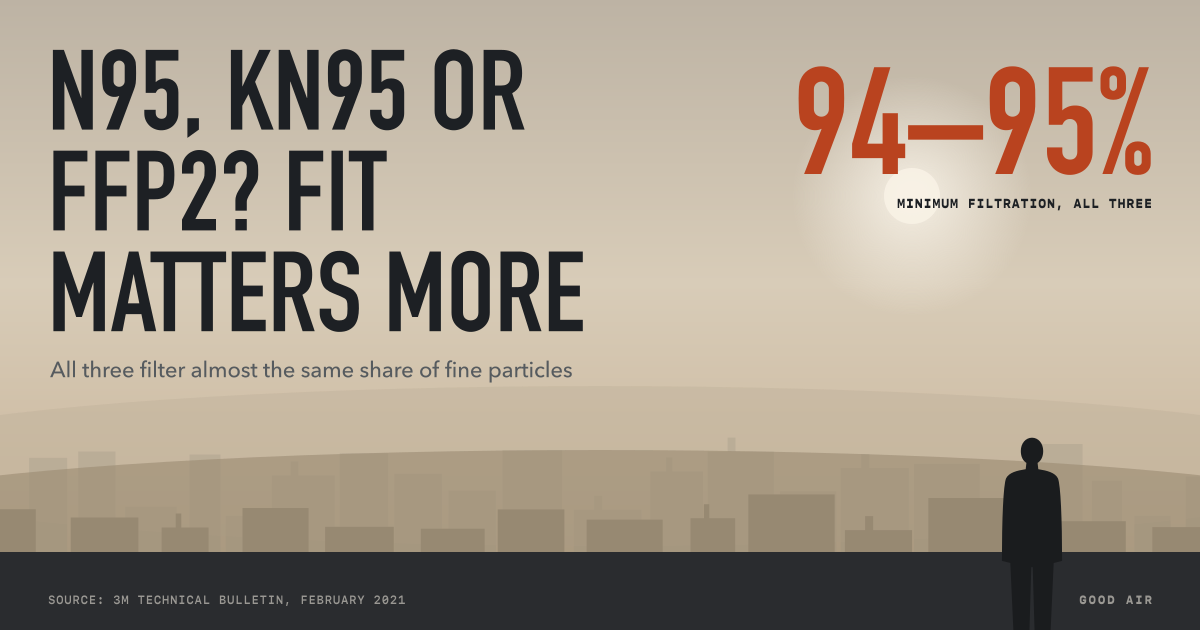
- Masks: a well-fitted N95, KN95 or FFP2 is the standard for smoke and smog. Our mask guide compares them.
- Air purifiers: a HEPA purifier sized for your room cuts both indoors. See what size purifier you need.
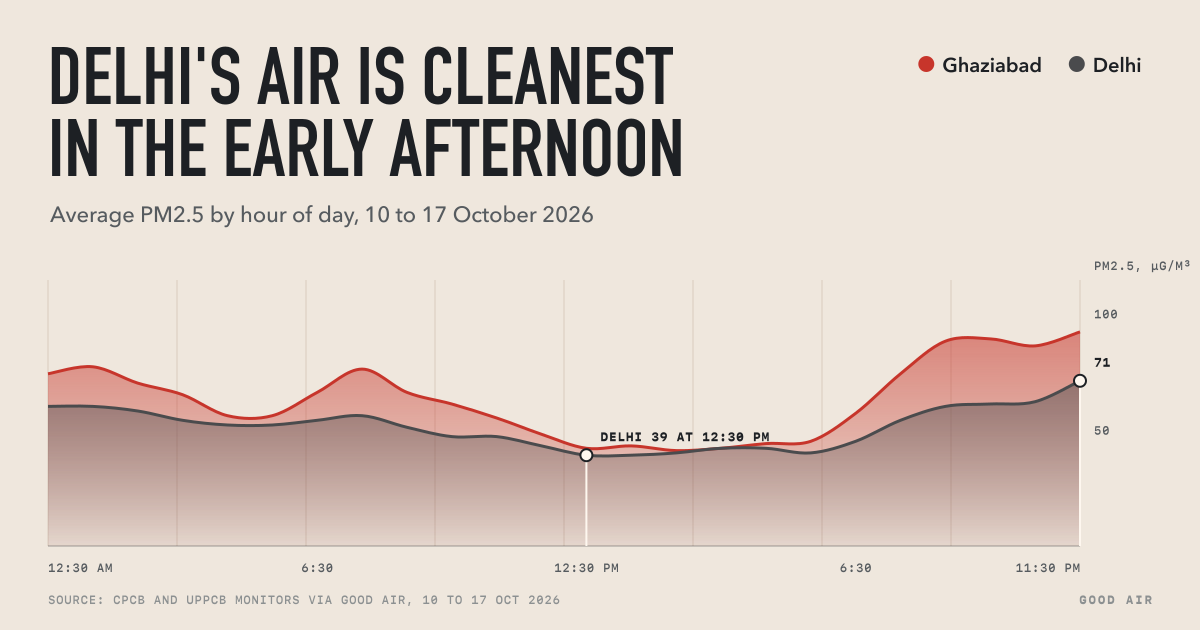
- Timing: on smoggy PM2.5 days, the air is often worst at night and early in the morning, when cold, still air traps smoke. Check the live reading rather than guessing.
Frequently asked questions
What is the difference between PM2.5 and PM10?
PM10 is all airborne particles 10 micrometres across or smaller, such as dust and pollen. PM2.5 is the finer part, 2.5 micrometres or smaller, mostly from burning and exhaust. A human hair is about 70 micrometres wide. PM2.5 is included within PM10 and is the more harmful of the two.
Is PM2.5 worse than PM10?
Yes. PM2.5 particles are small enough to reach deep into the lungs, and some pass into the bloodstream. The US EPA says fine particles pose the greatest health risk, and WHO links them to heart disease, stroke, lung disease and lung cancer. PM10 dust still irritates airways and can trigger asthma attacks.
What is a safe level of PM2.5 and PM10?
The World Health Organization's 2021 guidelines recommend a 24-hour average of no more than 15 µg/m³ for PM2.5 and 45 µg/m³ for PM10, and annual averages of 5 and 15 µg/m³. India's NAQI rates PM2.5 up to 60 µg/m³ and PM10 up to 100 µg/m³ over 24 hours as Satisfactory.
Why is PM10 high in Rajasthan?
PM10 is mostly coarse dust, and western Rajasthan is dry and sandy. Wind, dust storms, unpaved roads and construction lift dust into the air. On 14 October 2026, CPCB's bulletin named PM10 as the main pollutant in Bikaner, Sri Ganganagar and Jhunjhunu, while Delhi's main pollutant was PM2.5.
Does an N95 mask filter PM2.5?
Yes. A well-fitted N95, KN95 or FFP2 mask is designed to filter fine particles, including PM2.5, and it also stops larger PM10 dust. Fit matters as much as the label: air that leaks around the edges is not filtered. Cloth and surgical masks do little against PM2.5.