News · 6 min read
Southeast Asia haze 2026: Singapore's PSI hits 192 as Malaysia shuts schools
Peat fires in Sumatra and Kalimantan pushed Singapore's PSI to its 2026 high and shut Malaysian schools. What is happening and how to stay safe.
 By the Good Air teamUpdated · First published 14 October 2026
In this article · 8 sections
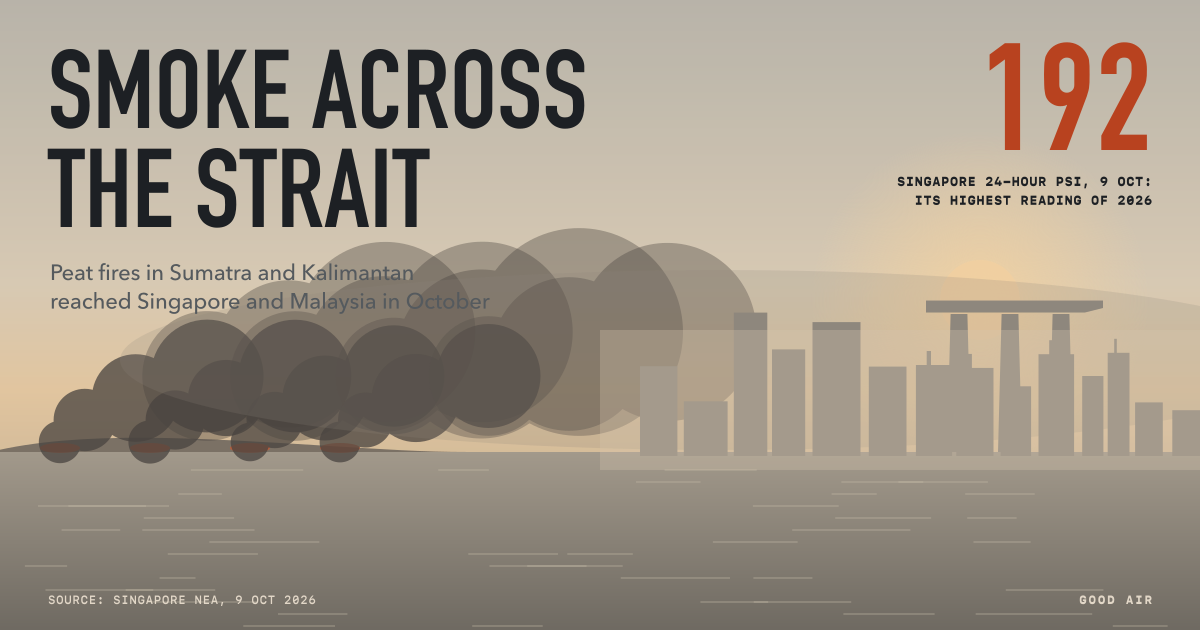
Haze from fires in Indonesia has spread across Southeast Asia in October 2026. On 9 October Singapore's 24-hour Pollutant Standards Index (PSI) reached 192, and on 15 October the west of the island hit 212, a new high for 2026. Malaysia closed schools in seven states and territories, and in Central Kalimantan smoke cut visibility in Palangka Raya to 150 metres.
This page explains what is burning, how bad the air is, and what you can do about it. For live readings from every government monitor in the region, see the Southeast Asia haze live tracker.
What is happening
Fires on carbon-rich peatland in Sumatra and Kalimantan, Indonesian Borneo, are the source. On the evening of 7 October Indonesia's Forestry Ministry counted 1,176 high-confidence hotspots nationwide. The largest numbers were in Central Kalimantan (225) and South Sumatra (224), followed by West Kalimantan (47), South Kalimantan (31) and Jambi (16). The ministry has deployed 61 aircraft to water-bomb fires and seed clouds (The Edge Malaysia, 8 October).

At least 200,000 hectares have burned, and more than 170,000 people in Indonesia have been treated for acute respiratory infections (Al Jazeera, 9 October).
Winds have carried the smoke north and east:
- Singapore. On 9 October, the National Environment Agency (NEA) reported 24-hour PSI of 135 to 192 across the island, with one-hour PM2.5 between 68 and 123 µg/m³. It traced the smoke to southern and central Sumatra (NEA, 9 October). By 11 October the PSI had eased to 112 to 155, still in the Unhealthy range, with smoke now also arriving from West Kalimantan (NEA, 11 October).
- Malaysia. The King urged that schools close whenever the Air Pollutant Index (API) reaches 150. Schools shut in Kuala Lumpur, Putrajaya, Johor, Melaka, Negeri Sembilan, Pahang and Selangor, affecting about two million students. On 12 October, 22 of the country's 68 monitoring stations read Unhealthy, with Kota Tinggi in Johor the worst at 170. Johor's schools are to stay closed until 16 October (Mothership, 12 October).
- Indonesia. The worst air is close to the fires, in Central and South Kalimantan and South Sumatra. Government monitors there have reported readings at or near the top of the scale.
Why peat fires make the worst haze
Peat is partly decomposed plant matter, built up over thousands of years in waterlogged swamp forest. When peatland is drained for plantations it dries out and becomes fuel. Once alight, peat smoulders underground at low temperature for weeks. That slow burning produces far more smoke per hectare than a forest fire, and the smoke is rich in fine particles (PM2.5) and carbon monoxide.
Peat fires are also very hard to put out: rain and water-bombing can douse the surface while the fire keeps burning below. The haze usually ends only when the northeast monsoon rains set in, typically from late October or November.
PSI, API, ISPU and AQI: four numbers for the same smoke
Each country reports the haze on its own index, which is why numbers in the news rarely match. (Indonesia's index is explained in full in What is ISPU?)
| Country | Index | How it is averaged | Unhealthy from |
|---|---|---|---|
| Singapore | PSI (NEA) | 24 hours | 101 |
| Malaysia | API (Department of Environment) | Published hourly | 101 |
| Indonesia | ISPU (Ministry of Environment) | 24 hours | 101 |
| US scale, used by Good Air | US EPA AQI | Latest hour | 151 (101 for sensitive groups) |
The 24-hour indices move slowly, so they can understate a sudden thick plume. For deciding whether to go out right now, the one-hour PM2.5 reading is the better guide. Singapore's NEA publishes it alongside the PSI, and Good Air's US AQI uses the latest hour.
How to protect yourself from haze
- Check the hourly reading before you go out, and plan outdoor time for when it is lowest. Haze often thins around midday as winds pick up.
- Wear a well-fitted N95 or FFP2 respirator outdoors when the air is Unhealthy. Surgical and cloth masks let most fine particles through. A respirator only works if it seals around the nose and chin.
- Keep windows and doors closed, and run an air purifier with a HEPA filter in the room you spend most time in, especially at night.
- Set the car's air conditioning to recirculate.
- Move exercise indoors. Heavy breathing pulls far more smoke into the lungs. See what to do at each AQI level.
- Take extra care with children, older relatives, pregnant people and anyone with asthma, COPD or heart disease. Keep reliever inhalers within reach and follow your doctor's action plan.
- Seek medical help for chest pain, severe breathlessness or palpitations.
Update, 18 October
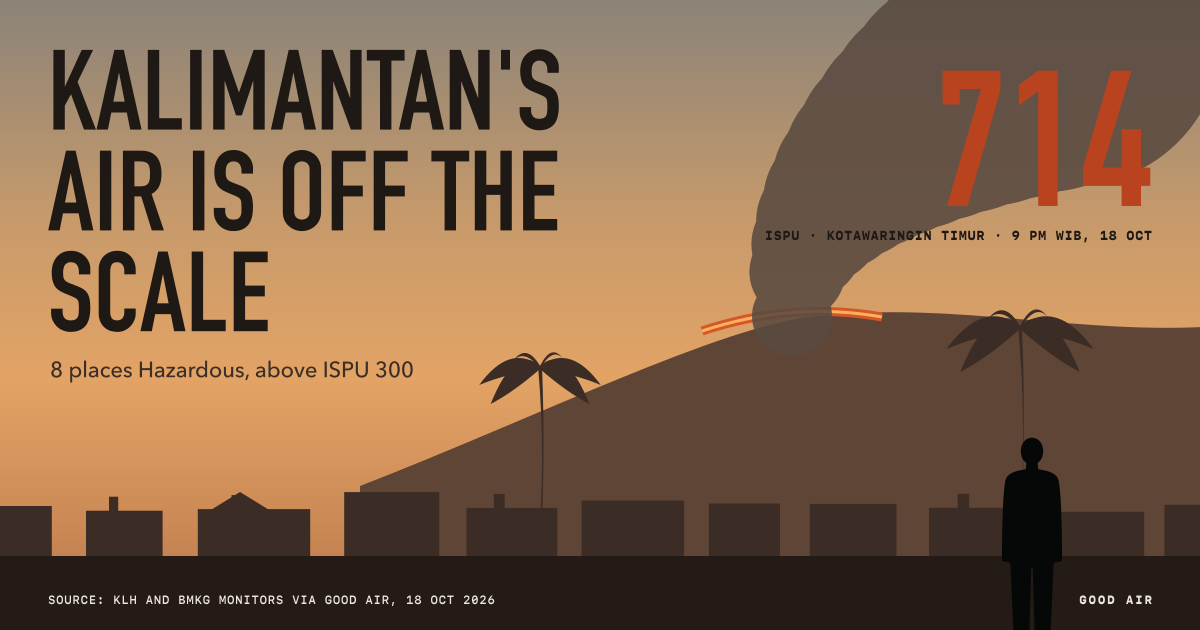
The worst air has moved back to Kalimantan and South Sumatra. At 9 pm WIB on 18 October, eight Indonesian cities and regencies were Hazardous on ISPU, led by Kotawaringin Timur in Central Kalimantan at 714, Barito Selatan at 576 and Gunung Mas at 551; Palembang read 361. Indonesia's high-confidence hotspots fell from 799 to 354 on 16 October, but peat keeps smouldering, so the smoke has not cleared (Bernama, 17 October). BMKG said smoke from Kalimantan was over Jakarta on 16 October, though still 2 to 3 km up. Full details: Kalimantan haze update.
In Singapore, the 24-hour PSI was 130 to 199 at 7 pm on 17 October. NEA forecast 150 to 220 for 18 October, and expects showers and a shift in the wind from 18 to 20 October that may reduce the smoke from Kalimantan (NEA, 17 October).
Update, 15 October
Singapore had its worst haze of the year. The 24-hour PSI in the west reached 212 at noon on 15 October, in the Very Unhealthy range. At 7 pm it stood at 185 in the centre, 180 in the west, 160 in the east, 157 in the south and 121 in the north, all Unhealthy. ActiveSG closed outdoor and non-air-conditioned facilities at sport centres in the south, east, west and central areas, and the ISCA Run planned for 17 October at Gardens by the Bay was cancelled (The Straits Times via Yahoo News, 15 October).
NEA forecast the 24-hour PSI on 16 October to be Unhealthy to low Very Unhealthy, with smoke from Kalimantan still carried in on easterly to south-easterly winds. Rain over the weekend may bring some relief if the winds shift. Above a PSI of 200, Singapore opens haze shelters at community clubs and hands out N95 masks to eligible groups, including children aged 7 to 16 (NEA, 9 October). Our guide on protecting children from air pollution covers what parents can do.
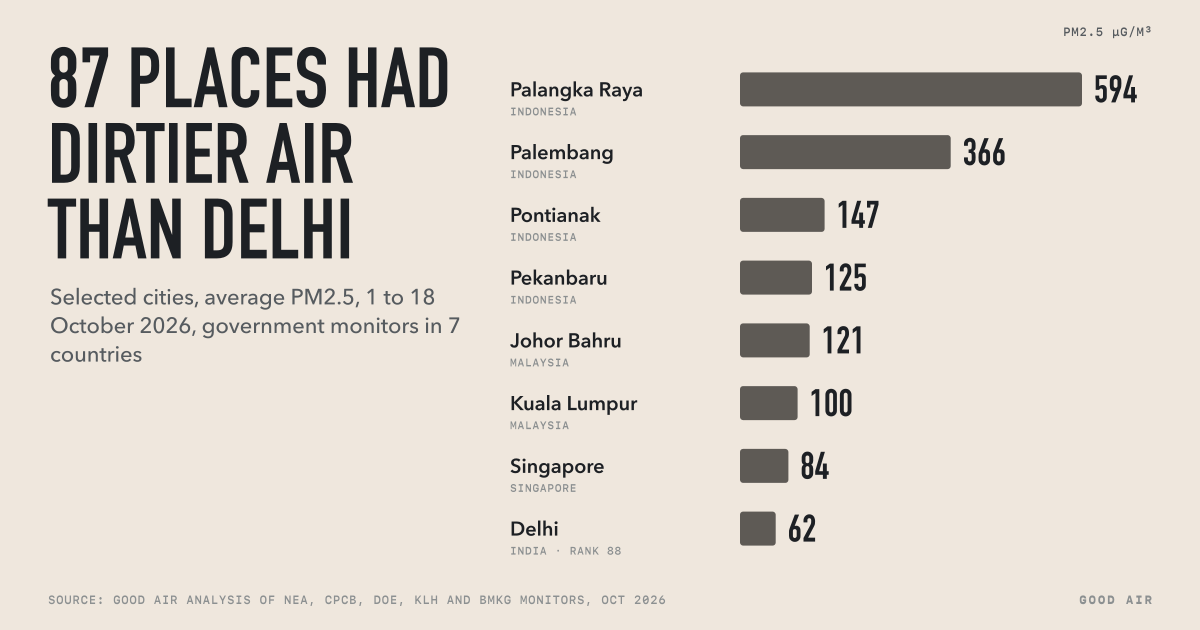
Near the fires the air was off the scale. On Good Air's map at about 6 pm Singapore time on 15 October, Palembang in South Sumatra and Banjarmasin in South Kalimantan were both at the top of the US AQI, 500, and Padang in West Sumatra read 411. Singapore was at 232, Pekanbaru 218, Batam 216, Johor Bahru 211 and Kuala Lumpur 207.
Update, 14 October
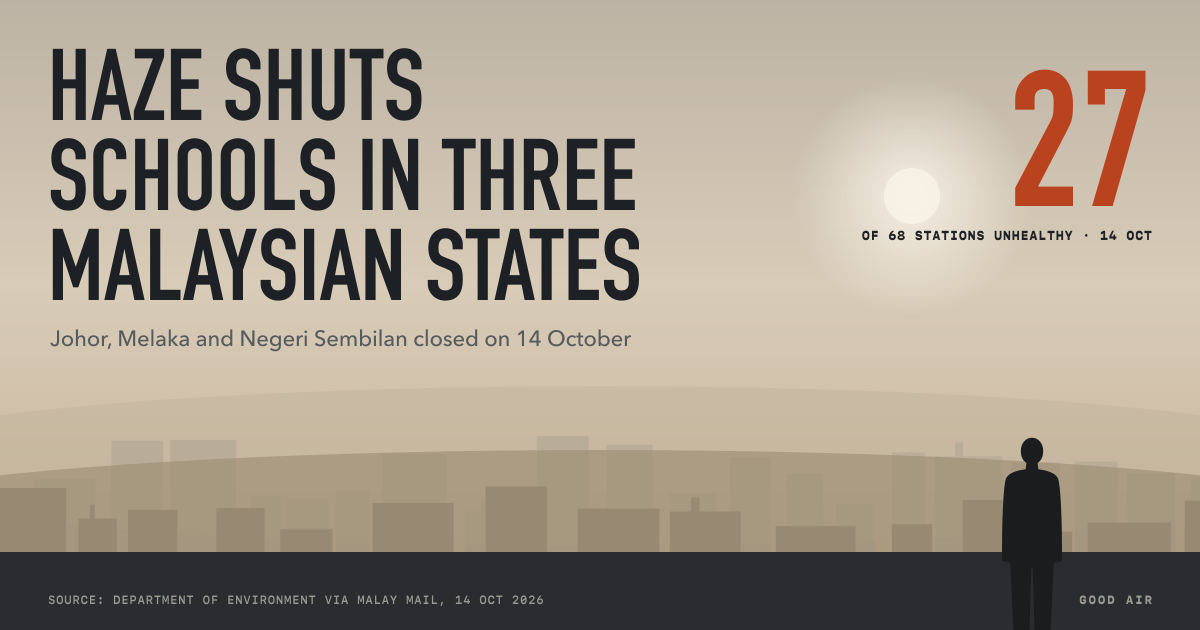
Malaysia's haze worsened again. On the morning of 14 October, 27 of its 68 monitoring stations read Unhealthy, up from 20 a day earlier, with Pasir Gudang in Johor highest at an API of 177 (Malay Mail via Yahoo News, 14 October). All schools in Johor, Melaka and Negeri Sembilan were closed, plus nine districts in Selangor, Pahang, Sabah and Sarawak. Which schools are shut, and how closures are decided: Malaysia haze school closures.
When will the haze stop?
The haze usually ends only when steady rain sets in over the peatlands of Sumatra and Kalimantan, typically from late October or November. Showers and wind shifts bring a few days of relief before then, as NEA expects for Singapore from 18 to 20 October, but the smoke can return within days while peat is still burning.
Malaysia's Foreign Minister Mohamad Hasan wants transboundary haze to be treated as a disaster under ASEAN's mechanisms. Prime Minister Anwar Ibrahim has called for an urgent meeting of ASEAN environment ministers. The Philippines, which chairs ASEAN this year, has confirmed haze is on the agenda for November's meetings (Jakarta Post, 13 October).
Relief will depend on rain over Sumatra and Kalimantan, and on wind direction. Until the monsoon arrives, expect the air to swing from day to day.
Frequently asked questions
Is the haze in Singapore dangerous?
A 24-hour PSI of 101 to 200 is in NEA's Unhealthy range. At that level NEA advises healthy people to reduce prolonged or strenuous outdoor activity. Children, older people, pregnant women and people with chronic lung or heart disease should cut outdoor activity further. Check NEA's latest advisory for the exact guidance.
Where does the haze come from?
From peat and forest fires in Indonesia, mainly in South Sumatra, Central Kalimantan and West Kalimantan in October 2026. Prevailing winds carry the smoke to Singapore and Peninsular Malaysia.
Do N95 masks work against haze?
Yes, if they fit well. N95 and FFP2 respirators filter at least 94 to 95 percent of fine particles when sealed around the face. Surgical masks and cloth masks offer little protection against PM2.5.
When will the haze end?
The haze usually clears when the northeast monsoon brings heavy rain to Sumatra and Kalimantan, typically from late October or November. Changes in wind direction can bring short breaks before then.