News · 5 min read
Kalimantan haze: Central Kalimantan's air turns hazardous as smoke drifts over Jakarta
Kalimantan haze update, 18 October 2026. Eight Indonesian cities and regencies hit hazardous ISPU, led by Kotawaringin Timur at 714.
 By the Good Air team
In this article · 7 sections
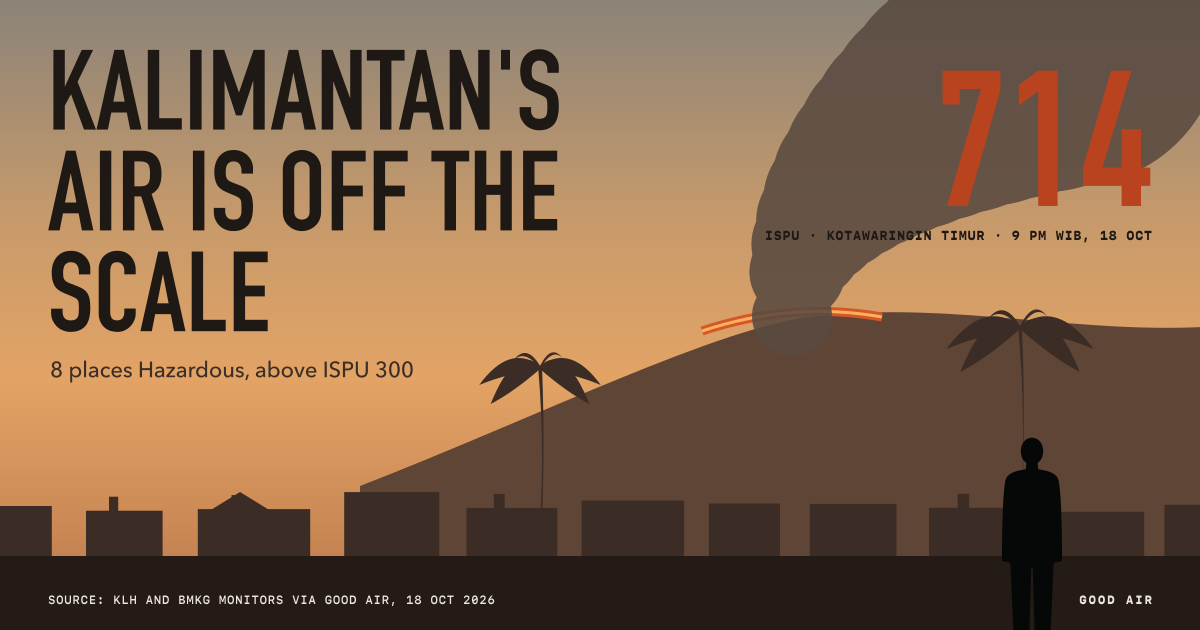
The Kalimantan haze is at its worst near the fires. At 9 pm WIB on 18 October 2026, Kabupaten Kotawaringin Timur in Central Kalimantan read 714 on ISPU, Indonesia's official air quality index, more than twice the threshold for Hazardous (Berbahaya) at 300. Eight Indonesian cities and regencies were Hazardous on government monitors at that hour, and smoke from Kalimantan had been spotted high above Jakarta.
This article covers where the air is worst, how many fires are burning, whether the smoke has reached Jakarta, and what people in the haze can do. The live numbers above refresh by themselves; the readings quoted below are fixed at 9 pm WIB on 18 October.
Where the air is worst right now
Good Air takes its Indonesian readings from monitoring stations run by the Ministry of Environment (KLH) and BMKG. At 9 pm WIB on 18 October 2026, 8 of the 88 reporting cities and regencies were Hazardous on ISPU and 11 more were Very Unhealthy (Sangat Tidak Sehat). The worst were all in Central Kalimantan and South Sumatra:
| Place | Province | ISPU | Category | US AQI |
|---|---|---|---|---|
| Kotawaringin Timur | Central Kalimantan | 714 | Hazardous | 500 |
| Barito Selatan | Central Kalimantan | 576 | Hazardous | 500 |
| Gunung Mas | Central Kalimantan | 551 | Hazardous | 500 |
| Palembang | South Sumatra | 361 | Hazardous | 389 |
| Abab Lematang Ilir | South Sumatra | 340 | Hazardous | 451 |
| Kapuas | Central Kalimantan | 328 | Hazardous | 419 |
| Palangka Raya | Central Kalimantan | 312 | Hazardous | 381 |
| Barito Kuala | South Kalimantan | 307 | Hazardous | 369 |

The US AQI stops at 500, which is why three places show exactly 500 on that scale. ISPU has no such cap in practice, so it can show how far past the top of the scale the smoke has gone. Most of these regencies have a single monitor, so one station can swing the reading. In Riau, Pelalawan (295), Bengkalis (256) and Pekanbaru (218) were Very Unhealthy.
Readings have been even higher this month. The Star reported on 17 October that the AQI in Palangka Raya, the capital of Central Kalimantan, had reportedly reached 1,023 (The Star, 17 October).
If you read Indonesian, the same data is on our Indonesian-language pages, with ISPU first, for example Kotawaringin Timur and Palangka Raya.
How many fires are burning
Fire counts have fallen sharply in the last few days, but the smoke has not. Indonesia's Forestry Ministry counted 354 high-confidence hotspots nationwide as of 9 pm on Friday 16 October, down from 799 the day before. South Sumatra had the most, 132, while Central Kalimantan fell from 389 to 19. The ministry said "very unhealthy and hazardous air quality conditions continue to affect Central Kalimantan", with similar conditions in South Sumatra and Jambi. It has 61 aircraft deployed, 44 of them water-bombing (Bernama, 17 October).
Over the whole season the fires are the worst in a decade. The ASEAN Specialised Meteorological Centre (ASMC) counted 38,511 hotspots in Kalimantan and Sumatra by 13 October, the highest since 2015, when the two regions recorded 58,106. Kalimantan alone accounted for 29,745 (The Star, 15 October).
Why does the air stay bad when fire counts drop? Much of the burning is in peat, which smoulders underground and can keep smoking for weeks after the surface fire is out. Satellites also miss fires under cloud and forest canopy, so a lower hotspot count is not proof that fewer fires are burning. Our Southeast Asia haze explainer covers why peat fires make the worst haze.
Has the haze reached Jakarta?
Yes, but high up so far. BMKG, Indonesia's weather agency, said on 16 October that Himawari-9 satellite images at 8 am showed smoke over parts of Banten, Jakarta and West Java about 2 to 3 km above the ground. "The smoke has reached Jakarta, but it remains high in the atmosphere and has yet to reach the ground," said Alpon Sepriando, who leads BMKG's satellite analysis team (The Star, 17 October).
Jakarta's own air was poor on 17 October, but it is hard to say how much of that came from the fires. The Jakarta Environmental Agency reported an ISPU of 156 (Unhealthy) at Tanjung Priok in North Jakarta at 6:30 am. Two flights between Soekarno-Hatta airport and Ternate were reportedly cancelled because of haze (Bernama, 17 October). At 9 pm WIB on 18 October, Jakarta averaged ISPU 80 (Moderate) across 11 stations.
Schools and health in Palangka Raya
Schools in Palangka Raya have taught remotely for most of the past six weeks. The city first moved kindergartens, primary and junior high schools to distance learning (PJJ) on 7 to 9 September and has extended it in three-day blocks since (CNN Indonesia, 6 October). The latest extension covered 15 to 17 October, after monitoring from 11 to 14 October found the air still Hazardous, said Aprae Vico Ranan, secretary of the city's education office (Antara Kalteng, 14 October). As of the evening of 18 October we had not found a decision for the coming week.
The Star reported on 17 October that more than 7,200 residents had sought treatment for acute respiratory infections since midyear, citing local health data.
Singapore and Malaysia
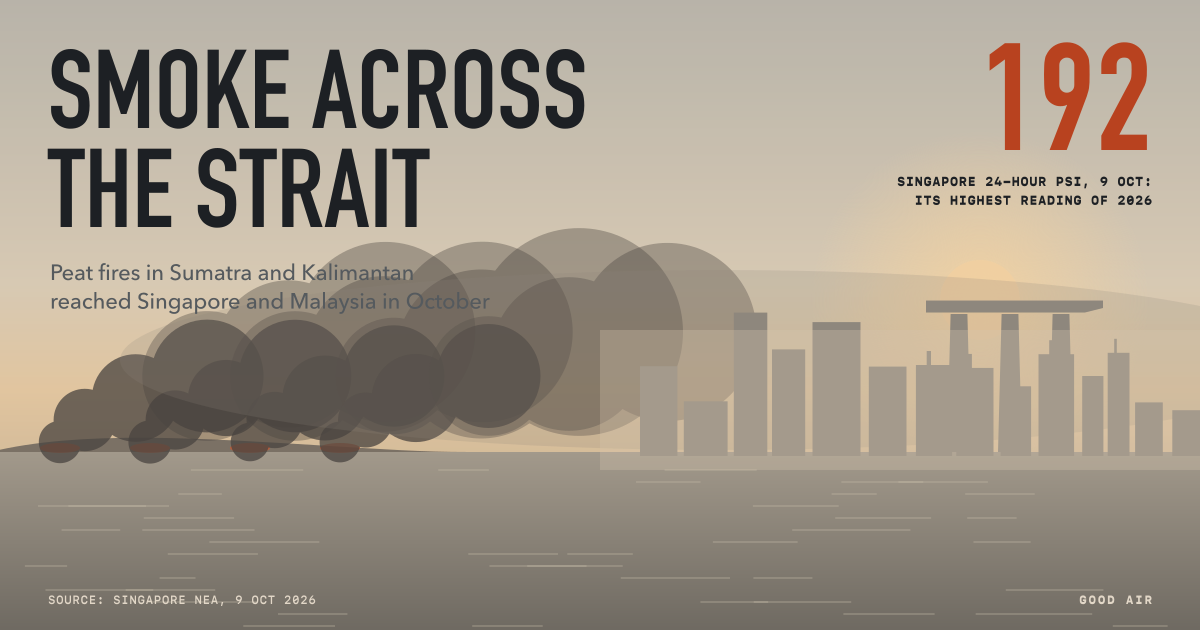
Smoke from Kalimantan is also reaching Singapore. At 7 pm on 17 October the 24-hour PSI was 130 to 199 (Unhealthy), with one-hour PM2.5 at 106 to 198 µg/m³. Singapore's National Environment Agency (NEA) forecast a 24-hour PSI of 150 to 220 for 18 October, Unhealthy to Very Unhealthy. It expects showers and a shift in the wind to the south from 18 to 20 October, which could cut the smoke arriving from Kalimantan, although smoke from Sumatra may still drift in (NEA, 17 October). Live readings for the region are on the Southeast Asia haze tracker.
How to protect yourself in hazardous haze
At ISPU above 300, everyone should stay indoors as much as possible. In practice:
- Stay inside with windows and doors shut. Make one room as clean as you can, with a HEPA purifier if you have one.
- Wear a well-fitted N95 or KN95 respirator if you must go out. Cloth and surgical masks let most fine smoke through. Our mask guide explains how to choose and fit one.
- Keep children, older people, pregnant women and anyone with asthma or heart disease indoors. See how to protect children from air pollution.
- Do not exercise outdoors, and avoid heavy exertion even indoors if the air is not filtered.
- Get medical help for chest pain, severe breathlessness or a cough that will not settle.
What each ISPU level means, and how it compares with the US AQI and Singapore's PSI, is in What is ISPU?. For the US AQI equivalents, see AQI 301 to 500.
When will the Kalimantan haze end?
Not until steady rain reaches the peatlands. Rain and a change in wind direction can bring days of relief, as NEA expects in Singapore from 18 to 20 October, but the smoke usually returns until the rainy season sets in properly over Kalimantan and Sumatra. We will update this page as the readings change.
Frequently asked questions
Is the air in Palangka Raya safe today?
No. At 9 pm WIB on 18 October 2026, Palangka Raya read ISPU 312, in the Hazardous (Berbahaya) category, on its government monitor. At that level everyone should stay indoors with windows closed, and wear an N95 or KN95 respirator if they have to go out. Check the live Palangka Raya page for the current reading.
What does ISPU Berbahaya mean?
Berbahaya means Hazardous, the highest of ISPU's five categories, used when the index is above 300. Indonesia's environment ministry treats it as air that can cause serious health effects across the population and needs a rapid response. People should stay indoors, keep children and vulnerable relatives inside, and avoid all outdoor exercise.
Has the Kalimantan haze reached Jakarta?
BMKG said on 16 October that satellite images showed smoke from Kalimantan over Banten, Jakarta and West Java, but about 2 to 3 km up, not yet at ground level. Jakarta's air was Unhealthy at some stations on 17 October, though how much came from the fires is unclear. At 9 pm WIB on 18 October, Jakarta averaged ISPU 80 (Moderate).
Why is the Kalimantan haze so bad in 2026?
Satellites have counted more fire hotspots in Kalimantan and Sumatra in 2026 than in any year since 2015: 38,511 by 13 October, according to ASMC. Many fires are in drained peatland, which smoulders underground for weeks and produces far more smoke than a forest fire. The smoke lingers until heavy rain arrives.