News · 5 min read
Delhi NCR moves to GRAP Stage 2 as the air turns Very Poor: the rules, and what comes next
CAQM invoked GRAP Stage 2 across Delhi NCR on 2 November 2026 when Delhi's AQI hit 324. What's banned, the latest AQI and when Stage 3 could follow.
 By the Good Air team

In this article · 5 sections
GRAP Stage 2 has been in force across the whole of Delhi NCR since Monday 2 November 2026. The Commission for Air Quality Management (CAQM) invoked it "with immediate effect" after Delhi's 24-hour average AQI reached 324 (Very Poor) at 4 pm, up from 261 a day earlier and 117 on 31 October (CPCB, 2 November; ETV Bharat, 2 November). On Tuesday 3 November it rose again, to 350, still Very Poor (CPCB, 3 November).
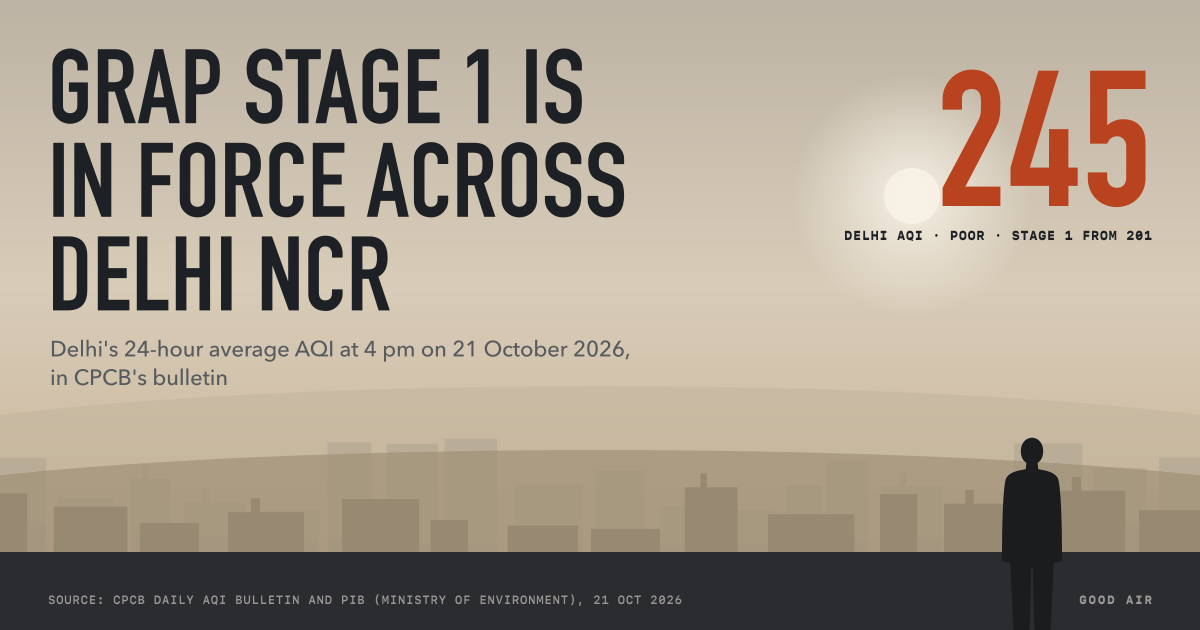
Stage 2 of the Graded Response Action Plan (GRAP) sits on top of the Stage 1 measures in place since 21 October. It raises parking fees, staggers office hours, steps up road cleaning and bans coal and firewood in eateries. It does not close schools or ban older cars; those are Stage 3 measures, which start when Delhi's daily AQI passes 400.
Key points
- Invoked: 2 November 2026 by CAQM's GRAP sub-committee, for the entire NCR, with immediate effect. CAQM cited "a sharp rise" in pollution and said IMD and IITM forecasts show the AQI staying Very Poor in the coming days (The Week, 2 November).
- Trigger: Delhi's 24-hour AQI of 324 at 4 pm, inside the Very Poor band (301 to 400) that Stage 2 covers. Delhi's figure came from 58 of its 59 stations.
- The next day: 350 on 3 November, from 57 of 59 stations. Gurugram (305), Manesar (309), Bahadurgarh (324), Ballabgarh (319) and Baghpat (360) were also Very Poor.
- Hotspots: On 2 November, Jahangirpuri reached 436, Rohini 415 and Punjabi Bagh 413, in the Severe range (India.com, 3 November). These single monitors don't decide the GRAP stage; the city average does.
- What's next: Stage 3 applies from 401 (Severe). Diwali is on Sunday 8 November, and IMD forecasts no rain in Delhi up to 9 November.

Delhi NCR's AQI on the first two days of Stage 2
CPCB's 4 pm bulletin gives each city's India NAQI as the average of the past 24 hours. These are the figures CAQM works from.
| City | 2 November | 3 November | Category on 3 November |
|---|---|---|---|
| Baghpat | not listed | 360 | Very Poor |
| Delhi | 324 | 350 | Very Poor |
| Bahadurgarh | not listed | 324 | Very Poor |
| Ballabgarh | 278 | 319 | Very Poor |
| Manesar | 211 | 309 | Very Poor |
| Gurugram | 246 | 305 | Very Poor |
| Noida | 330 | 291 | Poor |
| Ghaziabad | 289 | 235 | Poor |
| Greater Noida | 289 | 189 | Moderate |
| Faridabad | 115 | 106 | Moderate |
Source: CPCB daily AQI bulletins at 4 pm on 2 November and 3 November. PM2.5 was the main pollutant in Delhi on both days.
The air moved around the region rather than worsening everywhere at once. Noida, Ghaziabad and Greater Noida improved on 3 November while the cities to the west and south-west of Delhi, along the Haryana side, got worse. Westerly winds of 10 to 15 km/h blew over Delhi on 3 November, and the air at Safdarjung was calm at 5:30 pm (IMD New Delhi, 3 November, 8:45 pm).
What GRAP Stage 2 means for you
Most measures are orders to government agencies. The ones you are most likely to notice (Asianet Newsable, 2 November; India TV, 2 November; The Week, 2 November):
- Parking costs more. Parking fees go up to discourage private car trips.
- Staggered office hours in Delhi, Gurugram, Faridabad, Ghaziabad and Gautam Buddh Nagar. CAQM moved this to Stage 2 in its November 2025 revision (All India Radio News, 22 November 2025).
- More Metro and bus services, with more CNG and electric buses.
- No coal or firewood in tandoors at hotels, restaurants and open eateries; only electric or gas appliances.
- More road cleaning: mechanised sweeping, water sprinkling with dust suppressants and anti-smog guns at hotspots, every day.
- Electric heaters for staff. Resident welfare associations must give heaters to security guards, sanitation and garden staff so they don't light open fires in the cold.
- Tighter checks on polluting vehicles, pollution under control (PUC) certificates, industry, brick kilns and power plants (ETV Bharat, 2 November).
Everything from Stage 1 also stays in force: dust rules at building sites, the ban on open burning, curbs on diesel generators and the ban on BS-IV and older inter-state buses entering the NCR. Separately, Delhi's own Winter Action Plan bars petrol and diesel vehicles registered outside Delhi that are not BS-VI until 31 January, with exemptions for CNG and electric vehicles (India TV, 2 November). Check Delhi Traffic Police for the exact terms before you drive in.
We could not open CAQM's own Stage 2 order on its website, so this list rests on news reports of the order. Our GRAP explainer sets out every stage and what changed for winter 2026.
How long Stage 2 may last, and what could trigger Stage 3
Nothing in the forecasts points to clean air before Diwali.
- No rain. IMD's seven-day forecast, issued at 8:45 pm on 3 November, shows no rain, mainly clear skies and morning mist every day to 9 November. Winds stay light and north-westerly, 5 to 20 km/h, then turn south-easterly on Diwali day, 8 November (IMD New Delhi, 3 November). Rain was what cleaned Delhi's air in late October, each time for only a day or two (our analysis).
- IITM's air quality forecast shows Delhi Very Poor from 3 to 5 November (India.com, 3 November).
- Diwali. The Supreme Court allows certified green crackers on 7 and 8 November, from 6 to 7 am and 8 to 10 pm only (The Week, 2 November). Our Diwali 2026 guide has the rules and how to protect your home.
Stage 3 comes in when Delhi's daily average passes 400, or earlier if forecasts show it about to. It bans most construction, restricts BS-III petrol and BS-IV diesel cars and can move primary classes online. Our guide to what GRAP Stage 3 bans lists every measure. Every November since 2018 has had Severe days in Delhi (our data).
How to protect yourself this week
- Check your own area, hour by hour. The city average hides big gaps: on 2 November, three Delhi monitors were above 400 while the city averaged 324. See Delhi by area and the Delhi NCR tracker.
- Time your outings. Our hourly data shows Delhi's air is usually cleanest from about noon to 5 pm and worst late at night (analysis).
- Keep windows shut on bad nights and run a purifier sized for the room (room-size guide).
- Wear a well-fitted N95 or FFP2 mask outdoors if you must be out for long (mask guide).
- Children, older adults and anyone with heart or lung disease should cut strenuous outdoor activity at Very Poor levels. Follow your doctor's advice.
Frequently asked questions
What is banned under GRAP Stage 2 in Delhi?
Coal and firewood in tandoors at hotels, restaurants and eateries, on top of every Stage 1 rule such as the ban on open burning. Stage 2 also raises parking fees, staggers office hours and steps up road cleaning. Construction and older cars are not banned until Stage 3.
When was GRAP Stage 2 imposed in 2026?
On Monday 2 November 2026, with immediate effect across the NCR, after Delhi's 24-hour AQI reached 324 at 4 pm.
Are schools closed under GRAP Stage 2?
No. Stage 2 does not close schools. Moving primary classes to hybrid teaching is a Stage 3 measure, and wider closures belong to Stage 4.
When will GRAP Stage 3 be imposed?
Stage 3 applies when Delhi's daily AQI passes 400, or when forecasts show it will. As of 3 November Delhi was at 350 and Stage 3 had not been invoked. The live tracker shows the stage in force today.
Does GRAP Stage 2 apply in Noida and Gurugram?
Yes. GRAP covers the whole National Capital Region, including Noida, Greater Noida, Ghaziabad, Gurugram, Faridabad and Sonipat.