Seasonal · 4 min read
Diwali 2026 and air pollution: firecracker rules and how to protect your family
Diwali is on 8 November 2026. Are firecrackers allowed in Delhi NCR? The latest Supreme Court hearings, green crackers, and how to protect your family.
 By the Good Air teamUpdated · First published 14 October 2026

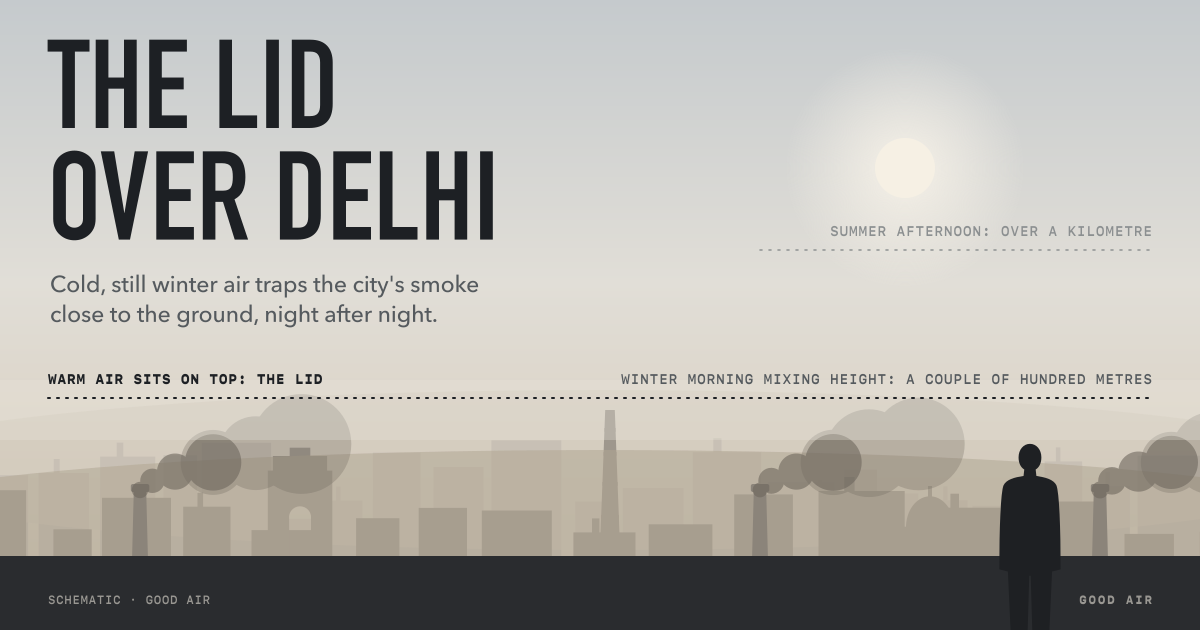
Diwali falls on Sunday, 8 November 2026. For Delhi and much of North India, that lands in the middle of the season when cold, still air already traps pollution close to the ground. Fireworks on the night add a short, sharp spike of fine particles and metal-laden smoke.
This guide covers what is decided about firecrackers so far, what happens to the air, and practical steps to protect your family.
Firecracker rules for Diwali 2026
The rules are still being settled.
- On 30 September 2026, a Supreme Court bench of Justices M.M. Sundresh and A.G. Masih, hearing Arjun Gopal v. Union of India, said it would not impose a total ban on firecrackers. It accepted the Centre's proposal on joined "lari" crackers (Organiser, 3 October).
- A study by NEERI, the national environmental engineering institute, on low-barium cracker formulations was due around 15 October (WeNotice, 5 October).
- Delhi NCR's ban stays in force for now. On 12 October 2026, a bench of Chief Justice Surya Kant and Justices Joymalya Bagchi and V. Mohana, hearing the Delhi-NCR air pollution case, issued no directions and left the existing ban in place. It asked the Commission for Air Quality Management (CAQM), the body that runs Delhi NCR's pollution plan, to take a view, and listed the matter for 15 October (LawBeat, 12 October).
- The Chief Justice said the court "has to be extremely careful before passing any order", and floated asking people to burst crackers minimally and only at set hours, and restricting the sale of harmful kinds. Justice Bagchi said the court's concern was health (Millennium Post, 13 October).
- As of 17 October 2026, we could find no report of an order from the 15 October hearing. Until the court rules otherwise, the complete ban on firecrackers in Delhi NCR that the Supreme Court ordered in December 2024 remains in force.
What happened last year: in October 2025, the Supreme Court relaxed the Delhi NCR ban for Diwali, allowing green crackers approved by NEERI to be sold through designated sellers and burst between 18 and 21 October within fixed time slots (LawBeat, 12 October 2026). A similar arrangement is one of the options in front of the court this year.
In past years, courts and state governments have limited sales to "green crackers", which are certified to emit less, and restricted bursting to a short window on Diwali night. Check your state's and district's orders closer to the date. We will update this guide when the Delhi NCR order is out; our Delhi air pollution tracker carries the latest.
What fireworks do to the air
Firecrackers release fine particles (PM2.5 and PM10), sulphur dioxide and metals such as barium, strontium, copper and aluminium, which give fireworks their colours. On a calm winter night these stay close to the ground.
In Delhi, the hourly PM2.5 readings on Diwali night and the following morning are typically among the highest of the year. The effect fades over one to two days if the wind picks up, but it adds to a baseline that is already high.
The health effects are immediate for some people: coughing, wheezing and asthma attacks, irritated eyes, and a higher risk of heart attacks in people with heart disease. Smoke and noise also distress pets and street animals.
How to protect your family

Before Diwali
- If someone at home has asthma or COPD, check their inhaler and medicine supply and their action plan with a doctor.
- Get well-fitting N95 or FFP2 masks, including child sizes.
- If you have an air purifier, change or clean the filter.
On the night
- Keep children, older relatives and anyone with heart or lung conditions indoors during the peak hours of bursting, usually 8 pm to midnight.
- Close doors and windows and run an air purifier in the room where vulnerable family members will sleep.
- If you do go out, wear an N95 or FFP2 mask and stand back from the bursting area.
- Choose quieter ways to celebrate: diyas, lights, rangoli, and community displays instead of firing crackers at home.
The morning after
- Don't rush to open windows or go for a morning walk; the air often stays bad until late morning. Check the live AQI for your city first.
- Postpone outdoor exercise until the reading falls back.
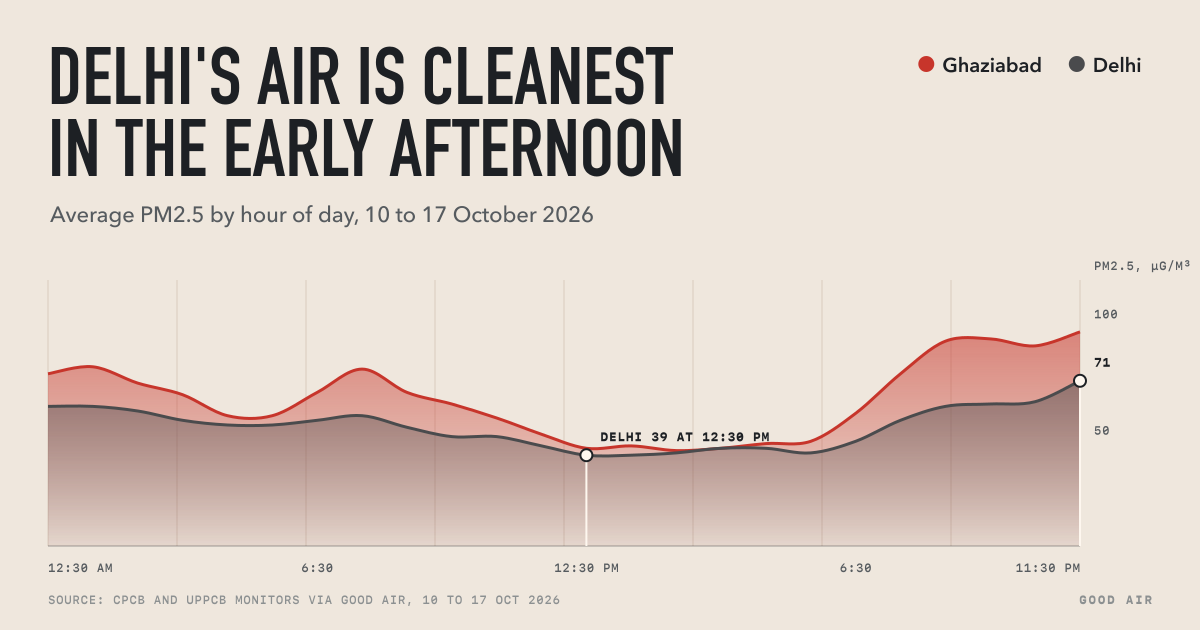
- If you want to air the house, the early afternoon is usually the cleanest time; our hourly data for Delhi NCR shows why.
- A dry cough or sore throat after a smoky night is common; see what helps a pollution cough and when to see a doctor.
Frequently asked questions
When is Diwali in 2026?
Diwali, Lakshmi Puja, is on Sunday, 8 November 2026.
Are firecrackers banned in Delhi for Diwali 2026?
As of 17 October 2026, yes: the complete ban on firecrackers in Delhi NCR ordered by the Supreme Court in December 2024 was still in force. On 12 October the court declined to relax it for now and asked CAQM for its view; no order from the follow-up hearing on 15 October had been reported. In 2025 the court allowed green crackers for four days in fixed time slots.
What are green crackers?
Firecrackers made to a formulation certified by CSIR-NEERI that cuts particulate emissions and avoids some of the most harmful chemicals, such as barium nitrate. They pollute less than conventional crackers but still pollute.
How long does Diwali pollution last?
The sharpest spike is usually on the night and the next morning. It typically eases over one or two days if winds pick up, but on calm, cold days it can merge with the wider winter smog.