News · 5 min read
GRAP Stage 1 is in force across Delhi NCR: what changes, and what it means for you
CAQM invoked GRAP Stage 1 across Delhi NCR on 21 October 2026 after Delhi's AQI hit 245 (Poor). The 25 actions, what's banned and what to do.
 By the Good Air team
In this article · 5 sections
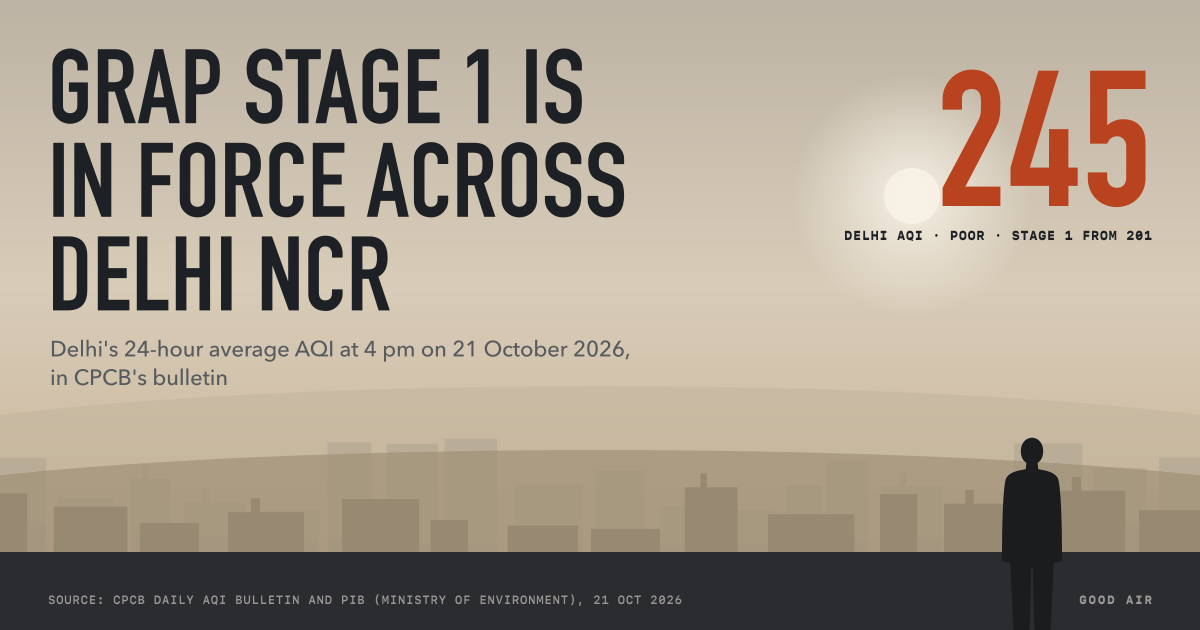
Stage 1 of the Graded Response Action Plan (GRAP), Delhi NCR's emergency plan for bad air, has been in force across the whole National Capital Region since Wednesday 21 October 2026. The Commission for Air Quality Management (CAQM) invoked it "with immediate effect" after Delhi's daily average AQI reached 244 at 2 pm and 245 at 4 pm, in the Poor category (PIB, Ministry of Environment, 21 October). A day earlier, Delhi's average was 179 (Moderate) (CPCB bulletin, 20 October).
Stage 1 switches on 25 actions for government agencies: tighter dust control at building sites, a stricter ban on burning waste, checks on polluting vehicles and diesel generators, and more buses and Metro trains. It does not close schools or ban private cars. Those measures belong to the higher stages.
Key points
- Invoked: 21 October 2026, by CAQM's GRAP Sub-Committee, for the entire NCR, with immediate effect (PIB, 21 October).
- Trigger: Delhi's 24-hour average AQI of 245 at 4 pm, in the Poor band (201 to 300) that Stage 1 covers.
- Not just Delhi: In the same bulletin, Greater Noida was at 280, Noida 249, Manesar 244, Ghaziabad 223 and Gurugram 216. Faridabad stayed Moderate at 123 (CPCB bulletin, 21 October).
- What's next: CAQM says it will review the situation "from time to time" using forecasts from IMD and IITM. Stage 2 applies when Delhi's AQI reaches 301 (Very Poor).
- Diwali falls on Sunday 8 November, with the worst of the smog season usually still ahead.

Delhi NCR's AQI on the day GRAP Stage 1 began
CPCB's 4 pm bulletin gives each city's India NAQI as the average of the past 24 hours. These are the figures CAQM uses.
| City | 20 October | 21 October | Category on 21 October |
|---|---|---|---|
| Greater Noida | 229 | 280 | Poor |
| Noida | 161 | 249 | Poor |
| Delhi | 179 | 245 | Poor |
| Manesar | 215 | 244 | Poor |
| Ghaziabad | 202 | 223 | Poor |
| Gurugram | 184 | 216 | Poor |
| Ballabgarh | 310 | 216 | Poor |
| Bahadurgarh | 196 | 205 | Poor |
| Faridabad | 120 | 123 | Moderate |
Source: CPCB daily AQI bulletins at 4 pm on 20 October and 21 October. Delhi's figure came from 55 of its 59 stations on 21 October. PM2.5 was the main pollutant in most cities.
What GRAP Stage 1 means for you
Most of the 25 actions are orders to government agencies, not rules for households. These are the ones you are most likely to notice (PIB, 21 October):
- Building sites. Dust rules must be enforced: covered materials and lorries, water sprinkling and anti-smog guns. Construction on plots of 500 square metres or more is not allowed unless the project is registered on the state's or Delhi government's dust-monitoring portal.
- Burning. The ban on open burning of leaves, crop waste and rubbish is to be strictly enforced, with the maximum environmental compensation for violations.
- Vehicles. Pollution under control (PUC) certificates are being checked. Visibly polluting vehicles can be impounded or fined the maximum. The ban on overage diesel and petrol vehicles is enforced, and trucks not bound for Delhi are diverted to the Eastern and Western Peripheral Expressways.
- Buses into the NCR. Inter-city and inter-state buses from Haryana, Uttar Pradesh, Rajasthan, Punjab, Himachal Pradesh, Madhya Pradesh, Uttarakhand and Jammu and Kashmir may run in Delhi NCR only if they are electric, CNG or BS-VI diesel.
- Restaurants. Coal and firewood are banned as fuel in tandoors at hotels, restaurants and open eateries; only electric, gas or other clean-fuel appliances are allowed.
- Diesel generators. They may not be used as a regular power supply. Small portable sets below 19 kW are permitted only for emergency services such as hospitals, lifts, the Metro and water pumping.
- Firecrackers. Court orders on firecrackers are to be strictly enforced.
- Getting around. Agencies are to add CNG and electric buses, raise Metro and RRTS frequency and introduce cheaper off-peak fares. Offices are encouraged to run shared commutes for staff.
Stage 1 does not stop most construction, close schools or restrict private cars. Those steps start at Stages 2 to 4. Our GRAP explainer sets out every stage.
Report polluting activity, such as rubbish burning or uncovered construction, on the 311 App, the Green Delhi App or CPCB's SAMEER App. CAQM has told agencies to act quickly on these complaints.
What CAQM asks citizens to do
CAQM's citizen charter for Stage 1 asks NCR residents to (PIB, 21 October):
- keep vehicles tuned, tyres properly inflated and PUC certificates up to date, and switch off engines at red lights
- use public transport or share rides, and prefer electric vehicles
- not burn or dump rubbish in the open, and use designated collection points
- avoid diesel generators except for essential needs
- celebrate festivals in an eco-friendly way and avoid firecrackers
- check the AQI on the SAMEER app and the GRAP stage in force on CAQM's website
What our monitors show, area by area
GRAP follows Delhi's 24-hour average. Hour-by-hour readings at individual monitors run much higher, especially at night. At 8 am India time on 22 October, 36 of the 71 Delhi NCR monitors reporting had an hourly India NAQI above 300, and the median monitor read 304. The highest readings were at:
- Vasundhara, Ghaziabad: 424
- Jahangirpuri, Delhi: 390
- Chandni Chowk, Delhi: 381
- Narela, Delhi: 372
- Indirapuram, Ghaziabad: 369
- Rohini, Delhi: 361
These are single-hour figures from Good Air's feed of CPCB-network monitors, not the official 24-hour average, and they change every hour. Each area page shows the live reading, its rank among NCR monitors, the last 30 days and the hours when its air is usually worst. Across Delhi NCR, the air has tended to be cleanest in the early afternoon, as our best time of day guide explains.
What comes next
CAQM's Sub-Committee said it would keep "a close watch on the air quality scenario" and review the stage using IMD and IITM forecasts (PIB, 21 October). Under this winter's GRAP schedule, Stage 2 applies when Delhi's AQI reaches 301 (Very Poor), Stage 3 at 401 (Severe) and Stage 4 above 450 (CAQM GRAP schedule). Each stage adds to the ones below it.
As of 9 am on 22 October we found no announcement of Stage 2. We will update this article if the stage changes. The Delhi air pollution tracker carries the latest stage and readings, and our Diwali 2026 guide covers the firecracker rules and how to protect your home.
To see which parts of Delhi NCR had the dirtiest air in the run-up to Diwali, read our ranking of the most polluted areas of Delhi.
Frequently asked questions
Is GRAP Stage 1 in force in Delhi now?
Yes. CAQM invoked Stage 1 across the whole of Delhi NCR on 21 October 2026, with immediate effect, after Delhi's 24-hour AQI reached 245 (Poor). As of 9 am on 22 October no higher stage had been announced. Check the stage in force on CAQM's website.
What is banned under GRAP Stage 1?
Open burning of waste and biomass, coal and firewood in restaurant tandoors, diesel generators as a regular power source, overage diesel and petrol vehicles, and construction on unregistered plots of 500 square metres or more. Inter-state buses must be electric, CNG or BS-VI diesel. Dust rules at building sites are strictly enforced.
Are schools closed under GRAP Stage 1?
No. Stage 1 does not close schools, stop most construction or restrict private cars. It covers dust control, waste burning, vehicle checks, diesel generators and more public transport. Stricter steps begin at higher stages, which apply from AQI 301.
What AQI triggers GRAP Stage 2?
Stage 2 applies when Delhi's 24-hour average AQI reaches 301, the Very Poor band. Stage 3 starts at 401 (Severe) and Stage 4 above 450. CAQM decides using CPCB's daily average and forecasts from IMD and IITM, so a stage can start before the threshold is reached.
How do I report pollution under GRAP?
Use the 311 App, the Green Delhi App or CPCB's SAMEER App, or the agencies' social media accounts. CAQM has told agencies to act quickly on complaints about rubbish burning, construction dust and polluting vehicles.


