Seasonal · 4 min read
Dhaka's smog season is back: why the air gets worse every winter, and how bad it gets
Dhaka air pollution is climbing into winter 2026, with the AQI reaching 213 on 6 October. Why the smog returns each year, when it peaks and how to stay safe.
 By the Good Air team
In this article · 7 sections
Dhaka's air pollution season has started early in 2026. On 6 October, Dhaka ranked as the most polluted major city in the world, with an AQI of 213 (Very Unhealthy) at 11:10 am (UNB via The Business Standard, 6 October). On the morning of 16 October, Good Air's reading from 14 monitors in Dhaka was a US AQI of 192, Unhealthy.
Dhaka's air is usually worst from December to February and cleanest during the June to September monsoon (The Daily Star, 16 March 2025). October is when the slide begins, as the rain stops and the brick kilns around the city start firing.
How bad is Dhaka's air right now?
The first half of October 2026 has been Unhealthy on most mornings:
| Date | Dhaka AQI | Source |
|---|---|---|
| 5 October 2026 | 179, Unhealthy; second worst of major cities | IQAir via Pressenza |
| 6 October 2026 | 213, Very Unhealthy; worst in the world | IQAir via UNB |
| 16 October 2026 | 192, Unhealthy | Good Air, 14 monitors |
On 5 October, two neighbourhoods were worse than the city average: BIDS in Agargaon at 188 and Becharam Deuri in Old Dhaka at 186 (Pressenza, 5 October). Readings move by the hour, and apps that use different monitors give different numbers. The Dhaka air quality page shows the latest from each monitor we track, and Bangladesh's page ranks other cities.
Why does Dhaka's air get worse in winter?
Several things change at once when the monsoon ends:
- The rain stops. Monsoon rain washes particles out of the air. From October there is little rain until spring.
- The wind drops and the air stagnates, so pollution builds up near the ground instead of blowing away.
- The brick kilns start. Kilns on the city's edge fire through the dry season. North-westerly winter winds carry their smoke, and pollution from further away, into the city.
- Construction and dust. Building sites and road digging that don't spray water or cover materials, and sand filling, add dust.
- Traffic. Old, high-emission vehicles in congested streets.
- Burning. Open burning of rubbish and plastic.
Sources: Pressenza, 5 October 2026; The Daily Star, March 2025.
Cold nights add a temperature inversion: a layer of cold air at the ground under warmer air, which acts like a lid until the morning sun breaks it up. That is why early mornings are often the worst time of day.
Where does Dhaka's pollution come from?
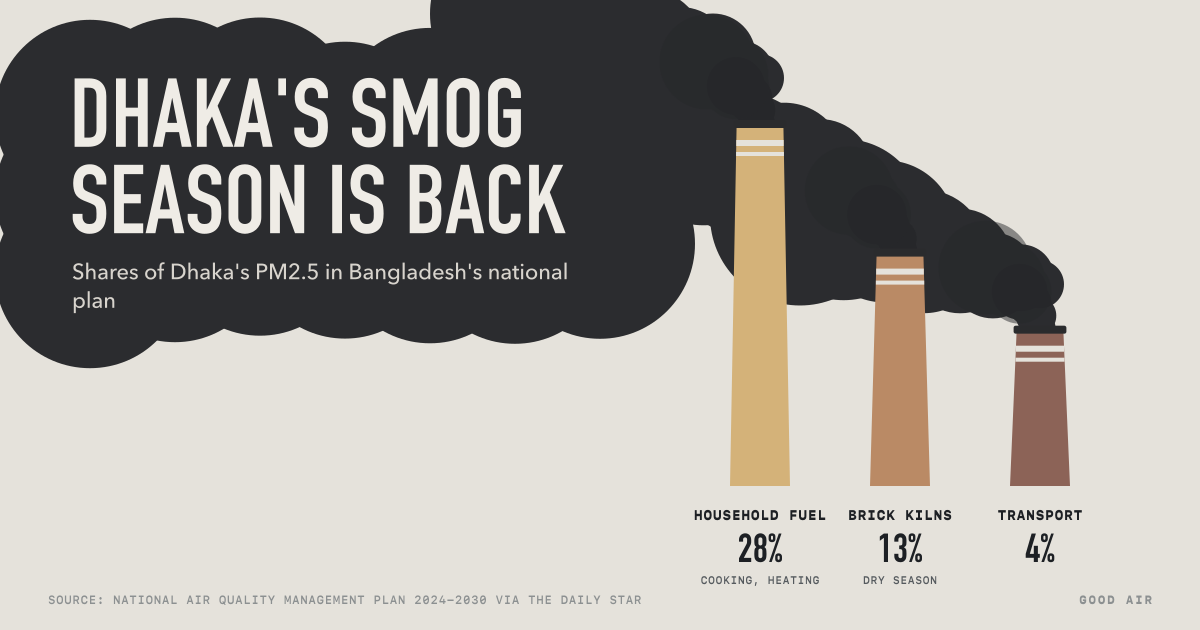
Studies disagree. Bangladesh's National Air Quality Management Plan 2024 to 2030 gives household fuel burning the largest share of Dhaka's PM2.5, 28%, with brick kilns at 13% and transport the smallest at 4%. An older study by the Norwegian Institute for Air Research, from 2015, found industry was the biggest source (The Daily Star, March 2025).
A World Bank study of Dhaka in 2022 measured where people breathe the dirtiest air. PM2.5 was highest near major construction sites with heavy traffic, 150% above WHO's 24-hour guideline of 15 µg/m³, followed by areas near brick kilns, 136% above it (World Bank, 8 December 2022).
PM2.5 is the fine dust, 2.5 micrometres or smaller, that reaches deep into the lungs. Our explainer on PM2.5 vs PM10 covers the difference.
How bad does it get in winter?
Last winter shows what is coming. Between 25 January and 23 February 2025, Dhaka had 18 Unhealthy days, 15 Very Unhealthy days and one Hazardous day, with an average AQI of 203 (The Daily Star, March 2025). On the US scale used in these counts, 151 to 200 is Unhealthy, 201 to 300 Very Unhealthy, and 301 and above Hazardous.

Professor Ahmad Kamruzzaman Majumder, an air quality researcher, warned in early October that without strict enforcement of High Court directives on pollution, this season "could surpass all historical records" (Pressenza, 5 October).
The health cost is large. The World Bank estimated that air pollution caused 78,145 to 88,229 deaths in Bangladesh in 2019. It found that children under five, people over 65 and people with heart or lung disease, diabetes or allergies are most at risk.
Dhaka's smog season, month by month
| Months | What to expect |
|---|---|
| June to September | Monsoon rain; the cleanest air of the year, though still above WHO guidelines |
| October to November | Rain stops, kilns start, the AQI climbs into the Unhealthy range on many mornings |
| December to February | The worst months; Very Unhealthy days are common |
| March to May | Particle pollution eases; ground-level ozone rises in summer |
Source: The Daily Star, March 2025.
What is Bangladesh doing about it?
The National Air Quality Management Plan aims to cut average PM2.5 to 30 µg/m³ in Dhaka and 15 µg/m³ nationally by 2030. Researchers writing in The Daily Star called the plan weak, because it makes suggestions rather than binding rules, and noted that only 4 of the country's 16 official monitoring stations are in Dhaka (The Daily Star, March 2025).
What is not known yet is whether enforcement will be stricter this winter. As of 16 October 2026, we found no new government measures announced for the season.
How to protect yourself in Dhaka
Health professionals quoted by Pressenza on 5 October recommend:
- Wear an N95 or KN95 mask outdoors. Our guide to N95, KN95 and FFP2 masks explains fit.
- Keep windows closed when pollution peaks, and run an air purifier if you have one.
- Avoid hard outdoor exercise early in the morning, when the air is often worst.
- Take extra care with children. Our guide on protecting children from air pollution sets out what to do at each AQI level.
Frequently asked questions
Why is Dhaka's air pollution so bad in winter?
When the monsoon ends in October, rain stops washing particles out of the air, winds weaken and pollution stagnates near the ground. Brick kilns around Dhaka start firing for the dry season, and winter winds carry their smoke into the city, adding to traffic, construction dust and waste burning.
What is Dhaka's AQI today?
On the morning of 16 October 2026, Good Air's reading from 14 monitors put Dhaka at a US AQI of 192, Unhealthy. On 6 October 2026, Dhaka was ranked the most polluted major city in the world at 213. Readings change hourly; Good Air's Dhaka page shows the latest.
When is air pollution worst in Dhaka?
Dhaka's air is usually worst from December to February and best during the June to September monsoon. Between 25 January and 23 February 2025, Dhaka had 18 Unhealthy, 15 Very Unhealthy and one Hazardous day. Early mornings are often the worst time of day.
Do brick kilns cause Dhaka's air pollution?
Brick kilns are one of several major sources. Bangladesh's National Air Quality Management Plan puts their share of Dhaka's PM2.5 at 13%, behind household fuel burning at 28%. A World Bank study found PM2.5 near brick kilns was 136% above WHO's 24-hour guideline. Kilns matter most in the dry season, when they operate.
Is it safe to visit Dhaka in winter?
Healthy travellers can visit, but expect many Unhealthy days from November to February. Check the live AQI each morning, carry an N95 or KN95 mask, and plan outdoor time for the afternoon rather than early morning. People with asthma, heart or lung disease should take extra care.