Seasonal · 5 min read
Hanoi's pollution season has begun: why the haze is back and how long it lasts
Hanoi's air reached US AQI 221 on 14 October 2026 as the smog season began. What causes it, how long it lasts, and what to do on bad days.
 By the Good Air team
In this article · 6 sections
Hanoi's 2026 pollution season has started. On 14 October 2026, Good Air's reading from the government monitors of Vietnam's Center for Environmental Monitoring (CEM) put Hanoi at a US AQI of 221, in the Very Unhealthy band and the highest of any Vietnamese city we track. Haze has covered the capital since at least 12 October, and Hanoi's environment department says such episodes usually start in October and run through the dry season to March (VietnamPlus, 13 October).
The short version: expect more smoggy mornings over the next five months, worst on calm, clear nights with a big gap between day and night temperatures. Check the live reading before going out.
How bad is Hanoi's air today?
The haze arrived over the weekend. On the morning of 12 October, IQAir's index for Hanoi was in the red (Unhealthy) band, and the Ba Dinh and Tay Ho districts reached purple, which is worse (Dan Tri International, 12 October). By the evening of 13 October, IQAir listed Hanoi among the most polluted major cities in the world, alongside Kuala Lumpur, Singapore and Jakarta (IQAir, 13 October).
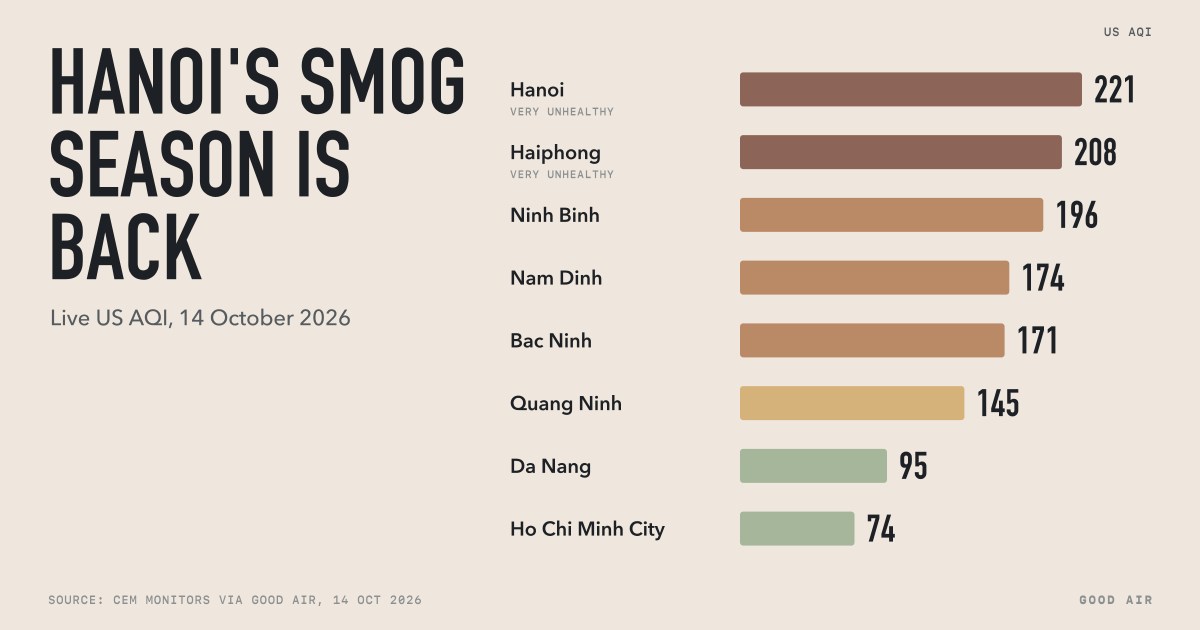
On 14 October, Good Air's live list for Vietnam looked like this. The north is in smog; the centre and south are not.
| City | US AQI, 14 October 2026 | Band |
|---|---|---|
| Hanoi | 221 | Very Unhealthy |
| Haiphong | 208 | Very Unhealthy |
| Ninh Binh | 196 | Unhealthy |
| Nam Dinh | 174 | Unhealthy |
| Bac Ninh | 171 | Unhealthy |
| Quang Ninh | 145 | Unhealthy for Sensitive Groups |
| Da Nang | 95 | Moderate |
| Ho Chi Minh City | 74 | Moderate |
Readings differ between apps because each uses different monitors and averaging. Our Hanoi figure comes from CEM's official stations. The Hanoi air quality page updates through the day.
Why is the haze back in October?
Two things change in Hanoi in October: the rain stops and the nights get cooler.
Clear skies let the ground lose heat quickly after dark. A layer of cold air forms at the surface under warmer air above. This is a temperature inversion, and it acts like a lid. Smoke and exhaust stay trapped near the ground until the morning sun warms the surface again. Dan Tri reported that forecasts for the week of 12 October called for continued dry, sunny weather and large swings between day and night temperatures, so the haze was expected to last several days.
Rain clears the air, and October to March is Hanoi's driest stretch. That is why pollution periods in Hanoi mainly fall between October and March of the following year, as VnExpress reported from the environment department's own reports (VnExpress International, 15 November 2024).
Where does Hanoi's PM2.5 come from?
PM2.5 is the fine dust, under 2.5 micrometres across, that reaches deep into the lungs. It is the pollutant that drives Hanoi's AQI. Vietnam's Environment Department, under the Ministry of Agriculture and Environment, gives this breakdown for Hanoi and other big cities:
- Secondary particles: 27%. These form in the air from gases such as nitrogen oxides and sulphur dioxide.
- Road transport: 23%.
- Construction and road dust: 20%.
- Open burning of waste and crop residue: 12%.
- Industry: 10%.
- Other sources: 8%.

The burning share matters more in October and November, when farmers around the capital clear their fields after the rice harvest. Smoke from Indonesia's fires, which has pushed Singapore and Malaysia into haze this month, is a separate problem further south. IQAir's regional alert of 13 October blamed the Indonesian fires for the smoke across the region but gave no Hanoi-specific cause. Our Southeast Asia haze tracker follows that story.
Is Hanoi's air getting better?
On the official numbers, 2026 started better than recent years. Nguyen Minh Tan, deputy director of the Hanoi Department of Agriculture and Environment, said 74.42% of days from 1 January to 29 September were rated good or moderate, close to the city's target of over 75% (VietnamPlus, 13 October). Dan Tri reported that September 2026 was less polluted than in previous years.
The longer record is less encouraging. Surveys in 2022 and 2023 found Hanoi's average PM2.5 at 1.1 to 2.1 times Vietnam's national standard, and the World Health Organization recommends an annual average of no more than 5 µg/m³ (VnExpress International, 15 November 2024).
A good first nine months does not predict the winter. Associate Professor Hoang Anh Le of the VNU University of Science told Dan Tri that residents should not become complacent as a new season begins.
What is Hanoi doing about it?
The city says it is targeting three sources: traffic dust, construction dust and open burning (VietnamPlus, 13 October):
- Burning: monitoring systems for open burning, and more local inspections during the harvest.
- Construction: sites must cover work, spray water and wash vehicles before they leave.
- Streets: all 126 communes and wards must step up street cleaning and road washing.
- Traffic: a low-emission zone pilot began on 1 July in Hoan Kiem ward, and car emission tests began in March. Within Ring Road 1, petrol motorcycles still make up about 94% to 97% of vehicles.
- Buses: 875 of the city's 1,977 buses have been converted to cleaner power, 44.3% of the fleet.
A plan to strengthen pollution control and response is due this month. As of 14 October it had not been published.
How to protect yourself this season
General advice from Dan Tri's experts and international health agencies is consistent:
- Check the hour, not the day. Hanoi's air is usually worst late at night and early in the morning, when the inversion is strongest. If you exercise outdoors, the afternoon is often cleaner. Our guide on when it is safe to exercise outside gives AQI thresholds.
- Shut windows on Very Unhealthy days and run an air purifier, if you have one, in the bedroom.
- Wear a well-fitted mask. Cloth and surgical masks do little against PM2.5. Our guide to N95, KN95 and FFP2 masks explains what to buy.
- Take extra care with children, older people and anyone with heart or lung disease. On the US AQI, they should cut back on long or hard outdoor activity from 101 upwards.
- Know the bands. Our explainer on AQI 201 to 300 sets out what Very Unhealthy means.
Frequently asked questions
When is Hanoi's pollution season?
Hanoi's pollution season usually runs from October to March. Hanoi's Department of Agriculture and Environment says pollution episodes begin to appear in October, and the dry season lasts from November to March. Calm, dry weather and cold nights trap pollution near the ground in these months.
What is Hanoi's AQI today?
On 14 October 2026, Good Air's reading from Vietnam's official CEM monitors put Hanoi at a US AQI of 221, Very Unhealthy, the worst in Vietnam. Readings change hourly. The live figure is on Good Air's Hanoi air quality page.
Is it safe to visit Hanoi in October?
Yes, for most healthy travellers, but plan for smoggy days. October brings the first haze episodes of the season. Check the live AQI each morning, plan outdoor sightseeing for the afternoon when air is often cleaner, and carry an N95 or KN95 mask. People with asthma or heart disease should take extra care.
Why is Hanoi's air worse than Ho Chi Minh City's?
On 14 October 2026, Hanoi read a US AQI of 221 and Ho Chi Minh City 74. Hanoi has a cool, dry winter with frequent temperature inversions that trap pollution. Ho Chi Minh City stays warm and gets more rain and wind, which disperse pollution, so its air is usually cleaner in the same months.
What causes air pollution in Hanoi?
Vietnam's Environment Department attributes Hanoi's PM2.5 to secondary particles formed from gases (27%), road transport (23%), construction and road dust (20%), open burning of waste and crop residue (12%), industry (10%) and other sources (8%).