Data stories · 10 min read
Is the haze over? Yes: Singapore cleared on 25 October, Malaysia on 26 October, Sumatra and Kalimantan on 9 November
Haze season 2026 is over. Singapore's PM2.5 fell from 102.7 to 15.0 µg/m³; Malaysia's last unhealthy day was 26 Oct and Indonesia's 9 Nov. Data by country.
 By the Good Air team

In this article · 8 sections
Yes, the 2026 haze season is over. In Singapore, mean PM2.5 fell from 102.7 µg/m³ (US AQI 184) in the worst week, 13 to 19 October, to 15.0 (US AQI 62) in 10 to 16 November, and no region's 24-hour PSI has been above 100 since 25 October. Malaysia's last day with more than one unhealthy station was 26 October, and Sumatra and Kalimantan, where the fires burned, had their last day with more than one unhealthy place on 9 November.
The region's weather watchdog agrees. The ASEAN Specialised Meteorological Centre (ASMC) lowered its haze alert for the southern ASEAN region to Level 0 on 12 November, which it says marks the end of the dry season (ASMC alerts; ASMC, both read 17 November). This is Good Air's count of the season from the government monitors we archive, with the rule we used for each country.
Key findings
- Singapore had 32 days with a 24-hour PSI above 100 in at least one region between 16 September and 25 October. Since then the highest reading has been 89. On 16 November the daily PM2.5 was 9.4 µg/m³ (US AQI 52).
- Malaysia had 919 station-days with an unhealthy API, 22% of all station-days from 16 September to 16 November. The worst day was 7 October, with 42 of 68 stations above 100. The peninsula cleared on 25 October and Sarawak, next to Kalimantan, a day or two later.
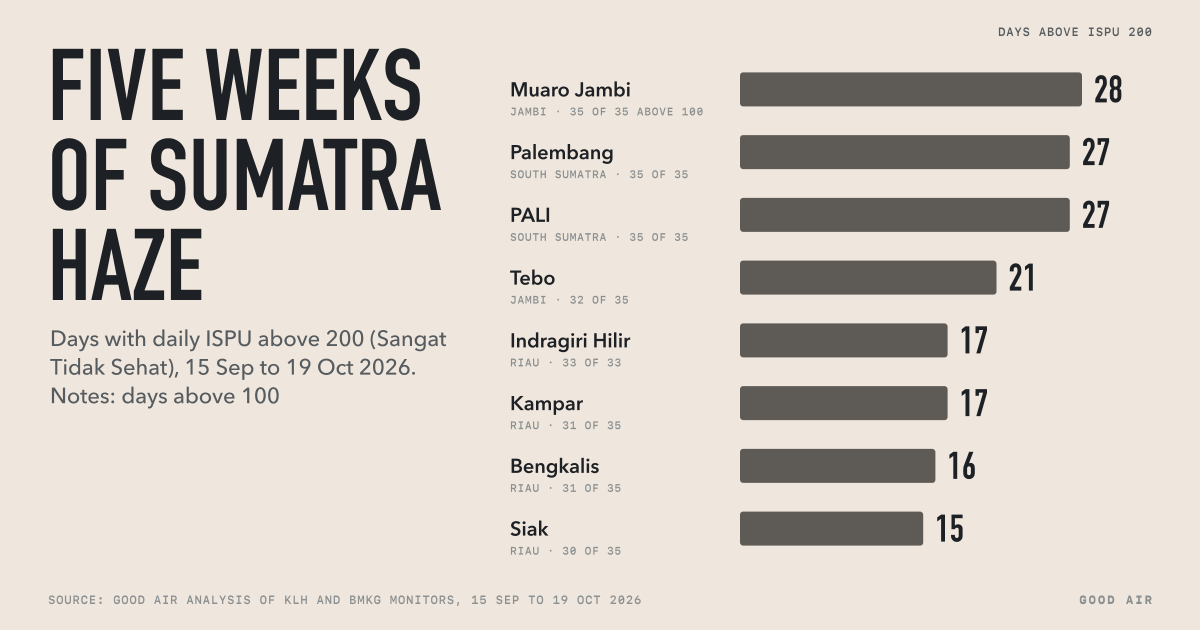
- In Sumatra, half of all place-days were unhealthy (713 of 1,439), peaking at 23 of 27 places on 17 October. In Kalimantan the share was 52% (589 of 1,125), and the true figure is higher, because 190 Kalimantan readings were impossible values we left out.
- On 16 November, none of the 16 Sumatran and 19 Kalimantan places with a usable reading was unhealthy. The last holdouts were single monitors: Penukal Abab Lematang Ilir (PALI) in South Sumatra until 13 November and Kapuas in Central Kalimantan, just over 100, from 13 to 15 November.
- The season started before our archive did. Singapore's 24-hour PSI was already 83 to 116 on 4 September, and our records begin on 15 September.
When did the 2026 haze season end?
Each country reports haze on its own 24-hour index: the Pollutant Standards Index (PSI) in Singapore, the Air Pollutant Index (API) in Malaysia and the Indeks Standar Pencemar Udara (ISPU) in Indonesia. On all three, 101 to 200 is Unhealthy. Our API vs PSI vs ISPU explainer shows how they compare. We used each country's own index, with one rule per country, over the 62 days from 16 September to 16 November.
| Country or region | Rule for an unhealthy day | Unhealthy days | Worst | Last unhealthy day |
|---|---|---|---|---|
| Singapore | Any region's 24-hour PSI above 100 | 32 days | PSI 230, 18 Oct | 25 Oct |
| Malaysia | Station's daily mean API above 100 | 919 of 4,139 station-days (22%) | 42 of 68 stations, 7 Oct | 26 Oct (6 stations) |
| Sumatra | Place's daily ISPU above 100 | 713 of 1,439 place-days (50%) | 23 of 27 places, 17 Oct | 9 Nov (2 places) |
| Kalimantan | Place's daily ISPU above 100 | 589 of 1,125 place-days (52%) | 16 places on four days, last on 12 Oct | 9 Nov (2 places) |
For Malaysia, Sumatra and Kalimantan, "last unhealthy day" means the last day with more than one station or place above 100. A single monitor can stay high for local reasons, and we explain each one below.
Singapore: below PSI 100 since 26 October
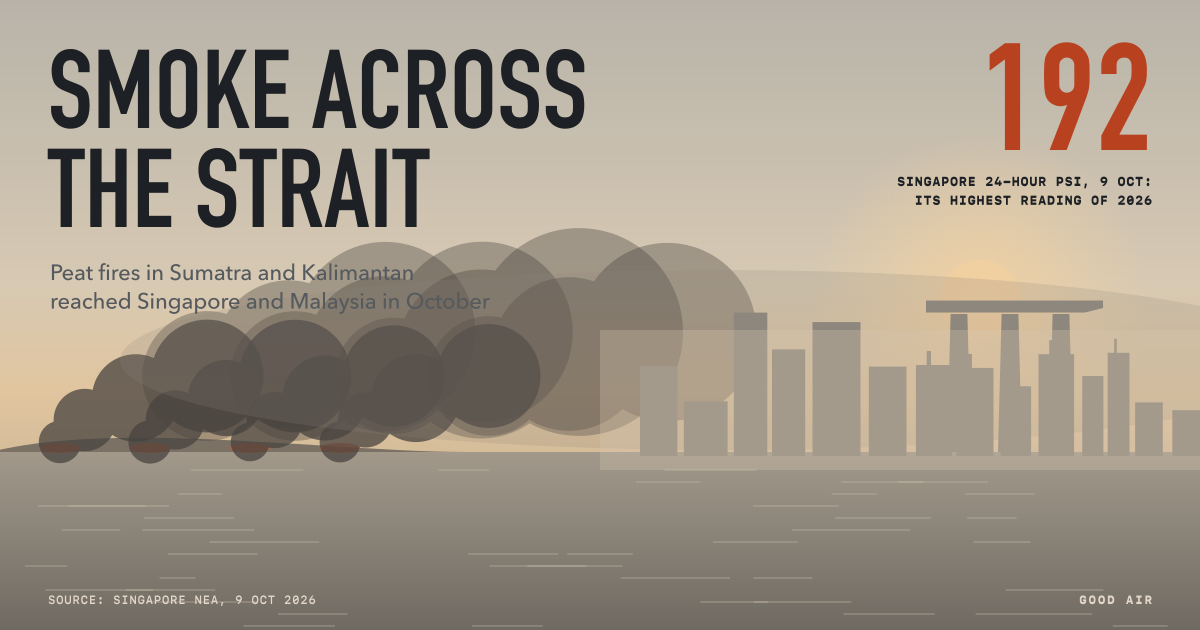
Singapore's worst week was 13 to 19 October, when daily PM2.5 averaged 102.7 µg/m³ across the island. The worst single day was 15 October, at 139.1 µg/m³ (US AQI 214). The highest 24-hour PSI in our archive was 230, in the West region, in the 24 hours from 8 am on 18 October. NEA's 8 pm reading on 16 October was 159 to 222 (NEA, 16 October).

The turn came on 25 October. At 7 pm that day the 24-hour PSI was 91 to 107, and NEA expected winds from the southwest or west and showers to keep the smoke away (NEA, 25 October). From 26 October the PSI stayed below 90 in every region, and daily PM2.5 never again passed 35.4 µg/m³, the top of the US AQI's Moderate band.
NEA issued its final haze update for the season on 7 November, when the 24-hour PSI was 51 to 55. Most government haze measures ended that day. The Ministry of Health's Haze Subsidy Scheme and Public Health Preparedness Clinic scheme were to be deactivated from 12 November (NEA, 7 November). Live readings are on our Singapore air quality page.
Malaysia: the last unhealthy day was 26 October
Malaysia's haze came in two big waves, in mid-September and through most of October. In the worst week, 13 to 19 October, an average of 30.3 of the 68 Department of Environment (DOE) stations were above API 100 each day. In 10 to 16 November it was 0.3, and the median station's API averaged 41, which is Good.
The stations with the most unhealthy days over the season were Nilai in Negeri Sembilan (31 days, on our Seremban page), then Pasir Gudang and Larkin in Johor Bahru, Cheras in Kuala Lumpur and Batu Pahat (30 each). That is the same Johor to Selangor belt our October count found: Malaysia haze October 2026, worst-hit areas.
The haze left the peninsula first. Its last unhealthy day was 25 October, when four stations were above 100: Batu Pahat, Kluang, Pasir Gudang and Paka. Sarawak, which borders Kalimantan, lasted longer: on 26 October all six unhealthy stations in Malaysia were in Sarawak, from Kuching and Serian to Sibu and Samalaju. MetMalaysia expected the northeast monsoon to begin on 27 October and to last until March 2027 (The Star, 23 October). After that, only two single stations went above 100:
- Samalaju in Sarawak, near Bintulu, on 27 October, peaking at 152, the tail of the Sarawak episode.
- Batu Muda in Kuala Lumpur from 13 to 15 November, peaking at 156. Every other Klang Valley station stayed at 91 or below in those days, which points to a local source rather than haze.
Measured as PM2.5, the 49 Malaysian cities we track averaged 10.9 µg/m³ (US AQI 54) from 10 to 16 November. Kuala Lumpur was highest at 23.1, partly because of Batu Muda. School closures during the haze are covered in Malaysia haze school closures.
Indonesia: Sumatra and Kalimantan cleared last
The smoke came from peat and forest fires in Sumatra and Kalimantan, and the air there stayed bad longest. In the worst week, the median Sumatran place averaged 163.7 µg/m³ of PM2.5 (US AQI 239) and the median Kalimantan place 98.0 (US AQI 181). From 10 to 16 November those figures were 25.4 (US AQI 81) and 24.5 (US AQI 80), Moderate on the US scale. Kalimantan's October figure is an underestimate: several of its smokiest monitors reported impossible values that week, and we left those days out.

The count of unhealthy places fell in steps. In Sumatra it averaged 20.9 a day in the worst week, 4.0 in the week from 2 November and 0.9 in the week from 9 November. On 9 November two places were still above 100 in each region: PALI and Indragiri Hilir in Sumatra, Barito Selatan and Tabalong in Kalimantan. All four are single monitors.
After that, only two places were unhealthy, one at a time:
- PALI, in South Sumatra, from 10 to 13 November. Its one monitor's daily PM2.5 was 61 to 90 µg/m³ while the rest of Sumatra cleared. It had the most unhealthy days in Sumatra, 53 of its 56 usable days. Muaro Jambi (49 of 62) and Ogan Ilir (45 of 62) came next.
- Kapuas, in Central Kalimantan, from 13 to 15 November, with a daily ISPU of 114, 103 and 102. On 16 November it was 88.
The regional picture matches. ASMC counted 13 and 1 hotspots in Sumatra and 3 and 54 in Kalimantan on 10 and 11 November, and said showers had suppressed the hotspots and smoke (ASMC alerts). Full season rankings are in Sumatra haze 2026, unhealthy days and Kalimantan haze. Live readings: Palembang, Pekanbaru, Palangka Raya and the Indonesia air quality page.
When did the haze season start?
Earlier than our data shows. Good Air's archive for the three countries begins on 15 September 2026, and on 16 September Singapore's PSI was already above 100 in one region and 40 of Malaysia's 68 stations were unhealthy.
ASMC's alerts give the outline. It declared the start of the dry season for the southern ASEAN region on 10 July, raised its alert to Level 2 on 3 August and to Level 3, its highest, on 26 August. It stepped down to Level 2 on 29 October, Level 1 on 5 November and Level 0 on 12 November (ASMC alerts). Smoke from Sumatra and Kalimantan was reaching Singapore by 4 September, when the 24-hour PSI was 83 to 116 at 7 pm (NEA, 4 September).
This was a late end. In ASMC's list since 2015, the southern dry season or its alert ended between 12 October (2022) and 20 November (2019). Only 2015, 2019 and 2023 ended later than this year's 12 November. Our day-by-day account of October is in Southeast Asia haze 2026.
Could the haze come back?
Not in the next few months, on the forecasts we found. ASMC expects haze to stay suppressed as the monsoon rains move south, though isolated hotspots may persist in dry areas (ASMC, read 17 November).
The next risk is the 2027 dry season. ASMC declared the start of the southern dry season between 29 May (2023) and 3 August (2020) in every year from 2017 to 2026 (ASMC alerts). A Universiti Malaya meteorologist, Prof Emeritus Datuk Dr Azizan Abu Samah, told The Star the reprieve could last from November to July 2027, when haze could return with slash-and-burn activity and the southwest monsoon. Two experts also warned that El Niño could bring drier weather in early 2027, including to northern Sarawak and Sabah (The Star, 26 October).
Single hours can still spike near a local fire, a busy road or industry. For deciding whether to go out now, the one-hour PM2.5 reading is the better guide than a 24-hour index, and the official advice is on NEA's haze site, the DOE's API portal and Indonesia's ISPU pages.
How we measured
- Data. Good Air's archive of government monitors: NEA's five Singapore regions, the DOE's 68 Malaysian stations, and Indonesia's KLH (ISPU) and BMKG (PM2.5) monitors, combined per city or regency as on our city pages. No satellite estimates, models or low-cost sensors.
- Days. UTC days, which run from 8 am to 8 am in Singapore, Malaysia and central Indonesia and from 7 am in western Indonesia. The archive starts on 15 September, a partial day, so our counts run from 16 September to 16 November (62 days). A day needs 18 hours of data; from 9 November we checked the hours carry real values.
- Indices. Singapore's PSI and Malaysia's API are the published 24-hour indices. Singapore's PM2.5 is the one-hour reading, averaged over the day. Malaysia's PM2.5 and US AQI in our archive before 24 October were computed with an outdated DOE table and are overstated, so for the season we used the API itself, and Malaysian PM2.5 only for 10 to 16 November.
- Indonesia. A place-day counts as unhealthy when its daily ISPU is above 100 and, where PM2.5 is reported, its daily PM2.5 is above 55.4 µg/m³, the ISPU's PM2.5 level for 100. That check removes days pushed over 100 by other pollutants or by short spikes. Daily ISPU values above 500 are impossible on the scale and treated as sensor errors: we left out 190 in Kalimantan and 33 in Sumatra. Days when a monitor read the same value all day (84) were dropped, as were three places with frozen monitors for most of the season: Pangkalpinang, Nagan Raya and Bandar Lampung.
- Faults found hour by hour. We checked every Indonesian reading above 100 from 9 to 16 November. Six were sensor faults and are not counted: Banjarmasin on 10 November (a PM2.5 reading that climbed to 542 µg/m³ while the same monitor's ISPU read 68), Kotawaringin Timur on 14 and 15 November (readings that climbed and reset within hours), and Pekanbaru on 14 to 16 November (single hours of up to 1,458 µg/m³ between hours mostly below 60).
- Gaps. BMKG's monitors were missing from 27 October to 1 November, so fewer places reported in those days. Many regencies have one monitor; we say so where we name them.
- Regions. Sumatra includes Batam and Bangka; places are grouped by monitor location. Medians are of places with at least five valid days in the week. US AQI is the US EPA's 2024 scale applied to the mean.
Frequently asked questions
Is the haze over in Singapore?
Yes. No region's 24-hour PSI has been above 100 since 25 October, NEA issued its final haze update of the season on 7 November, and from 10 to 16 November daily PM2.5 averaged 15.0 µg/m³ (US AQI 62).
Is the haze over in Malaysia?
Yes. The last day with more than one DOE station above API 100 was 25 October in Peninsular Malaysia and 26 October in Sarawak. From 10 to 16 November the median station's API was 41, Good. Batu Muda in Kuala Lumpur passed 100 from 13 to 15 November, but no other Klang Valley station did.
When did the 2026 haze season end in Indonesia?
In Sumatra and Kalimantan the last day with more than one unhealthy place was 9 November, and on 16 November none was unhealthy. ASMC lowered its alert to Level 0 on 12 November, marking the end of the dry season.
When will the haze come back?
Most likely with the next dry season. ASMC declared the start of the southern ASEAN dry season between late May and early August in every year from 2017 to 2026, and a Universiti Malaya meteorologist expects the reprieve to last until about July 2027.
Which country had the worst haze in 2026?
Indonesia, near the fires. In the worst week, 13 to 19 October, the median Sumatran place averaged 163.7 µg/m³ of PM2.5 (US AQI 239), against 102.7 (US AQI 184) in Singapore. Half of all Sumatran place-days had an unhealthy ISPU.