News · 7 min read
Santa Ana winds: Norte Fire forces 16,000 from homes as red flag warnings, heat and power shutoffs run through Saturday
Santa Ana winds in October 2026: the Norte Fire, 70,000 customers without power, red flag warnings and 95°F heat in Southern California until 17 October.
 By the Good Air teamUpdated · First published 15 October 2026
In this article · 8 sections
Santa Ana winds are blowing into Southern California from Thursday 15 October 2026, with gusts of 50 to 70 mph in the mountains of Los Angeles and Ventura counties and humidity as low as 8%. The National Weather Service (NWS) in Los Angeles expects the winds to last from 6 am Thursday to 8 pm Saturday 17 October, peaking from Thursday afternoon to Friday afternoon (Men's Journal via Yahoo News, 14 October).
Red flag warnings cover most of Los Angeles and Ventura counties, and Southern California Edison is considering cutting power to about 224,500 customers to stop its lines sparking fires (CBS Los Angeles, 14 October).
Latest: Norte Fire and the last day of the winds (17 October)
- Norte Fire. A wildfire that started at about 11:30 am on Friday 16 October near Portico Del Norte in San Clemente grew to 570 acres by Friday night, 0% contained, driven toward the coast by the Santa Ana winds. The Orange County Fire Authority confirmed six homes damaged or destroyed, mostly on the San Juan Capistrano side. About 16,000 residents and 4,600 homes across San Clemente and San Juan Capistrano were under evacuation orders, and Capistrano Unified dismissed ten schools early. Two firefighters were injured; no residents were hurt (NBC Los Angeles, 16 October; LAist, 16 October). The cause is not yet known.
- Power shutoffs. Southern California Edison had cut power to 69,746 customers by 7 am on Friday, 34,946 in Los Angeles County, including central and western Malibu and parts of Calabasas, and 34,800 in Ventura County. It said more shutoffs remained possible (FOX 11 Los Angeles, 16 October).
- Heat. Heat advisories run until 8 pm PDT on Saturday 17 October, with highs up to 95°F (35°C) on the Malibu and Ventura coast, the Central Coast and inland Orange County, and in the upper 80s to mid 90s on the Orange County and San Diego coasts. Offshore Santa Ana flow is what makes the coast this hot in October.
- Wind. The NWS in San Diego kept high wind warnings until 8 pm Saturday for the San Diego County valleys, with gusts of 45 to 55 mph in the eastern valleys and "widespread power outages" expected, and until midnight Saturday in the San Diego and Riverside County mountains, with gusts up to 50 mph. Red flag warnings in Los Angeles and Ventura counties run until 8 pm Saturday. The NWS in Los Angeles said winds would be weaker on Friday night and Saturday.
- Smoke. The NWS in San Diego issued an air quality alert for Orange County because of wildfire smoke. Check the live reading for San Diego and Los Angeles, and see our wildfire smoke guide.
The rest of this article was written on 15 October, at the start of the event.
What are Santa Ana winds?
Santa Ana winds are hot, dry winds that blow from the deserts toward the Southern California coast, usually between autumn and spring. They start when high pressure builds over the Great Basin, the high desert of Nevada and Utah, while pressure is lower off the coast. Air flows from high to low pressure, so it pours south-west over the mountains and down toward the sea. The bigger the pressure difference, the stronger the wind (WeatherNation, 22 December 2020).
As the air sinks, it is squeezed by higher pressure and warms up, and its humidity drops. NWS meteorologist Mark Jackson told WeatherNation that it can warm at almost 30°F per mile of descent. Hot, dry air moving fast dries out grass and brush quickly, and Santa Ana episodes can last from a day to several days in a row. The strongest gusts tend to come around sunrise, funnelled through passes and canyons.
The winds do not start fires. They make any fire that does start spread fast and far, and they carry embers ahead of the flames.
Where are the warnings, and when?
These warnings were in force on the morning of 15 October 2026 (Pacific time), from Good Air's feed of NWS alerts:
| Warning | Areas | Until |
|---|---|---|
| Red flag warning | Most of Los Angeles and Ventura counties, including the Santa Monica Mountains, Malibu Coast, Santa Clarita Valley and Santa Susana Mountains | 8 pm Saturday 17 October |
| High wind warning | Inland Empire (San Bernardino and Riverside valleys), San Diego County inland valleys | 8 pm Saturday 17 October |
| High wind warning | San Diego and Riverside county mountains, San Gorgonio Pass near Banning | Midnight Saturday 17 October |
| High wind warning | Western Santa Monica Mountains, I-5 corridor, San Gabriel Mountains and Highway 14 corridor | 8 pm Friday 16 October |
| Heat advisory | Coastal San Diego and Orange counties, Ventura County coast, Santa Barbara and San Luis Obispo coasts | 8 pm Saturday 17 October |
| Red flag warning | Sierra Nevada foothills and southern Sierra (Hanford and Sacramento offices) | Friday 16 October |
A red flag warning means that heat, wind and low humidity together create critical fire weather. The NWS wording for this event: "If fire ignition occurs, conditions are favorable for extreme fire behavior which would threaten life and property" (CBS Los Angeles, 14 October). The full, current list is on our US weather alerts page.
How strong will the winds be?
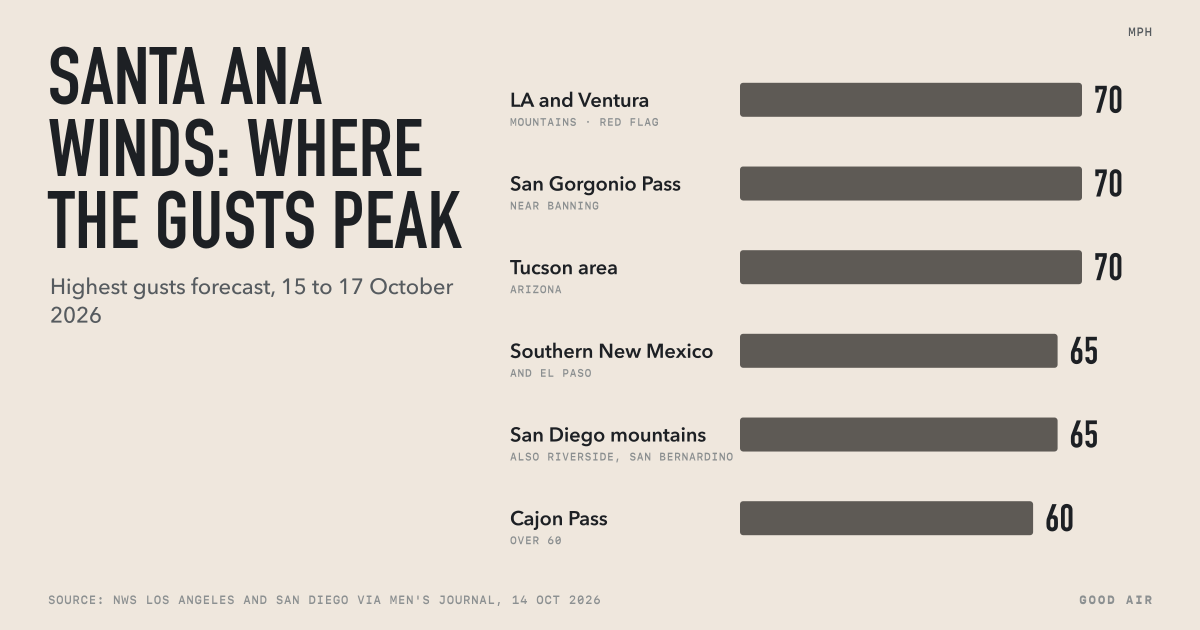
The NWS forecasts north-east to east winds of 20 to 40 mph across Los Angeles and Ventura counties, with these peak gusts (Men's Journal via Yahoo News, 14 October):
- Los Angeles and Ventura mountains: 50 to 70 mph.
- San Diego, Riverside and San Bernardino mountains: 50 to 65 mph, up to 70 mph below San Gorgonio Pass and over 60 mph near Cajon Pass. The NWS San Diego office warned: "Widespread power outages are expected."
- Beyond California: the same system could bring gusts of 55 to 70 mph to Tucson, Arizona, and up to 65 mph to El Paso and southern New Mexico.
The winds should ease slowly over the weekend of 17 and 18 October.
How hot will it get?
Very warm for October. ABC7 Los Angeles forecast inland temperatures in the 90s °F from Thursday, with beaches in the mid-80s (ABC7, 12 October). Heat advisories run until 8 pm Saturday on the coast from San Diego to San Luis Obispo. The NWS says the dry, hot air will cancel out the benefit of the recent rain (CBS Los Angeles, 14 October).
What are officials doing?
- Power shutoffs. Southern California Edison is considering Public Safety Power Shutoffs for about 224,500 customers in Los Angeles and Ventura counties, including parts of Malibu. Utilities cut power in high winds so that damaged lines cannot start fires.
- Firefighters. Los Angeles County Fire has prepositioned crews and aircraft, and the state is moving firefighters and equipment into Orange, Ventura, Los Angeles and Santa Barbara counties through Sunday 18 October.
- Parks. Several agencies have a new plan to close parkland on red flag days, starting on 15 October. Closures are usually announced the day before (Men's Journal via Yahoo News, 14 October).
- A first fire. The Los Angeles Fire Department stopped a brush fire of about 1.5 acres in Brentwood early on Wednesday 14 October.
Los Angeles County Fire Chief Anthony Marrone urged residents to prepare at once, and emergency managers said they were drawing on lessons from the January 2025 wildfires (CBS Los Angeles, 14 October).
What about air quality?
Before the winds arrived, the air was clean. At about 9 pm PDT on 14 October, Good Air's reading for Los Angeles was a US AQI of 43 (Good), with ozone the main pollutant, and San Diego was at 42. That can change fast in a Santa Ana event:
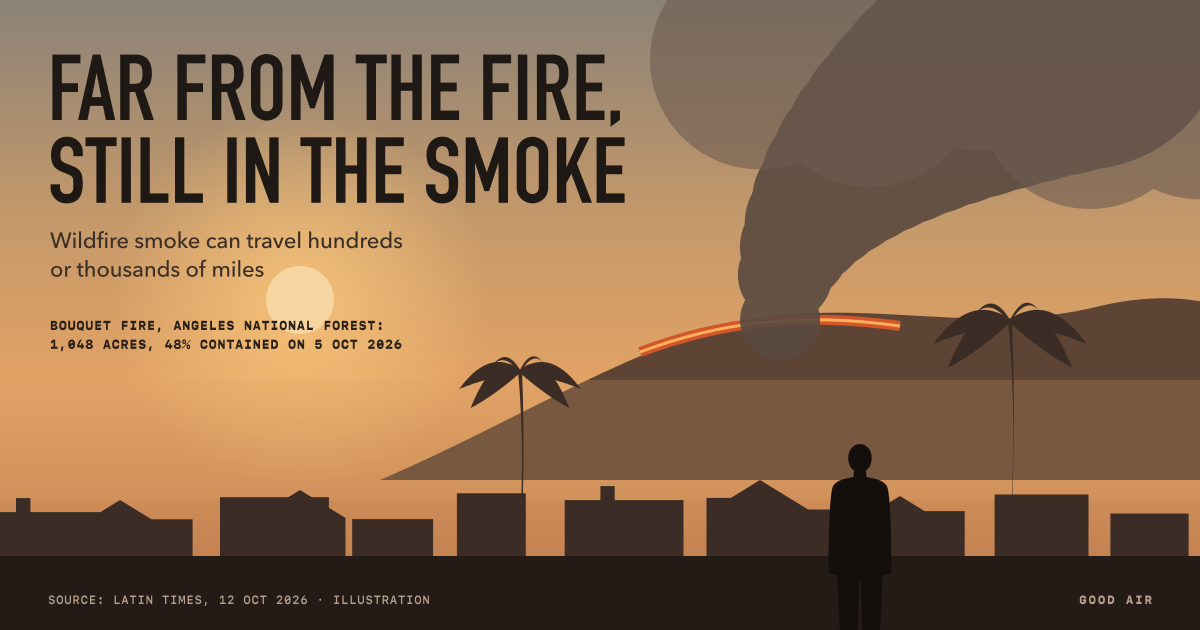
- Smoke: any wildfire will send smoke downwind, toward the coast and out to sea. Our wildfire smoke guide covers masks, purifiers and when to stay in.
- Dust: strong winds lift dust, which raises PM10, the coarse particles explained in PM2.5 vs PM10.
- Live data: the Los Angeles air quality page and our US wildfire smoke tracker update through the day.
How to prepare

- Sign up for local alerts from your county and utility, and know your evacuation zone and two ways out.
- Charge phones and power banks, and keep a torch and a battery radio in case the power is cut.
- Clear dry leaves and anything flammable from gutters, decks and the area around your home.
- Don't use anything that sparks outdoors: no mowers, grinders, barbecues or campfires during a red flag warning.
- Bring in or tie down patio furniture and bins.
- Keep an N95 mask and an air purifier ready in case of smoke.
Frequently asked questions
When will the Santa Ana winds stop?
The NWS in Los Angeles expected the October 2026 Santa Ana winds to last from 6 am Thursday 15 October to 8 pm Saturday 17 October, peaking from Thursday afternoon to Friday afternoon. Some high wind warnings in the San Diego area mountains run until midnight on Saturday. The winds were forecast to weaken slowly over the weekend.
What causes Santa Ana winds?
Santa Ana winds form when high pressure builds over the Great Basin of Nevada and Utah and pressure is lower off the California coast. Air flows from the deserts over the mountains toward the sea, and it warms and dries as it sinks. The result is hot, very dry, gusty wind, most common between autumn and spring.
What is a red flag warning?
A red flag warning is a National Weather Service alert that heat, strong wind and low humidity together create critical fire weather. In October 2026, the NWS warned that if a fire started, conditions were favourable for extreme fire behaviour that would threaten life and property. Outdoor burning and spark-making work should be avoided.
Will Southern California Edison cut power?
Southern California Edison was considering Public Safety Power Shutoffs for about 224,500 customers in Los Angeles and Ventura counties during the 15 to 17 October 2026 Santa Ana wind event. Customers can check SCE's outage information for their address.
Do Santa Ana winds affect air quality?
They can. Before the October 2026 winds, Los Angeles had Good air, at a US AQI of 43. Strong winds lift dust, which raises PM10, and any wildfire sends smoke downwind toward the coast. Check the live AQI during and after a Santa Ana event, especially if fire is reported nearby.