Data stories · 6 min read
After the monsoon, Maharashtra's air got worse four times as fast as Delhi's
We compared 219 Indian cities before and after the 2026 monsoon left. Maharashtra's median AQI doubled, all 34 cities worse; Delhi NCR's rose 25%.
 By the Good Air team

In this article · 8 sections
When people talk about India's pollution season, they talk about Delhi. But the city whose air got worse fastest after the 2026 monsoon left was not in the north. Good Air compared the air in 219 Indian cities in the week of 15 to 21 September with the week of 12 to 18 October. In Maharashtra, every one of the 34 cities with official monitors got worse, and the median India AQI doubled, from 51 to 97. In Delhi NCR it rose by a quarter, from 120 to 152.
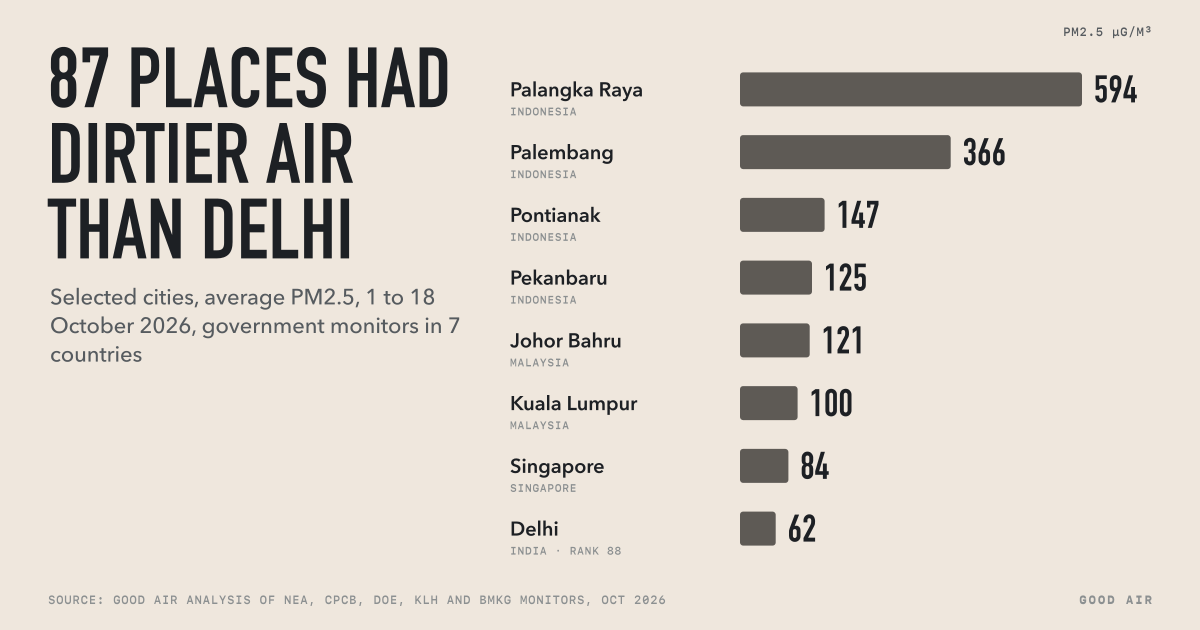
Mumbai's index went from 41 to 102, Pune's from 54 to 126 and Ahmedabad's from 72 to 147. Delhi's own index rose from 120 to 143. Delhi still has dirtier air than Mumbai. But the gap between them has closed fast, and on 18 October CPCB's afternoon bulletin put Ahmedabad (184) almost level with Delhi (187) (CPCB, 18 October).
This is our own analysis of air quality after the monsoon, built from CPCB and state pollution control board monitors. You can download every city's figures.
Key findings
- 179 of 219 cities got worse. The median city's India AQI rose from 68 to 92.
- The number of cities with Good air (AQI 50 or below) fell from 44 to 9. Cities in the Moderate band (101 to 200) almost tripled, from 34 to 94.
- Maharashtra rose most: +100%. All 34 cities got worse. In mid-September 16 of them had Good air. By mid-October none did, and 16 were Moderate.
- 33 cities at least doubled their AQI, and 18 of them are in Maharashtra.
- Gujarat (+71%) and Madhya Pradesh with Chhattisgarh (+85%) came next. All 10 Gujarat cities got worse.
- Delhi NCR rose 25%, Uttar Pradesh 22%, and Punjab with Haryana barely moved (+2%). These areas started from a much higher level.
- The south held steady. Karnataka rose 7%, Telangana and Andhra Pradesh 3%, and Chennai's AQI fell from 93 to 73.

Region by region
The table shows the median India AQI (NAQI) of each region's cities in the weeks of 15 to 21 September and 12 to 18 October, and how much it rose. NAQI is the official index published by the Central Pollution Control Board: 0 to 50 is Good, 51 to 100 Satisfactory, 101 to 200 Moderate and 201 to 300 Poor.
| Region (cities) | Mid-Sep | Mid-Oct | Change |
|---|---|---|---|
| Maharashtra (34) | 51 | 97 | +100% |
| Madhya Pradesh and Chhattisgarh (19) | 57 | 90 | +85% |
| Gujarat (10) | 74 | 130 | +71% |
| Bihar and Jharkhand (11) | 68 | 93 | +53% |
| Rajasthan (32) | 71 | 113 | +46% |
| Delhi NCR (12) | 120 | 152 | +25% |
| West Bengal and Odisha (20) | 61 | 72 | +23% |
| Uttar Pradesh (18) | 86 | 104 | +22% |
| Karnataka (8) | 56 | 57 | +7% |
| Telangana and Andhra Pradesh (12) | 62 | 62 | +3% |
| Punjab, Haryana and Chandigarh (24) | 90 | 91 | +2% |
"Change" is the median of each city's own rise, so it can differ a little from comparing the two medians.
Maharashtra: a step change in three days
Maharashtra's air did not drift worse. It jumped. The median AQI of its monitored cities was 62 on 28 September and 99 on 1 October, and it has stayed between 85 and 103 every day since.

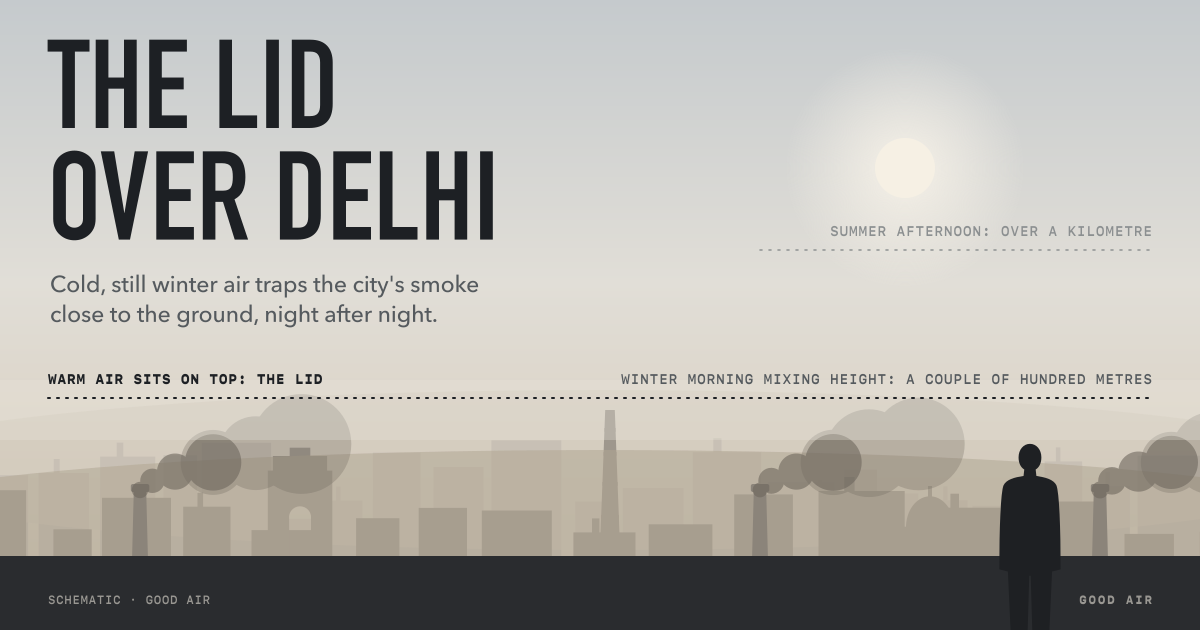
That jump lines up with the end of the monsoon. By 3 October the India Meteorological Department (IMD) had declared the monsoon withdrawn from all of Gujarat and Madhya Pradesh and from parts of Maharashtra, with the line running south of Mumbai and Pune (IMD, 3 October). It left the rest of Maharashtra on 8 October (IMD, 8 October). Once the rain stops, it no longer washes particles out of the air, and calmer, drier weather lets pollution build up near the ground.
Two details in our data say the rise is not just dust. Over the same weeks, the median PM2.5 in Maharashtra's cities rose 145%, from 19 to 42 µg/m³. Coarser PM10, which includes most road and construction dust, rose 106%. Fine particles come mainly from burning: vehicles, industry, cooking fuel and waste.
India AQI by week, for Maharashtra's largest cities and the steepest risers:
| City | Mid-Sep | Mid-Oct | Change |
|---|---|---|---|
| Pimpri-Chinchwad | 49 | 142 | +192% |
| Mumbai | 41 | 102 | +152% |
| Nagpur | 52 | 127 | +145% |
| Pune | 54 | 126 | +133% |
| Nashik | 44 | 93 | +112% |
| Navi Mumbai | 52 | 106 | +104% |
| Thane | 56 | 84 | +51% |
The Brihanmumbai Municipal Corporation (BMC) brought out a 2026 air pollution action plan on 2 October. It names at least 10 hotspots per ward, enforces dust rules at construction sites, and suspends polluting work within 2 km of any station that stays above AQI 300 for three days (Free Press Journal, 2 October). Mumbai's city-wide AQI has not come near 300. But its Satisfactory days are over for now.
Why Delhi rose less
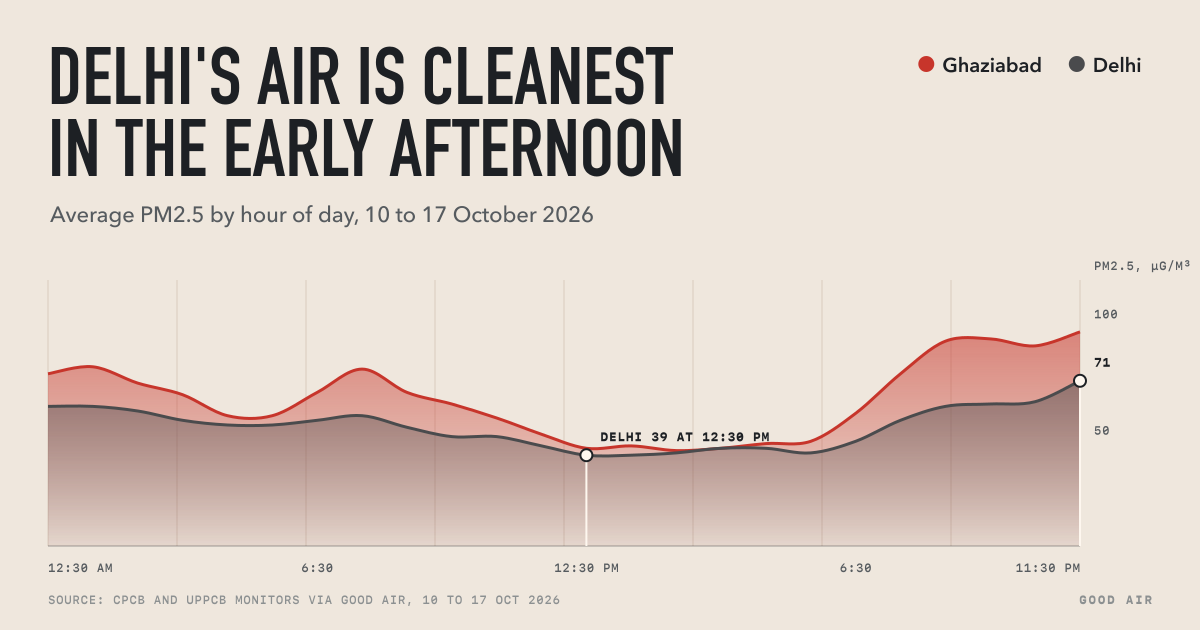
Delhi's smaller rise is not good news. Its air was already Moderate in mid-September, at 120, so there was less room to climb in percentage terms. The monsoon withdrew from Delhi early, on 23 September (IMD, 23 September), so part of the rise had already happened by our second week. Delhi NCR's median swung between 49 and 189 over the five weeks, as short spells of rain and wind cleaned the air and then let it fill again.
On 18 October CPCB rated Delhi Moderate at 187, near the line where the Commission for Air Quality Management (CAQM) brings in Stage I of the Graded Response Action Plan, at AQI 201 (CAQM, 29 September). See our GRAP explainer and the Delhi air pollution tracker for the latest.
Why the south stayed clean
The south got rain again just as the north and west dried out. The northeast monsoon reached Tamil Nadu, Puducherry, Kerala, coastal Andhra Pradesh and south interior Karnataka on 15 October, the same day the southwest monsoon left the whole country (IMD, 15 October). We wrote about that in our northeast monsoon report. On 18 October Chennai (58), Hyderabad (60) and Bengaluru (66) were all Satisfactory in CPCB's bulletin.
What to expect
The pattern so far: the north and west of India get worse first, the south later and less. In the north, stubble burning in Punjab and Haryana and the colder, stiller air of November usually push Delhi into the Poor and Very Poor bands. Diwali falls on 8 November this year. Our Diwali air quality guide has advice for the night. For Maharashtra and Gujarat, the question is whether October's new level holds or climbs again in winter. We will rerun this comparison in mid-November.
How we measured
- Data. India AQI (NAQI) readings from CPCB's continuous monitoring network, which includes state pollution control board stations, collected by Good Air every hour. No satellite estimates, model output or low-cost sensors.
- City value. CPCB's monitors grouped by city. For each day, the mean of that day's readings, counted only if the city had at least 18 hourly readings that day.
- Comparison. Each city's average over 15 to 21 September and 12 to 18 October 2026, using days in UTC. A city is included only if it had at least 5 valid days in each week: 219 cities qualified.
- Regions. By state, using CPCB's own labels. Delhi NCR is Delhi plus Noida, Greater Noida, Ghaziabad, Gurugram, Faridabad, Ballabgarh, Sonipat, Bahadurgarh, Meerut, Hapur and Bhiwadi. Tamil Nadu (2 cities) and Kerala (1) had too few qualifying cities to show as regions.
- Caveats. NAQI is based on 24-hour averages, so it lags sudden changes by a day or so. Two weeks of data do not tell you about a whole season, and weather in either week can move the result.
Use this data
The data is free to use and republish, with credit. Please cite it as: Good Air analysis of CPCB air quality monitor data, 15 September to 18 October 2026 (goodairapp.com).
Frequently asked questions
Why does air quality get worse after the monsoon in India?
Monsoon rain washes particles out of the air, and the moist, windy weather spreads pollution out. When the monsoon withdraws, the air turns drier and calmer, so pollution from traffic, industry, construction and burning builds up near the ground. In 2026 this happened in Maharashtra, Gujarat and Madhya Pradesh in the first days of October.
Is Mumbai's air quality bad right now?
Mumbai's India AQI averaged 102 from 12 to 18 October 2026, in the Moderate band, up from 41 in mid-September. It is much cleaner than Delhi but no longer Satisfactory most days. Check Mumbai's live AQI for today.
Which Indian state's air got worse most after the 2026 monsoon?
Maharashtra. The median India AQI of its 34 monitored cities rose 100%, from 51 to 97, between the weeks of 15 to 21 September and 12 to 18 October. All 34 got worse.
Is Delhi's air better than last year?
Our station archive does not yet reach back to October 2025, so we can't make a like-for-like comparison. On 18 October 2026 CPCB rated Delhi Moderate at 187. Its worst weeks usually come in November and December.
Can I use these figures?
Yes. Credit "Good Air analysis of CPCB data (goodairapp.com)" and link to this page. The CSV above lists every city's figures for both weeks.