Seasonal · 6 min read
No Burn Day in Los Angeles: Southern California's 2026–27 wood-burning season, the rules and how to check today's alert
No Burn Day season in Los Angeles and Southern California starts 1 November: the 25 µg/m³ trigger, who is exempt, fines, how to check today and our data.
 By the Good Air team

In this article · 8 sections
A No Burn Day in Los Angeles is a 24-hour ban on burning wood in fireplaces, wood stoves and outdoor fire pits, called by the South Coast Air Quality Management District (South Coast AQMD) during its Check Before You Burn season, which runs from 1 November to the end of February (South Coast AQMD, What is a No-Burn Alert?, viewed 25 October 2026). It covers Orange County and the non-desert parts of Los Angeles, Riverside and San Bernardino counties. The district called 21 No-Burn Day alerts in 2025–26 (South Coast AQMD, 1 February 2026).
This is the second winter under a stricter rule. Since an amendment to Rule 445 on 5 September 2025, a No-Burn Day is called when fine particle pollution (PM2.5) is forecast to exceed 25 micrograms per cubic metre (µg/m³) over 24 hours anywhere in the South Coast Air Basin, down from 29, and low-income households are no longer exempt. Among the 16 South Coast monitors in Good Air's archive, no day from 15 September to 24 October 2026 reached 25. The closest was 22.1 µg/m³, at Mira Loma on 2 October.
Key facts for winter 2026–27
- Season: 1 November (a Sunday this year) through the last day of February. As of 25 October 2026, we found no district announcement of changes for 2026–27.
- Trigger: a forecast 24-hour average above 25 µg/m³ of PM2.5 for any area of the South Coast Air Basin. The ban then applies basin-wide, below 3,000 feet, for a full calendar day (South Coast AQMD, Rule 445, amended 5 September 2025). The district's FAQ page still gives the old figure of 29.
- Check: aqmd.gov/cbyb, the South Coast AQMD app, Air Alerts email, or 866-966-3293.
What is banned on a No-Burn Day?
On a No-Burn Day you may not burn wood, pellets or manufactured fire logs in any indoor or outdoor wood-burning device, and you may not burn charcoal except in a cooking device (South Coast AQMD, 21 December 2025). That covers fireplaces, wood and pellet stoves, and fire pits, burn bowls and chimineas at homes (Rule 445).
Still allowed:
- Gas and propane fireplaces, including gas-log sets (What is a No-Burn Alert?).
- Barbecues. Charcoal in a dedicated cooking device, like a grill, is allowed (South Coast AQMD, Check Before You Burn FAQ, viewed 25 October 2026). Charcoal in a fireplace is not.
- Commercial wood-fired cooking, such as restaurant ovens (Rule 445).
Burning garbage, treated wood or plastic in a fireplace is banned all year (Rule 445).
Who is exempt from No-Burn Days?
| Exemption | Who qualifies under Rule 445 |
|---|---|
| Altitude | Homes and businesses 3,000 feet or more above sea level |
| Desert areas | The Coachella Valley and the High Desert, outside the South Coast Air Basin |
| Sole source of heat | Properties where a wood-burning device is the only permanent heat |
| Utility outage | Homes that lose gas or electric heat, for as long as the outage lasts |
| No gas service | Properties with no natural gas line within 150 feet of the property line |
| Ceremonial fires | Fires exempted under Rule 444, the open burning rule |
The low-income exemption ended with the September 2025 amendment. Low-income residents may still qualify under another exemption, such as sole source of heat (Check Before You Burn FAQ).
What is the fine for burning on a No-Burn Day?
There is no longer a fixed fine in the rule. Until September 2025, Rule 445 set penalties for each season: a wood smoke awareness course or $50 for a first violation, $150 or proof of installing a gas fireplace for a second, and $500 for a third. The 2025 amendment removed that section so the district can resolve each violation case by case, the way it handles violations of its other rules (South Coast AQMD Governing Board, agenda item 30, 5 September 2025). We found no published penalty schedule for 2026–27.
How many No-Burn Days were there last winter?
| Season | No-Burn Day alerts | PM2.5 trigger |
|---|---|---|
| 2024–25 | 26 (as of 3 February 2025) | 29 µg/m³ |
| 2025–26 | 21 (as of 2 February 2026) | 25 µg/m³ |
Sources: South Coast AQMD, 2 February 2025; South Coast AQMD, 1 February 2026. Both come from the last No-Burn release we found for each season, so they are likely the final totals.
The first 2025–26 alert came on Monday 3 November 2025, two days into the season (South Coast AQMD, 2 November 2025). The count reached 13 by 16 December (South Coast AQMD, 16 December 2025), 18 by 22 December and 21 by Monday 2 February 2026, the last alert we found.
When the district lowered the trigger, its staff estimated about 10 more No-Burn Days in an average season (Governing Board, 5 September 2025). Last winter still had fewer than the one before; the district says the number depends on the weather (Check Before You Burn FAQ).
On the US Air Quality Index (AQI), 25 µg/m³ over 24 hours works out to about 81, which is in the Moderate band (9.1 to 35.4 µg/m³) (EPA, February 2024). So a No-Burn Day can be called on a day whose forecast is Moderate, not Unhealthy.
How to check if today is a No-Burn Day in Los Angeles
- Check Before You Burn map at aqmd.gov/cbyb: enter an address or ZIP code (South Coast AQMD, Check Before You Burn, viewed 25 October 2026).
- South Coast AQMD app, which sends a notification when a No-Burn Day is called.
- Air Alerts by email, or 866-966-3293 for a recorded message.
A No-Burn Day is based on a 24-hour forecast, which the district says may not show on real-time air quality maps (South Coast AQMD, 2 November 2025). Our Los Angeles air quality page shows the live US AQI and AirNow's forecast for tomorrow, but only the district's alert counts. See also California air quality and California weather alerts.
South Coast air before the season: what our data shows
Among the 16 monitors in the South Coast Air Basin that report PM2.5 to EPA AirNow, the average from 15 September to 24 October 2026 was 8.1 µg/m³. The median US monitor, among 1,301, averaged 5.3. The Inland Empire ran highest (all 16 are in the download below):
| Monitor (AirNow name) | County | PM2.5, 15 Sep–24 Oct (µg/m³) | Highest day |
|---|---|---|---|
| Mira Loma - Van Buren | Riverside | 12.4 | 22.1 (2 Oct) |
| Riverside - Rubidoux | Riverside | 10.7 | 19.3 (2 Oct) |
| Compton | Los Angeles | 10.1 | 16.1 (1 Oct) |
| Fontana - Arrow Highway | San Bernardino | 9.4 | 18.0 (25 Sep) |
| Mission Viejo | Orange | 8.5 | 15.0 (1 Oct) |
| Long Beach Signal Hill | Los Angeles | 8.4 | 14.1 (1 Oct) |
| Anaheim | Orange | 8.2 | 14.3 (1 Oct) |
| Los Angeles - N. Main Street | Los Angeles | 8.2 | 16.2 (1 Oct) |
| North Hollywood | Los Angeles | 7.4 | 13.2 (1 Oct) |
| Banning - South Hathaway Street | Riverside | 5.8 | 11.7 (20 Sep) |

- No day reached the trigger. Across 637 monitor-days, only one was above 20 µg/m³: Mira Loma on 2 October, at 22.1, a US AQI of about 75. The particle season had not started anyway.
- 1 and 2 October were the closest. The 15 monitors reporting on 1 October averaged 14.2 µg/m³, the highest of the period, and 13 of the 16 had their highest day on 1 or 2 October.
- October was cleaner than September. All 16 monitors averaged less from 1 to 24 October (7.1 µg/m³ across the basin) than from 15 to 30 September (9.6). The winter rise has not begun.
- Los Angeles's AQI was Moderate on most days. The city's daily US AQI averaged 54, above 50 on 26 of 40 days, peaking at 79 on 8 October; Rancho Palos Verdes averaged 50. The median of 263 US cities averaged 37.5. In our hourly data for 17 to 24 October, PM2.5 was the main pollutant in 91 of the 106 hours when Los Angeles was above 50.
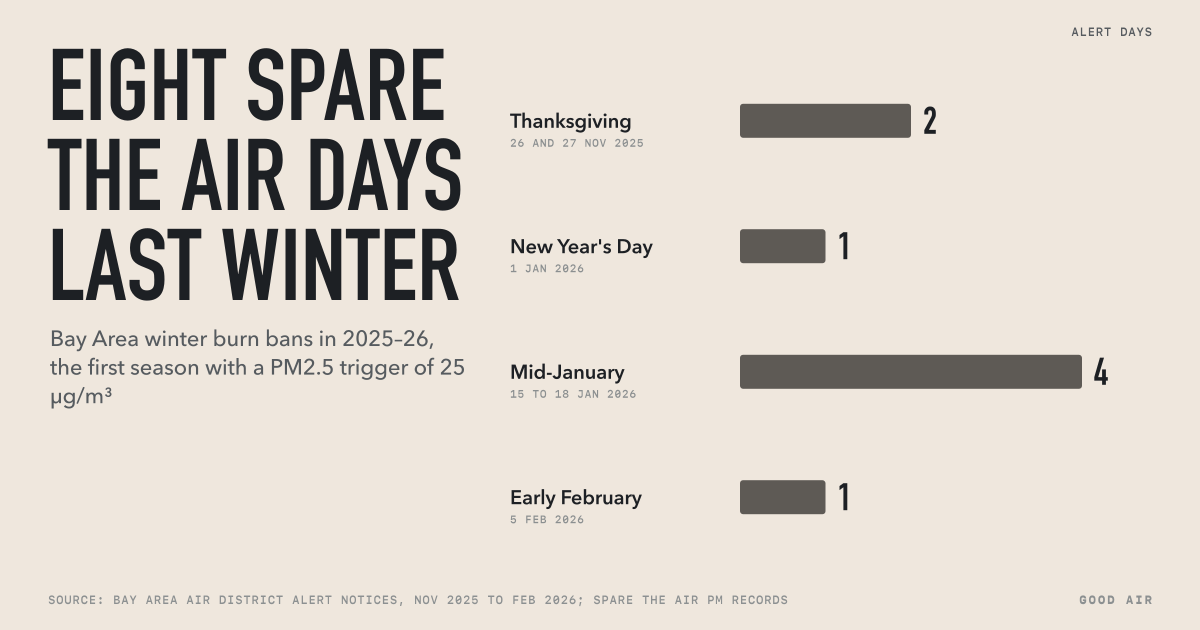
Compare the live US ranking, and the Bay Area's version of the rule in Spare the Air winter 2026–27.
How we measured
- Data. Daily PM2.5 at individual EPA AirNow monitors and the hourly US AQI for each city, collected by Good Air. Government monitors only.
- Monitors. The 16 AirNow monitors in the South Coast Air Basin that reported PM2.5, each with 38 to 40 valid days of 40. We left out three temporary monitors named only EBAM-10, -12 and -14, and monitors outside the basin or in the mountains. None showed frozen readings. The basin figure is the mean of the 16 monitor averages.
- Daily values. The mean of each day's hourly readings, counted only with at least 12 hours. Days are in UTC, starting at 5 pm Pacific time the day before, so they are not the district's official values.
Frequently asked questions
Is today a No Burn Day in Los Angeles?
Check the South Coast AQMD's Check Before You Burn map at aqmd.gov/cbyb, the South Coast AQMD app, or call 866-966-3293. No-Burn Days can be called from 1 November to the end of February and last one calendar day. Good Air's Los Angeles page shows the live AQI and AirNow's forecast for tomorrow, but only the district's alert counts.
When does the No Burn season start in Southern California?
The South Coast AQMD's Check Before You Burn season starts on 1 November and runs through the last day of February. Wood burning is banned only on days when the district calls a No-Burn alert, not for the whole season. In 2025–26 the first alert came on 3 November and the last on 2 February.
Can I use my fire pit or fireplace on a No-Burn Day?
Not with wood, pellets or fire logs. The ban covers indoor fireplaces and stoves and outdoor fire pits, chimineas and burn bowls at homes in the South Coast Air Basin. Gas and propane fireplaces are allowed, and so is charcoal in a barbecue grill used for cooking.
What is the fine for burning wood on a No-Burn Day in Los Angeles?
Rule 445 used to set a $50 fine or a wood smoke awareness course for a first violation, $150 for a second and $500 for a third. In September 2025 the South Coast AQMD removed those fixed amounts so it can resolve each violation case by case, as with its other rules.
How many No-Burn Days were there last year in Southern California?
The South Coast AQMD called 21 No-Burn Day alerts in the 2025–26 season, according to its release of 1 February 2026, against 26 in 2024–25. It was the first winter with the lower trigger of 25 µg/m³ of PM2.5. The number each year depends on the weather.