Seasonal · 6 min read
Bay Area wood burning ban: Spare the Air winter 2026–27 rules, fines and how to check today's alert
The Bay Area wood burning ban returns with winter Spare the Air season in November: what's banned, $100 and $500 fines, exemptions and how to check today.
 By the Good Air team
In this article · 9 sections
The Bay Area wood burning ban comes back with the winter Spare the Air season, which the Bay Area Air District runs from November through February. On a Spare the Air day it is illegal to burn wood, fire logs or pellets in fireplaces, wood stoves, pellet stoves or outdoor fire pits, and a first violation means a wood smoke awareness course or a $100 ticket, with $500 for a second (Bay Area Air District, 4 February 2026).
This is the second winter under a stricter trigger. Since 1 October 2025, the district calls a burn ban when fine particle pollution (PM2.5) is forecast to exceed 25 micrograms per cubic metre (µg/m³) over 24 hours, down from 35, so alerts come earlier and more often. Last winter it called eight alert days, starting at Thanksgiving. As of 23 October 2026, the district had not announced any change for 2026–27.
Key facts for winter 2026–27
- Season: November through February (Spare the Air, Alerts and Advisories, viewed 23 October 2026). In past years the district has opened it on 1 November (Bay Area Air District, 1 November 2019), which falls on a Sunday this year. Since 2019, a ban can also be called on any day of the year when particle pollution is high, such as during a wildfire (Spare the Air, Wood Burning Rule, viewed 23 October 2026).
- Trigger: a forecast 24-hour average above 25 µg/m³ of PM2.5 anywhere in the district, under Regulation 6, Rule 3, as amended on 1 October 2025 (Bay Area Air District, Regulation 6 Rule 3, updated 1 October 2025). The district says that means alerts when air quality is in the "mid-moderate" range (Bay Area Air District, 4 February 2026).
- Check: sparetheair.org or 1-877-4NO-BURN (1-877-466-2876).
What is banned on a Spare the Air day?
During a winter alert, the district bans "burning wood, manufactured fire logs or any other solid fuel, both indoors and outdoors" across the nine-county Bay Area (Bay Area Air District, 4 February 2026). That covers wood-burning fireplaces, including open hearths, wood stoves, pellet stoves and outdoor fire pits, in homes and in businesses such as hotels and restaurants (Spare the Air, Wood Burning Rule).
A ban lasts a full 24 hours (Bay Area Air District, 1 November 2019).
What is still allowed?
- Gas, propane and electric fireplaces, gas logs and gas inserts.
- Cooking fires. They are not prohibited during alerts, but the district suggests a gas or propane barbecue rather than wood or charcoal (Spare the Air, Wood Burning Rule).
Some things are banned all year, alert or not: chimney smoke that blocks more than 20 percent of the view through it, and burning garbage, plastic, junk mail, painted or treated wood, wood pallets or unseasoned wood. New buildings may not have a wood-burning device at all.
Exemptions: who can still burn?
Exemptions are narrow, and the burden of proof is on you. Under Rule 6-3 (as amended 1 October 2025):
| Exemption | Who qualifies |
|---|---|
| Sole source of heat | Homes with no permanently installed gas, propane or electric heating, using an EPA-certified wood stove or a pellet stove registered with the district |
| Broken heater | Up to 30 days if your only non-wood heater is broken and repaired within 30 days, with repair records |
| Utility outage | A temporary loss of gas or electric service, with no other heat |
An open-hearth fireplace no longer qualifies, even as the only heat source. Rental homes in areas with natural gas service must have a heater that does not burn solid fuel, and cannot claim the sole-source exemption (Rule 6-3, Sections 110 and 305). Questions about the rule go to 1-877-4NO-BURN (Spare the Air, Wood Burning Rule).
Bay Area wood burning ban fines
| Violation | Penalty |
|---|---|
| First | Wood smoke awareness course (online or by mail), or a $100 ticket |
| Second | $500 ticket |
| Third and later | Higher amounts |
CBS San Francisco reported the same figures for Thanksgiving 2025 (CBS San Francisco, 26 November 2025). To report smoke from a neighbour's chimney, call 1-877-4NO-BURN or file at baaqmd.gov/complaints.
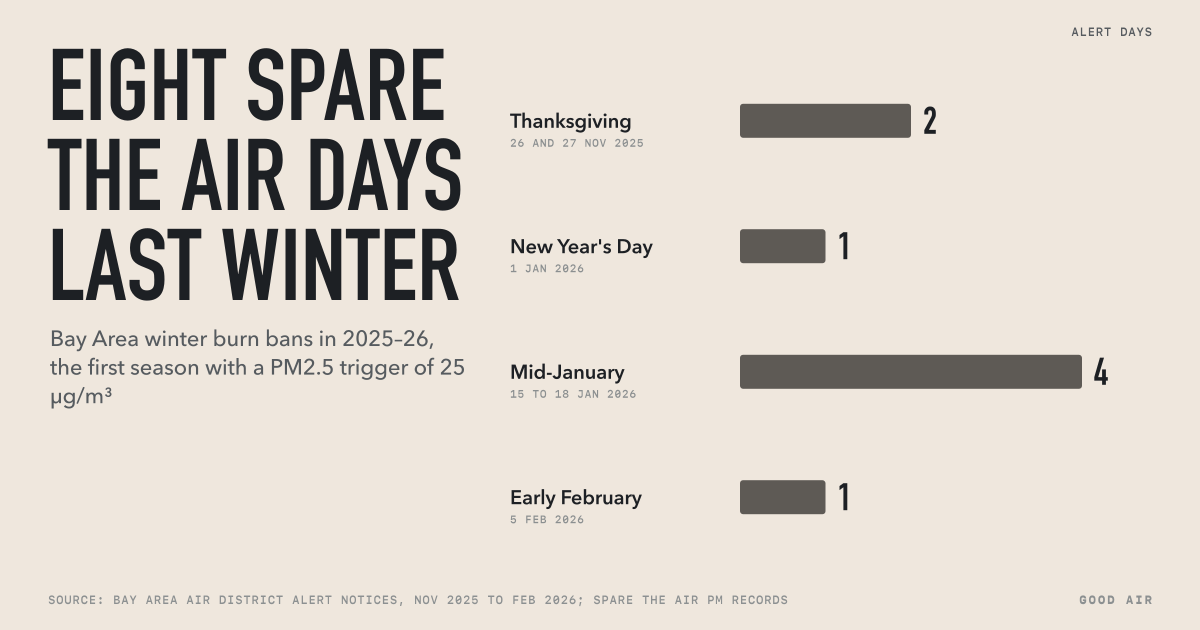
Last winter: eight Spare the Air days
The district's particle records list 2 Spare the Air alerts in 2025 and 6 in 2026 so far (Spare the Air, Particulate Matter Historical Data, viewed 23 October 2026). The district's dated notices account for all eight, every one of them in the November to February season:
- Thanksgiving: 26 and 27 November 2025. The first alerts of the winter. High pressure trapped smoke from more wood burning near the ground (Bay Area Air District, 25 November 2025).
- New Year's Day: 1 January 2026. The third alert of the season, called for fireworks smoke as well as wood smoke (Bay Area Air District, 30 December 2025; CBS San Francisco, 31 December 2025). There were none in December.
- Mid-January: 15 to 18 January 2026. The longest run, four days. First called for Thursday 15 January (14 January), it was extended to Saturday (15 January) and then Sunday 18 January, under a strong temperature inversion (17 January).
- Early February: 5 February 2026. Limited mixing and light offshore winds trapped smoke again (Bay Area Air District, 4 February 2026).
Winters vary: the district's season table, which stops at 2019–20, shows 19 alerts in 2017–18 and 2 in 2019–20. The Spare the Air alerts that ran until 6 October 2026 were for ozone (smog), not a burn ban (Bay Area Air District, 5 October 2026).
How to check if today is a Spare the Air day
The district can call an alert up to three days ahead (Bay Area Air District, 4 February 2026). To get it:
- Text START to 81757.
- Call 1-877-4NO-BURN.
- Sign up for email AirAlerts or automated phone calls at sparetheair.org. The email alert comes the day before (Bay Area Air District, Spare the Air FAQs, updated 6 October 2025).
- Use the Spare the Air app, or local TV and radio.
Our San Francisco, San Jose and San Mateo pages show the live US AQI and the Air District's forecast for tomorrow, via AirNow. On 22 October it forecast a Moderate 55 for San Francisco on 23 October, with PM2.5 the main pollutant. A forecast is not an alert, so check the district before you light a fire. For the rest of the state, see California air quality.
Bay Area air before the season: what our data shows
Among the 14 Bay Area Air District monitors in our archive that measure PM2.5, the average from 1 to 22 October 2026 was 7.5 µg/m³. The median US monitor, among 1,241, averaged 5.4. The South Bay was highest:
| Monitor (AirNow name) | County | PM2.5, 1–22 Oct (µg/m³) | Highest day |
|---|---|---|---|
| San Jose - Jackson St. | Santa Clara | 10.6 | 19.0 (3 Oct) |
| San Jose - Knox Ave | Santa Clara | 9.9 | 15.5 (3 Oct) |
| San Pablo - Rumrill | Contra Costa | 8.9 | 18.5 (11 Oct) |
| Oakland | Alameda | 8.6 | 14.4 (3 Oct) |
| Livermore-Portola | Alameda | 7.9 | 14.0 (22 Oct) |
| Redwood City | San Mateo | 7.7 | 11.9 (4 Oct) |
| San Francisco | San Francisco | 6.3 | 9.9 (11 Oct) |
| Sebastopol | Sonoma | 6.1 | 19.3 (7 Oct) |
| San Rafael | Marin | 5.6 | 8.9 (3 Oct) |

- No monitor came close to 25. Across 513 monitor-days from 15 September to 22 October, the highest was 19.3 µg/m³, at Sebastopol on 7 October.
- Early October stood out. Five of the nine monitors in the table had their highest October day on 3 or 4 October, around the start of the ozone alerts, and San Jose's daily US AQI reached 80 on 4 October.
- City AQI was Moderate on many days. San Francisco averaged a US AQI of 51 from 1 to 22 October and was above 50 on 12 of 22 days; San Jose averaged 55, above 50 on 15 days; San Mateo 48, on 9 days.
These readings come before the heating season. For a national comparison, see the most polluted US cities this autumn; for another winter burn ban, Phoenix's No Burn Days and Seattle and Puget Sound burn bans.
How we measured
- Data. Daily PM2.5 at individual EPA AirNow monitors and the hourly US AQI for each city, collected by Good Air. Government monitors only.
- Monitors. The 14 monitors run in the Air District's area that report PM2.5, with 18 to 22 valid days in October. We left out Laney College (one day of data) and an unnamed temporary monitor. The Bay Area figure is the mean of the 14 monitor averages.
- Daily values. The mean of each day's hourly readings, counted only with at least 12 hours. Days are in UTC, starting at 5 pm Pacific time the day before, so they are not the district's official daily values.
Frequently asked questions
Is today a Spare the Air day in the Bay Area?
Check sparetheair.org, call 1-877-4NO-BURN, text START to 81757 or use the Spare the Air app. The Bay Area Air District can call an alert up to three days ahead, and a ban lasts 24 hours. Good Air's San Francisco and San Jose pages show the district's air quality forecast for tomorrow, but only the district's alert counts.
When does the Bay Area wood burning ban start in 2026?
The winter Spare the Air season runs from November through February, and in past years the district has started it on 1 November. Burning wood is banned only on days when the district calls a Spare the Air alert, not for the whole season. Since 2019, an alert can be called at any time of year when particle pollution is high.
What is the fine for burning wood on a Spare the Air day?
A first violation of the Bay Area Air District's Wood Burning Rule means a choice between a wood smoke awareness course and a $100 ticket. A second violation brings a $500 ticket, and later ones cost more.
Can I use my fire pit or gas fireplace during a Spare the Air alert?
Not a wood-burning fire pit: the ban covers wood, fire logs and pellets, indoors and outdoors. Gas, propane and electric fireplaces are allowed, and cooking fires are not prohibited, though the district suggests a gas or propane barbecue.
How many Spare the Air days were there last winter?
Eight in 2025–26: 26 and 27 November 2025 (Thanksgiving), 1 January 2026, 15 to 18 January and 5 February. It was the first winter with the lower trigger of 25 µg/m³ of PM2.5.